Butcher’s/Bucher’s Mill Covered Bridge: The Empty Span That Sounded Occupied
Internship field report by Jupiter Meteor Nguyen, subsequently published by Joe on his weird little website because he says a timestamp is “intellectual proof-adjacent.”
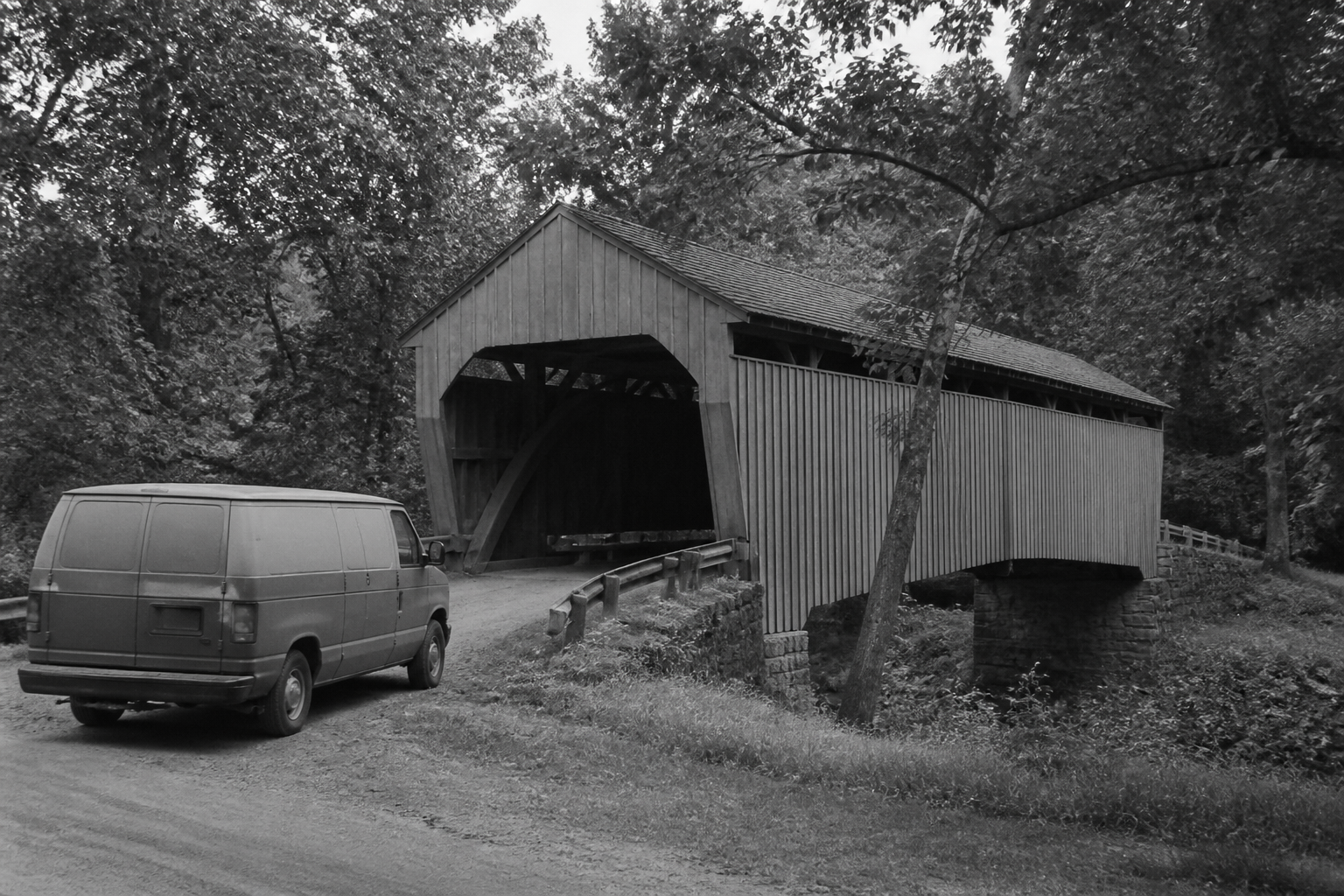
We stopped near Butcher’s Mill Covered Bridge in East Cocalico Township, Lancaster County, Pennsylvania, south of Denver on Township Route 955. The National Register record identifies it as Butcher’s Mill Covered Bridge, reference number 80003514, while Lancaster County material uses the variant Bucher’s Mill. I am using both names because pretending a spelling discrepancy is solved when it is not would be bad documentation.
The bridge is associated with Cocalico Creek and sits in the wooded setting described by the county tourism material. It is a small crossing: reportedly sixty-four feet long, and classified in fallback reference material as a Burr arch covered bridge. The National Register listing dates to December 11, 1980, and its documented areas of significance are engineering and transportation.
That is the historical foundation. There is no supplied documentation of a murder, tragedy, victim, mill operator, hidden machinery room, cursed wagoner, or dead bridge-builder. The word mill in the name is an association, not a license to invent an industrial ghost story.
Joe parked in the immediate roadside vicinity without blocking the bridge approach. I got out with my notebook, recorder, stopwatch, and vibration sensor. Cletus came out on leash and immediately inspected the grass with the solemnity of a dog who had been hired to inspect grass.
The creek made a low, irregular sound through the trees. Wind moved in the branches but did not appear especially strong at road level. The bridge enclosure turned ordinary road noise into a brief hollow resonance whenever a vehicle passed nearby.
Joe stood beside the vehicle with Cletus’s leash looped securely around his hand. He watched the bridge rather than staring theatrically into the woods, which I appreciated.
JOE
Before we say it’s haunted, we get the boring noises. Wind, creek, tires, loose boards, whatever else wants credit.
JUPITER
Correct. The boring noises get first refusal.
JOE
That ought to be on the website.
JUPITER
No. It should be on every website.
The county PDF describes the bridge as still open to traffic and calls it the second-shortest covered bridge in Lancaster County still open to traffic. I need to be precise: that is what the source says. We did not independently verify current traffic status, structural condition, or access rules beyond what we could safely observe from the roadside vicinity.
The same county source creates a more interesting historical problem. Its table lists 1881 as the bridge’s build year, but its narrative says an original bridge was destroyed in 1881 and rebuilt the following year. That implies 1882 for a reconstruction, but the supplied material does not fully establish whether the present bridge is exactly that rebuilt structure or how the conflicting wording should be resolved.
Joe called it “messy bridge paperwork.” That is not technically wrong.
A vehicle crossed while we were still logging our first ambient interval. The road-side approach produced tire sound, then the enclosure caught and carried the vehicle’s passage in a low wooden boom. The effect lasted only seconds, but it was useful. A covered crossing can sound larger than it is.
Cletus sniffed along the roadside edge, then looked up at a bird she could not reach. She did not react to the bridge in any way that could reasonably count as evidence.
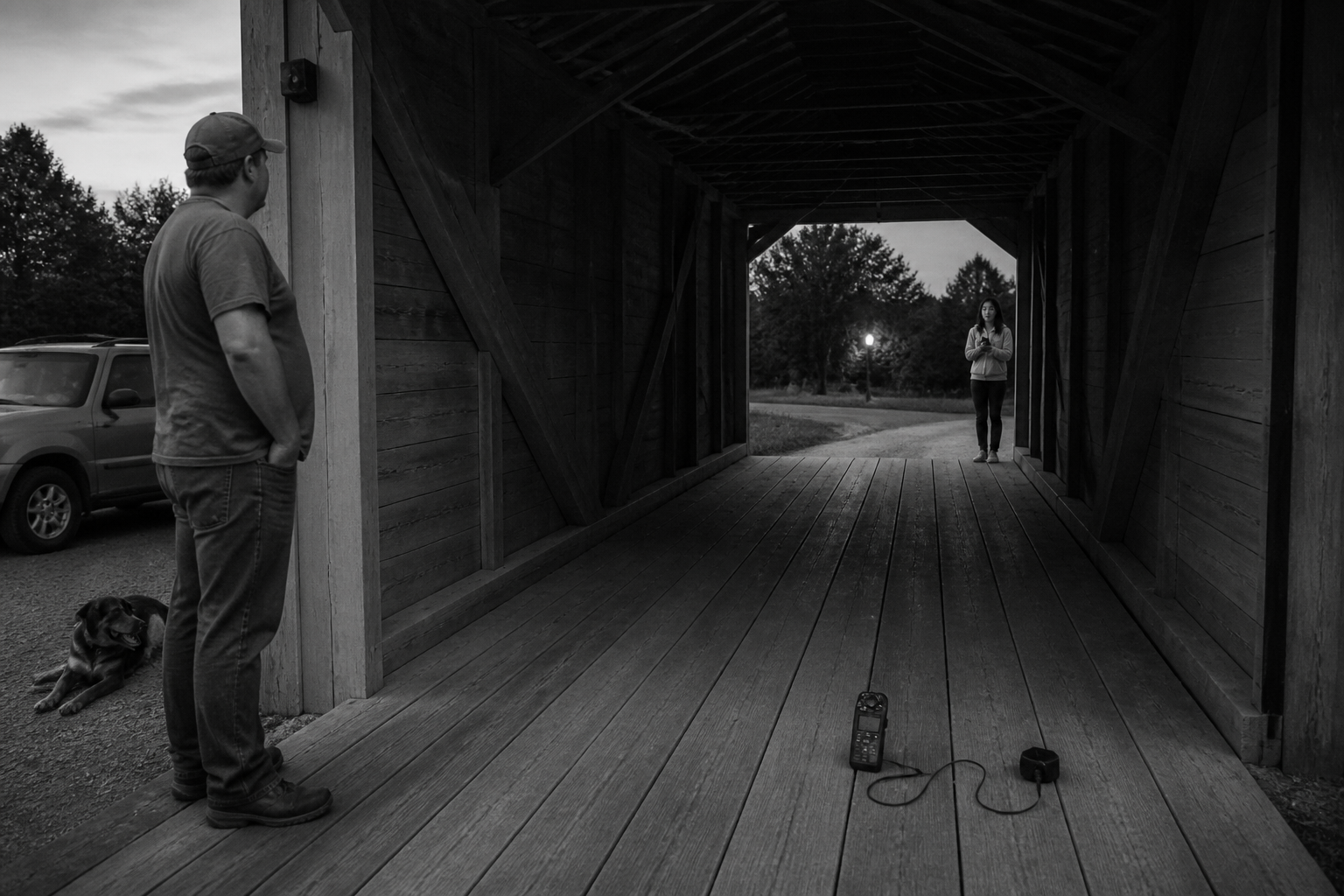
Once the vehicle noise faded, Joe led Cletus back beside the car and clipped the leash short enough that she could settle without wandering toward the bridge. I moved to one entrance of the covered span. Joe took position just outside the threshold, facing inward. I crouched near the deck edge with the recorder pointed along the empty interior and placed the vibration sensor where it could register deck movement without being stepped on.
The enclosed span was short enough that I could see straight through it from one portal to the other. Afternoon light entered at both ends, though it had begun to flatten into that gray-gold stage where depth becomes harder to judge.
Joe demonstrated a controlled human footstep sequence: four normal steps just inside the entrance, a pause, then four more. I recorded it as a comparison sample. His steps produced an audible response from the deck, but the pattern was understandable: impact, a brief wooden answer, then a diminishing enclosure echo.
JOE
That’s the bridge talking back normally.
JUPITER
That is the bridge responding mechanically to you standing on it.
JOE
You make everything sound like it needs a permit.
JUPITER
I need the ordinary version before I can identify an unusual version.
JOE
Fair. But old places do sometimes hold onto patterns.
JUPITER
Define “hold onto.”
Joe glanced into the bridge, thinking before he answered. That is one of his better habits, although he would probably deny it if described as a habit.
JOE
Not like a tape recorder in the walls. More like a place gets hit with the same kind of thing for years, and later it gives you a little of it back. Footsteps. Wagons. A door closing. Something with repetition.
JUPITER
So: an observation would be a repeated sound under controlled conditions. “Place memory” would be an interpretation assigned afterward.
JOE
Yes. See? We’re practically a laboratory.
JUPITER
We are standing beside a covered bridge with one recorder and a dog tied to a vehicle.
JOE
A field laboratory.
The bridge’s documented importance is structural and practical. It is a transportation structure in a creek-side setting, not a documented residence full of named occupants or an industrial building with a verified machine history. Its historical story, as far as our packet supports it, is about crossing the creek, being rebuilt after a reported destruction, and surviving long enough to be listed.
That did not prevent one sharp anomaly.
I reset the recorder and told Joe to repeat only the first two test steps. He stepped just inside the threshold. His left foot landed. His right foot landed.
Then, somewhere farther into the empty span, a single hard knock answered.
It was not a loud impact. It was more like a mallet strike against a board: compact, dry, and much sharper than the broad resonance of Joe’s shoes.
Joe stopped without taking another step. I watched the interior. No person emerged from the far end. Nothing crossed behind the openings. No board visibly lifted. The creek continued its indifferent noise outside.
Cletus remained near Joe’s leg, looking at the ground.
JUPITER
Do not move.
JOE
Was that on your channel?
JUPITER
Yes. I need ten seconds quiet.
We held still. The recorder captured creek noise, distant road sound, and a small amount of wind around the portal. Nothing repeated.
The first knock could have been timber resonance. It could have been a delayed response from Joe’s earlier test sequence. It could have been a sound transmitted from outside in a way neither of us could immediately identify. It was unusual enough to note, not sufficient to explain.
I moved to the opposite bridge entrance for an empty-span control interval. Joe stayed outside the first portal. We positioned ourselves so that neither of us was in the covered section. I could see him through the full length of the enclosure, and he could see me.
Cletus lay down near the vehicle, away from the deck. She sighed once, because human beings had apparently decided not to go anywhere useful.
I started the stopwatch. Joe checked his flashlight, though there was still enough light to see through the bridge. I kept the recorder running and watched the vibration sensor display.
JUPITER
Empty interval begins now. Neither of us enters until I call it.
JOE
Copy that.
JUPITER
No commentary during the recording.
JOE
I can do silent professionalism.
JUPITER
That is not a phrase I expected to hear today.
The first twelve seconds were ordinary.
Creek noise entered from the far side. A light wind passed through the trees but did not produce a strong movement in the bridge. The span stood empty between us, its floor darkening as daylight receded from the interior.
At thirteen seconds, the vibration sensor registered a low pulse.
I looked down at it, then immediately back through the bridge.
A heavy impact sounded from Joe’s end of the empty deck.
Then another.
Then another.
The cadence was not identical to a person walking. Each sound had a heavier, double-layered quality: a footfall-like impact followed by a deeper rolling or wheel-like tremor. The sequence moved away from Joe, through the center of the enclosure, toward me.
The bridge remained visibly empty.
The sound reached the middle. The recorder picked up the wooden enclosure amplifying it into a contained, advancing pressure. The sensor trace rose in distinct clustered peaks.
Then the sequence continued toward my portal.
I could hear the direction of it. That was what made it worse.
It did not merely happen inside the bridge. It traveled through it.
My hands went cold around the recorder, not because of any dramatic temperature change in the air, but because my body recognized motion where my eyes found none.
At the far end, directly in front of me, came one final paired impact: hard board strike, low rolling shudder.
Then the sound exited.
The vibration trace flattened. Creek noise returned to its previous apparent position, outside and below the bridge. Nothing stood beyond the portal. No vehicle had crossed. No person appeared from the trees.
For several seconds, neither Joe nor I spoke.
Cletus lifted her head from beside the vehicle, glanced toward us, and put her head down again.
JOE
You saw the span the whole time?
JUPITER
Yes.
JOE
Nobody came in behind me.
JUPITER
Nobody came in behind me either.
JOE
That had direction.
JUPITER
It had a directional acoustic and vibrational pattern. Do not make me agree with a bigger sentence yet.
JOE
I’m not asking you to.
I stopped the timer at thirty seconds, saved the recording file, and called to Joe that the control was over. We both entered from opposite ends with flashlights, despite there being no immediate reason a flashlight would reveal the source of a sound that had already left.
Still, inspection is what comes after an event if you are trying not to become the kind of person who tells a story before checking the floor.
Joe moved carefully toward the center of the bridge, watching the deck. I checked the boards nearest my entrance, then looked beneath the side openings toward the creek bank. There was no visible person, no animal large enough to explain the pressure pattern, no loose object rolling along the deck, and no obvious fresh disturbance.
We met near the center. The boards gave normal creaks under our actual weight.
JOE
No fresh marks. No dropped hardware. Nothing rolling around.
JUPITER
The trace is not a single vibration. It’s a sequence. There are separate peaks moving across the interval.
JOE
Like something crossed.
JUPITER
Like the bridge registered something that crossed, or like sound and vibration were transmitted in a way we have not identified.
JOE
That’s a very science way of saying it was weird.
JUPITER
It was weird.
That was as far as I was prepared to go in the moment.
The reported reconstruction history came back to me while we stood in the middle of the empty bridge. It would have been temptingly neat to connect an unseen crossing to a structure reportedly destroyed in 1881 and rebuilt the following year. But no evidence supports that connection. The historical ambiguity is context, not a cause.
We continued to inspect both portals, the deck edges, and the visible creek-side ground. Joe checked for loose boards and any obvious mechanical interaction with the structure. I reviewed the audio waveform and time stamps from outside the span, where I could better see the screen.
Nothing physical explained the recorded pass.
We ran one shorter repeat test after returning to our original positions. Again, the bridge interior remained empty. Again, I logged the creek and wind. This time there were no advancing impacts.
There was only a brief shift in the sound field about halfway through the interval. For two seconds, the creek seemed farther away from inside the enclosure, as if the bridge had closed around the sound. Then it returned to normal. The vibration sensor did not show the earlier sequence, and no board moved.
That secondary effect was weaker and less useful as evidence. It might have been wind direction. It might have been our own positioning near the portals. It might have been an acoustic feature we had not yet mapped.
The earlier passage remained the stronger event because it had a timed progression and a sensor trace.
By the time we returned to the vehicle, dusk had settled through the trees. Joe packed the flashlights, recorder case, and vibration sensor at the hatch. I sat in the passenger seat with my notebook open, labeling files before memory could convert observations into a smoother story than they deserved.
Cletus climbed into the back seat after Joe helped her up. She curled into an exhausted comma and ceased participating in our intellectual crisis.
JOE
I’m calling that a place-memory-style anomaly.
JUPITER
You can call it that as long as you include the words “style” and “anomaly,” not “proven ghost wagon.”
JOE
I wasn’t going to say ghost wagon.
JUPITER
You were visibly considering it.
JOE
Fine. No ghost wagon. But something made a crossing pattern on an empty bridge.
JUPITER
Something produced a recorded crossing pattern during a visibly empty interval. We do not yet know whether that something was structural resonance, nearby traffic interaction, unusual sound transmission, or an anomalous event.
JOE
That is still pretty good.
JUPITER
For an internship report, yes.
Joe closed the equipment case and secured it. The bridge had gone back to sounding like a small enclosed crossing near a creek: wood, air, water, distant road noise. Nothing followed us from the span. Nothing manifested at the vehicle. Nothing about Cletus’s behavior offered any meaningful addition to the record.
We left by Township Route 955 in the direction of Denver, with the strongest recording labeled, duplicated, and not solved.
The bridge remained behind us, empty again.
FIELD NOTES
- Site identity: Butcher’s Mill Covered Bridge, NRHP reference 80003514; Bucher’s Mill is a source-reported spelling variant.
- Documented context: Listed December 11, 1980; significant for engineering and transportation; associated with Cocalico Creek in a wooded setting.
- Reported structure details: Sixty-four feet long according to Lancaster County material; Burr arch classification comes from fallback/context material.
- Historical caution: The county PDF reports an original bridge destroyed in 1881 and rebuilt the following year, but its build-year wording is internally inconsistent.
- Primary event: Footfall-like and wheel-like vibration sequence crossed the visibly empty span from Joe’s portal to mine.
- Evidence: Audio recorder and vibration sensor both captured a timed pattern.
- Unresolved possibilities: Structural acoustics, road interaction, vibration transmission, or an anomalous effect.
- Dog status: Cletus remained an ordinary dog.