Ghost Crusade X-Treme Daily Newsletter
Filed by: Jupiter Meteor Nguyen
Date: September 8, 2026
Site: Pottawatomie County Courthouse, 106 Main St., Westmoreland, Kansas
Purpose: Internship Documentation #027
Documented Vibration Anomaly
We arrived to address a reported HVAC malfunction and documented anomalous vibrations within the structure.
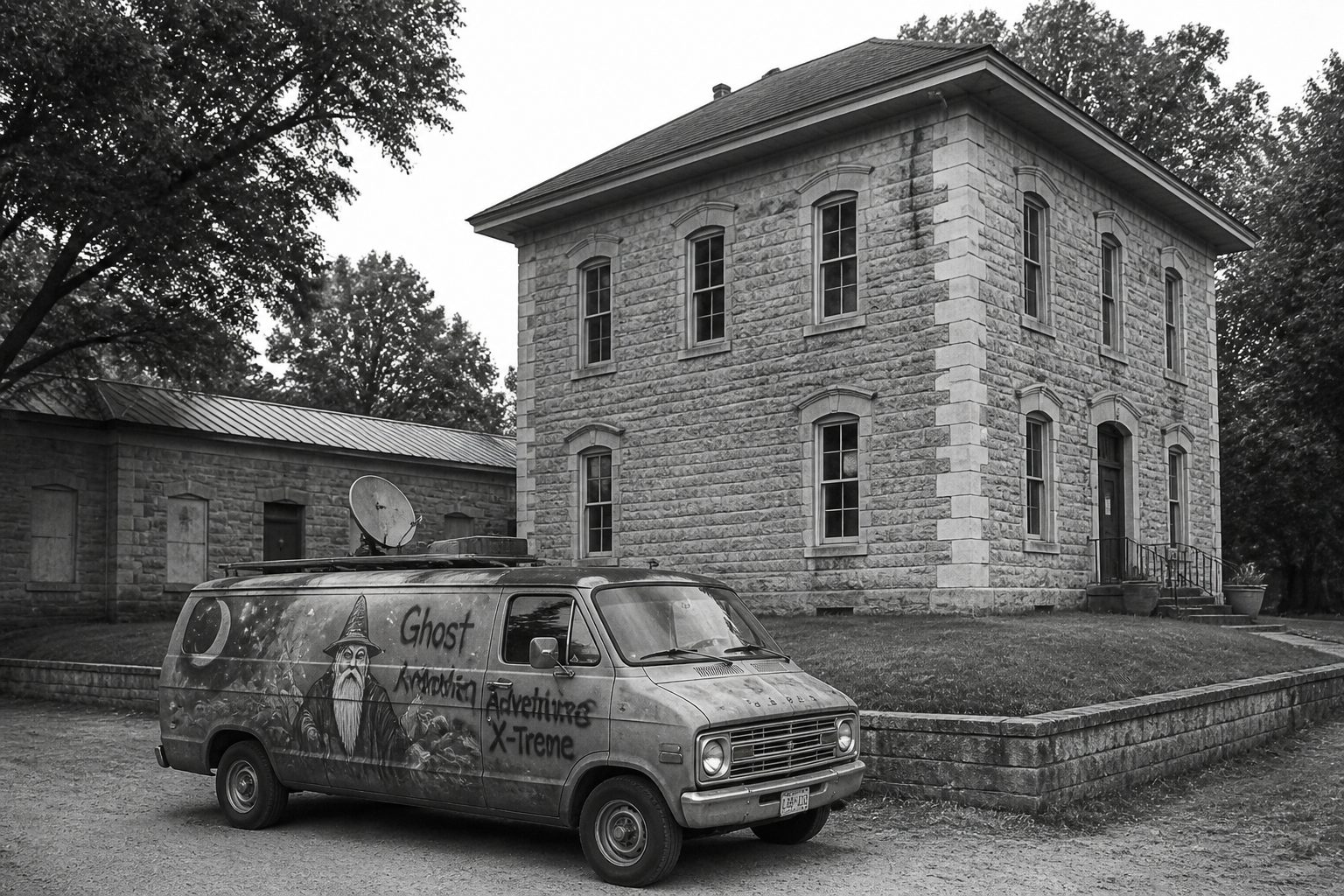
The building is a simple rectangle of rock-faced limestone, quarried from nearby Mount Ephraim, raised above the surrounding grade. Constructed in 1884, it’s the second-oldest extant courthouse in the state. The town’s founders donated a full block for it—Courthouse Square—and the structure sits at its center, flanked by stone retaining walls and a grass-covered lawn.
JOE The work order cited a rattling HVAC unit. Likely a mechanical fault.
JUPITER The ticket listed 'unexplained vibration.' Mr. Davenport noted a prior report of anomalous resonance at this location.
JOE Check your piezoelectric sensor calibration.
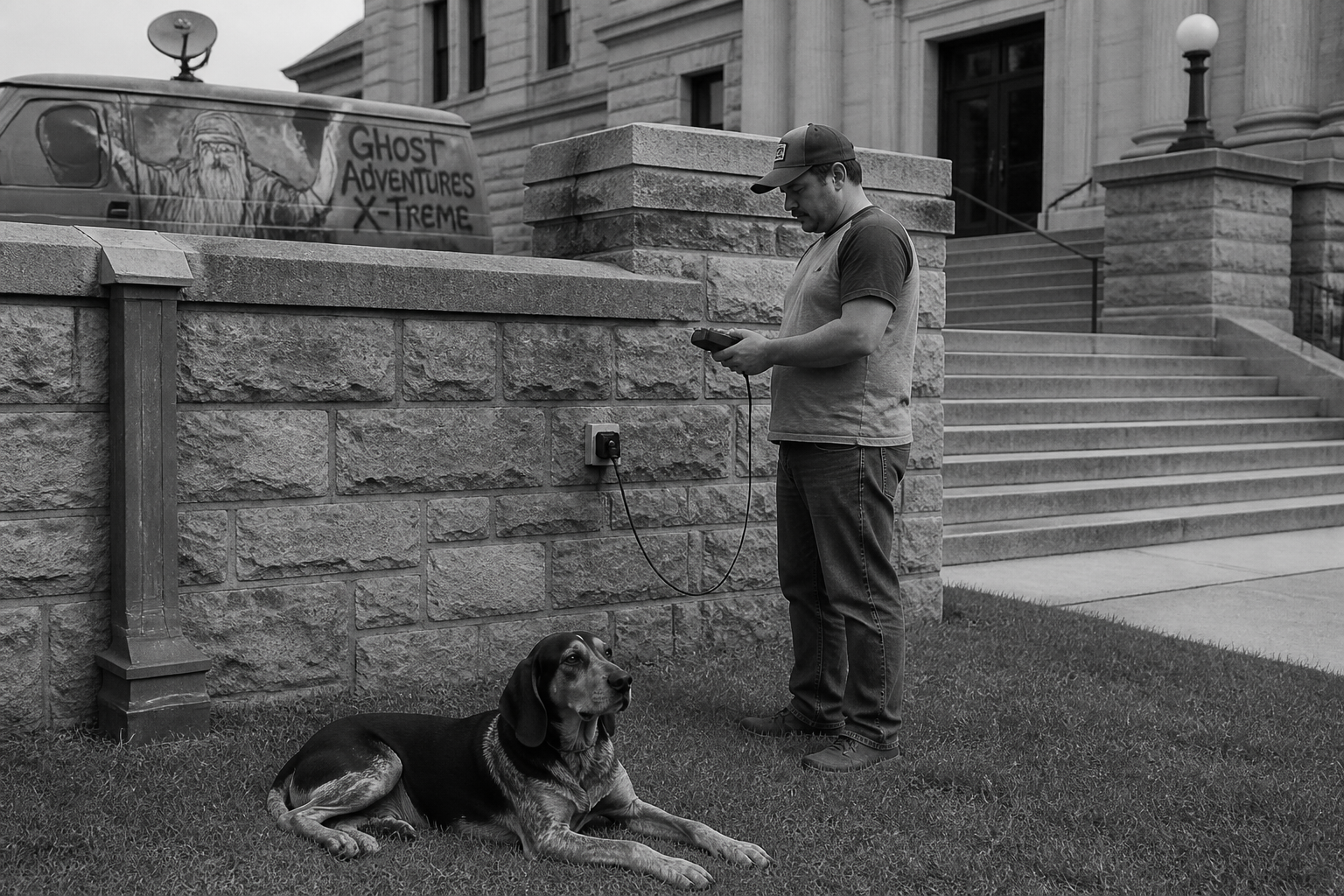
At 9:12 AM, I calibrated a piezoelectric sensor for ground-conducted vibration at the base of the south retaining wall. Mr. Davenport stood at the north steps. Our coonhound, Cletus, rested on the lawn.
The building’s documented history is clear. The cornerstone was laid April 23, 1884. County administrative functions moved out in 1994, and a new Justice Center was built next door in 2012. The building is now largely vacant. Its Late Victorian Italianate style is expressed in the tall, arched window hoods with projecting keystones, the wide boxed eaves, and the original wood-framed windows. To the west, the Old Jail, a smaller limestone building from around 1885, sat boarded.
At 9:12:43 AM, a single, sharp pulse—0.8 seconds in duration—registered through the limestone retaining wall directly beneath the sensor. Regional seismic monitors showed no concurrent activity. No proximate vehicular or rail traffic was noted.
JUPITER Ground vibration detected. 0.8 seconds. Localized to this wall.
JOE Record it. Baseline established.
We entered through the north entrance. The interior air was still. The ground-floor hallway runs north-south, framed by original stone bearing walls. Mr. Davenport examined air grilles along the baseboards. I mapped wall composition with an ultrasonic thickness gauge. Cletus followed.
At 9:37:18 AM, thermal sensors registered a six-degree Fahrenheit drop localized around the open wooden staircase in the center of the hall. The cold spot persisted for seventeen seconds. Cletus lifted her head, then rested it again.
JOE Possible pressure differential. Could be a faulty register seal in the 1976 addition.
JUPITER The localized thermal gradient does not correlate with measured airflow from that vent.
JOE It's a data point. Maintain monitoring.
We proceeded to the second floor. The courtroom retains a high degree of architectural integrity. The original ornate pressed-metal ceiling exists behind a suspended tile layer. Beadboard wainscoting lines the plaster walls. The hardwood oak floor is exposed in the gallery. The judge’s dais, witness stand, and wood pews remain. The interior was described in The Westmoreland Recorder in May 1885.
At 10:47 AM, we prepared equipment. I mounted a laser vibrometer facing the suspended ceiling. Mr. Davenport positioned a microphone array near the judge’s dais. Cletus rested near the jury box.
JOE Synchronize all recorders on my mark. Three, two, one, mark.
JUPITER Synchronized. All systems recording.
At 10:47:00, a visual distortion propagated across the suspended ceiling tiles in the room's center. It lasted 4.2 seconds. No thermal change was detected. Simultaneously, the laser vibrometer and contact mics registered a 47.3 Hz resonance in the limestone walls. Mr. Davenport’s audio recorder captured a low-frequency rumble not attributable to any mechanical source in the building schematics.
JOE Did you observe that?
JUPITER Yes. Visual refraction without thermal cause. Walls are resonating at 47.3 Hertz.
We spent the next hour inspecting the area. I placed contact mics at the joints of the wainscoting. Mr. Davenport examined the wood panels. Cletus remained near a vault door.
JUPITER The 1928 addition altered the south facade. Could this affect internal pressure dynamics?
JOE Potentially. But the resonance is isolated to the original stone bearing walls.
No repeat phenomenon occurred. We initiated an overnight passive recording session, deploying a battery-powered array of audio, infrasound, thermal, and structural resonance sensors focused on zones of high architectural integrity: the original courtroom walls, the staircase shaft, and the stone bearing walls.
I monitored from a folding chair near the judge’s bench. Mr. Davenport rested against a pew. Cletus slept near the exit. The building's period of significance ended in 1929. It was listed on the National Register of Historic Places on January 5,-Proceed with objective documentation.
At 3:17:00 AM, every structural sensor registered a coincident pulse. A single wave of 47.3 Hz resonance propagated through the load-bearing limestone walls of the original 1884 structure. It lasted 2.1 seconds. No corresponding change registered on thermal, electromagnetic, or atmospheric pressure monitors. Audio recorders captured only sub-audible vibration. Cletus did not stir.
At sunrise, we reviewed the data. The pulse was temporally precise and physically localized to the original architectural fabric. The 1976 addition and the 1928 bay registered no activity.
JOE The data shows no evidence of a sentient presence.
JUPITER No narrative content or external energy source is indicated.
JOE It is a physical anomaly. The stone itself is resonating.
JUPITER The persistence of the 47.3 Hz signal is notable. Samples of mortar and stone, when removed and mechanically excited, continued to resonate at that frequency.
We addressed the mundane issues. The cold spot was traced to a faulty register seal. The keystones and label stops on the window hoods are confirmed as standard Italianate ornamentation. The courthouse’s documented history contains no tales of murder, scandal, or tragedy.
The 47.3 Hz resonance remains unexplained. Its origin, its propagation mechanism, its precise synchronization at 3:17 AM, and why it manifests only in zones of high architectural integrity are unresolved.
We packed our equipment at 8:15 AM. Cletus waited by the van. We departed.
FIELD NOTES
- Primary phenomenon: Material resonance at 47.3 Hz detected in original load-bearing limestone walls.
- Secondary phenomena: Synchronized visual distortion (refraction without thermal cause); low-frequency acoustic emission not attributable to known mechanical sources.
- Resolved: Cold spot traced to HVAC pressure differential from faulty register seal in 1976 addition. Keystones confirmed as standard architectural detail.
- Unresolved: Origin and mechanism of 47.3 Hz resonance; its precise temporal occurrence; its persistence in removed material samples.
- Recommendation: Propose a controlled comparative study involving calibrated excitation of similar historic limestone structures and standardized material sampling for laboratory acoustic analysis.
- Note: Cletus’s collar tag detached near the memorial flagpole. Replacement required.