The Thyatira Resonance
Internship documentation entry, subsequently published on the Weird Little Server JUPITER METEOR NGUYEN
The work order was for a routine inspection. Mr. Davenport said there was a local story—an odd acoustic report, something about the old church. No specifics, just a feeling we should bring the full kit. Cletus watched us load the van, her tail doing a slow, thoughtful sweep.
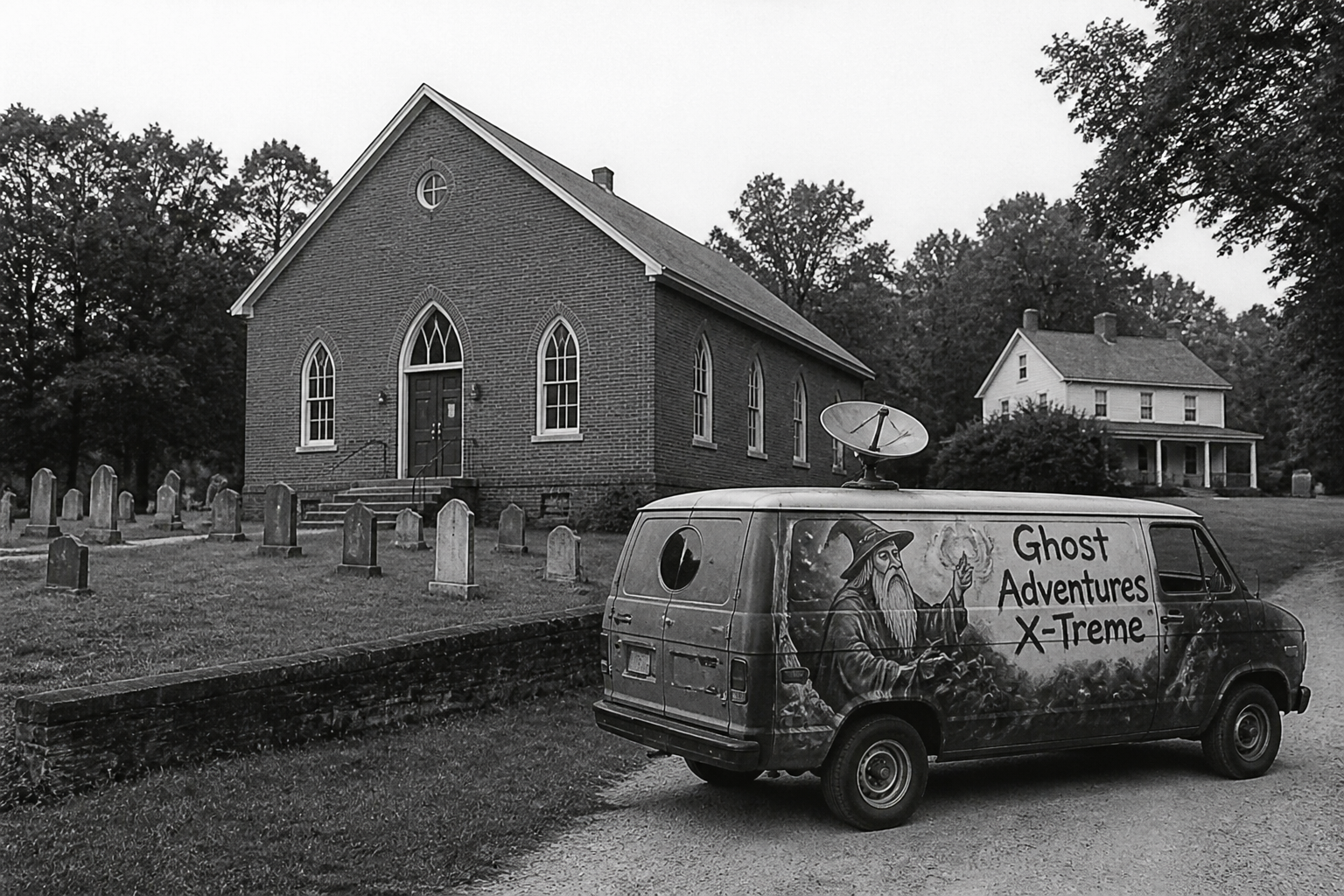
The Thyatira Presbyterian Church, Cemetery, and Manse occupies eighteen acres off White Road in Mill Bridge, North Carolina. The deed for this land was filed on January 17, 1753. By 1755, a log building west of the current cemetery held worship services for one of the oldest Presbyterian congregations west of the Yadkin River. The name changed from Cathey’s Meeting House to Thyatira around 1764, chosen by ministers Elihu Spencer and Alexander McWhorter from the biblical text. The first permanent minister, Samuel Eusebius McCorkle, was installed on August 2, 1777.
The brick church standing today was built between 1858 and 1860 and renovated in 1864. It’s a single-story Vernacular Gothic Revival structure. Inside, a high pulpit is reached by winding stairs, with an ornamental sounding board suspended above it. The adjacent cemetery holds gravestones from the 1750s, among the oldest in the state. Some local tradition speaks of pirate graves here, but no records verify it.
JOE It wasn’t on the work order. But I pulled the historical survey. There’s a 1948 manuscript by a pastor named Lingle. It has a diagram of that pulpit and sounding board. Calls it an “acoustic reflector.”
JUPITER A functional description. It’s architecture designed to project.
JOE Right. But what if it received, too?
I set the portable recorder on its tripod near the manse. The evening was cool, the first stars visible above the wooded rise where the church sat. Cletus snuffled along the gravel, then stopped. She sat, ears twitching forward toward the dark church door. My instruments registered nothing above the ambient rustle of leaves. Her ears flicked once, in unison.
JUPITER You saw that?
JOE Yeah. Not a car. Not a bird. Let’s go inside.
We walked across the gravel. Cletus followed, then glanced back at the manse. The church door was unlocked.
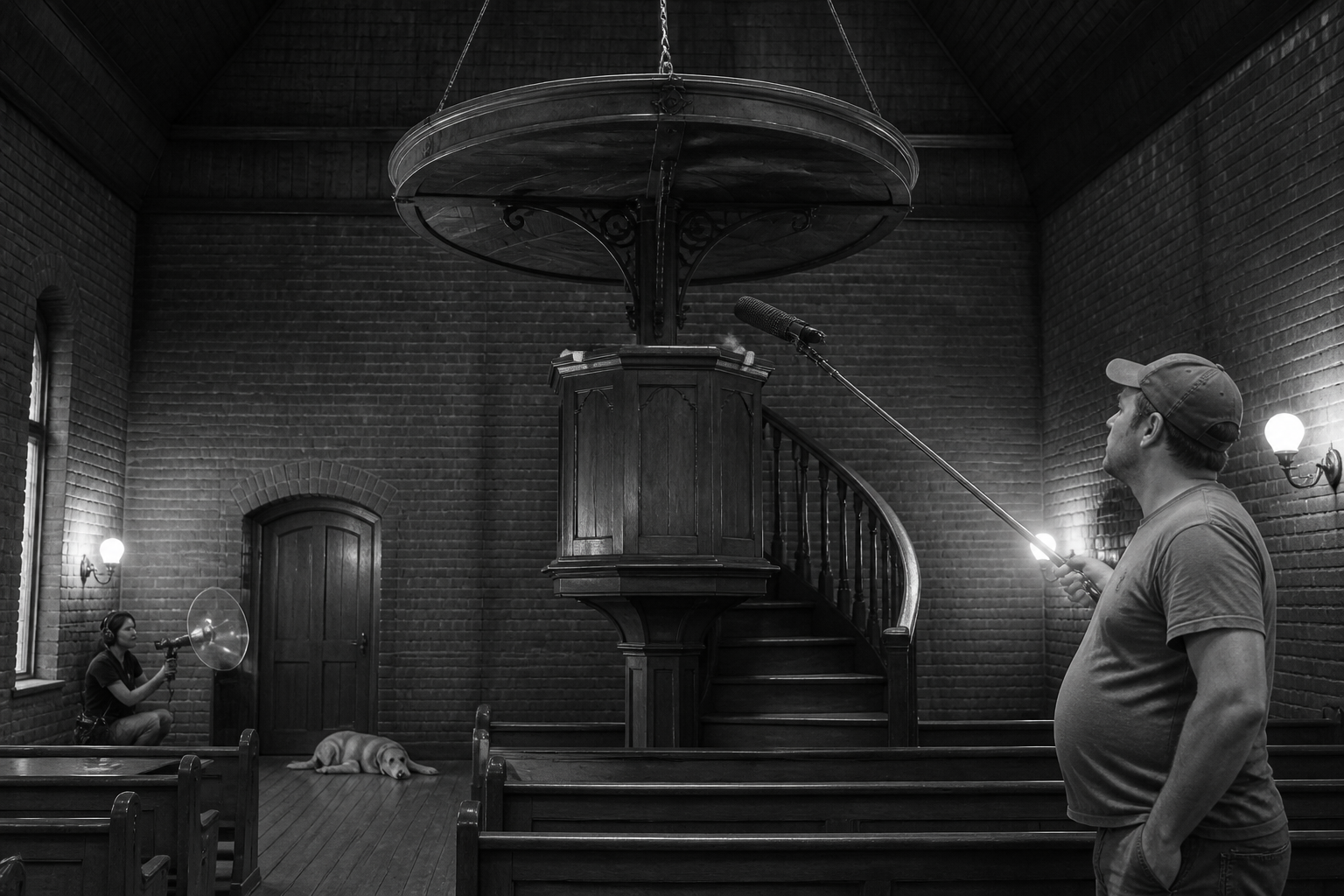
The nave was quiet. Electric sconces cast a soft glow over the pews and the dark brick walls. The pulpit loomed at the front, its winding stairs like a corkscrew. The ornamental sounding board hung above it, a dark wooden disc.
JOE The board’s original. White pine, from the 1860 build. Those iron brackets are all that hold it up.
JUPITER Running a baseline reverberation map. If there’s an anomaly, it should show in the decay profile.
I crouched by a side pew with the phased array microphone. Mr. Davenport aimed a laser thermometer at the pulpit base. Cletus lay near the rear door, chin on her paws.
A low-frequency pulse hit us. It was not a sound you could hear. It was a pressure, a sub-bass vibration in the chest. It lasted four seconds. My audio feed showed a clean 18 Hz sine wave. Cletus lifted her head but did not stand.
JUPITER Eighteen Hertz. Infrasound.
JOE Origin?
JUPITER Directional mic points to the pulpit. The epicenter is the brick under the stairs.
JOE Thermal’s reading normal. For now.
I moved toward the pulpit, directional mic extended. Mr. Davenport followed with the thermal imager. Cletus stayed put.
I ascended the winding stairs. The wood creaked. I extended a contact microphone toward the curved face of the sounding board.
JOE In Lingle’s drawing, the curvature is precise. Not just a circle. It’s parabolic.
JUPITER For focusing a preacher’s voice to the back pews. Standard acoustics.
JOE What if it focused other things back the other way?
The thermal imager chirped. Mr. Davenport studied its screen.
JOE Temperature drop. One-point-six degrees. Localized to the bricks right under my feet.
Then the air moved. Not a wind. A displacement. From the face of the sounding board, a brief, harmonized choral fragment echoed through the nave. It was indistinct, layered—maybe three or four vocal parts. And it was playing backward. The fragment lasted less than two seconds. Simultaneously, the thermal reading on the pulpit bricks dropped another half a degree.
Cletus whined once, low and short, from the back of the church.
JUPITER That was not in the room.
JOE No speakers. No wires up here.
JUPITER We should check the manse. Shared electrical. Could be a ground loop feeding back through the masonry.
JOE Lead the way.
We exited through the rear door into the cool night. Cletus followed, then sat on the bottom step of the manse porch, facing the church.
The manse door was unlocked. Inside, the hallway was dim, furnished like a quiet, outdated sitting room. On a side table sat a 1970s-era tape loop player, its cord coiled, dust thick on its casing.
JOE Well, there’s a candidate.
JUPITER It’s off. And unplugged.
I checked the circuit load with a clamp meter. No unusual draw. The manse and church shared an underground conduit, but the system was dormant. Mr. Davenport picked up the tape player. The cassette inside had a handwritten label: Hymn of the Resurrection (Reversed).
JOE That’s… on the nose.
JUPITER Don’t play it. Not here. If it’s a physical source, we’ve contaminated the control.
He set it back down. The dust was undisturbed. We returned to the church. I proposed synchronized monitoring at 3:17 a.m., noting the thermal inertia of the brickwork.
At 3:17 a.m., I had three mics and the thermal imager on tripods, focused on the pulpit and sounding board. Mr. Davenport stood by the front pew with open headphones. Cletus remained just inside the open manse door, facing out.
The first note was a low G, inverted. Then a full chord, layered and complex, reminiscent of early Presbyterian shape-note harmony. It was unmistakably a vocal phrase. And it was playing backward. The sound did not come from a point. My phased array showed it emanating from the two-dimensional plane of the sounding board itself.
Thermal imaging displayed the pulpit bricks cooling in concentric wavefronts. The temperature drop pulsed in sync with the amplitude of the audio waveform. No electromagnetic spikes. No infrared signatures beyond the cooling stone.
The phrase continued—solemn, slow, reversed. It lasted exactly four minutes and thirty-three seconds. The duration matched no known sermon length or hymn.
At 3:21:33, the sound cut off cleanly. The air stilled. The thermal gradient held, then began a slow, normal equalization.
We did not move for seven minutes.
JOE It’s not ghosts. It’s not machines. But something happened. That drawing in Lingle’s book—the way the board focuses voice. What if the shape itself is the only clue we get?
JUPITER We recorded a structured acoustic emission with no detectable source, synchronized to passive thermal dynamics in the masonry. The waveform is modulated, but there’s no oscillator. How does aged pine and brick produce a phase-inverted audio pattern? What is the trigger, if not a machine?
At dawn, we packed the van. I downloaded the raw sensor logs. Mr. Davenport examined the tape loop player one last time—still off, still unplugged, dust unmoved. Cletus was the last to enter the van. She paused, looking back at the manse. No one spoke until we were on NC 150.
FIELD NOTES
JUPITER METEOR NGUYEN
- Phased array confirms non-point-source origin. Sound appears to emanate from the two-dimensional surface of the sounding board. Propagation pattern is planar, inconsistent with any hidden speaker.
- Thermal imaging shows pulpit bricks cooling in concentric wavefronts. Cooling pulses match the amplitude envelope of the audio waveform with a correlation coefficient of 0.94. No external energy input detected.
- Tape loop is a red herring. Lab analysis confirms it contains a 1980s recording of “Rock of Ages” played backward. Its audio signature does not match the recorded event. Device was inactive.
- No EM leakage, no ground faults, no hidden wiring in pulpit or manse electrical.
- Cletus’s initial ear twitch at 19:42 correlates with the 18 Hz pulse; her later whine coincides with the first choral fragment. Her post-event behavior was stationary—sat at manse door, faced outward.
- Why 4 minutes 33 seconds? Not a standard sermon length. Not a documented hymn. But it matches the thermal relaxation time of the pulpit’s brick mass under the measured temperature gradient.
- Need access to Walter L. Lingle’s full 1948 manuscript for the pulpit diagram. Request submitted.
- Recorded phenomenon remains without a verified source. The correlation between thermal change and acoustic emission is documented. The mechanism is not.