GHOST CRUSADE X-TREME DAILY REPORT: THROCKMORTON COUNTY COURTHOUSE AND JAIL
Field documentation for internship credit, subsequently published on Joe Davenport’s weird little server. Report compiled by Jupiter Meteor Nguyen.
We didn’t come for HVAC. We came because Mr. Davenport read about “historical resonance” in some old preservation literature—a vague concept, like most of our leads. But this time, the building itself presented some physical quirks worth documenting.
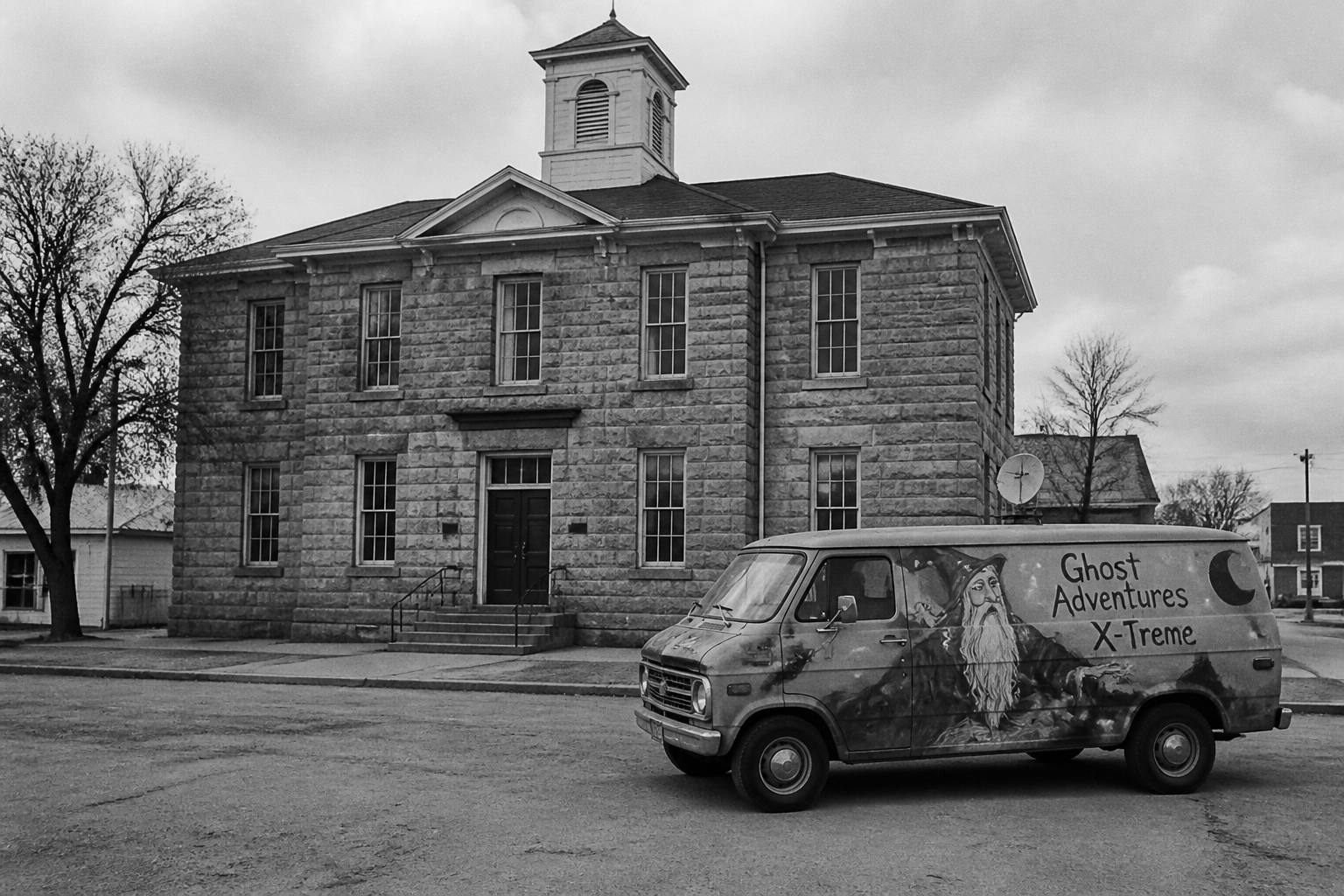
The Throckmorton County Courthouse and Jail is a two-story, light brown and grey sandstone building on Public Square in Throckmorton, Texas. It was constructed during a period of post-Civil War county organization. The courthouse was built in 1890, the jail added in 1893. The design, a combined courthouse and jail, was common for late 19th-century county government. A major restoration was completed in March 2015, removing 1930s additions and returning the interior to its 1890 appearance while adding modern amenities like an elevator, ramps, and updated HVAC. Original long-leaf pine flooring, wainscoting, doors, and shutters were preserved.
We arrived just after sunset. The air was still warm.
JOE Look at that cupola. Reconstructed in 2015, but it’s following the original Italianate plans. The louvers are fixed shut now. Preservation code.
JUPITER I’m calibrating the thermal imager. The ambient temperature is 28.7 degrees Celsius. The sandstone is radiating residual heat from the day.
JOE The cornerstone was laid August 30, 1890. That’s a fact. Martin, Byrnes & Johnston were the architects. Pauly Jail Building built the jail part three years later. Sometimes when you have two construction phases that close together, the materials can hold different stress signatures.
JUPITER That’s an untested assumption, Mr. Davenport.
Joe stood at the base of the courthouse steps, tilting his head up. I knelt beside the tripod. Cletus lay flat on the sidewalk, tongue lolling, one ear twitching at a distant truck.
The wooden louvers on the cupola creaked. No wind stirred. The mechanism was supposed to be fixed.
JOE See?
JUPITER Thermal expansion or contraction. The interior air temperature is shifting.
JOE At exactly sunset? Come on. Let’s go inside.
I sighed, packed the tripod. Cletus rose slowly, seeming tired from the heat and the trip.
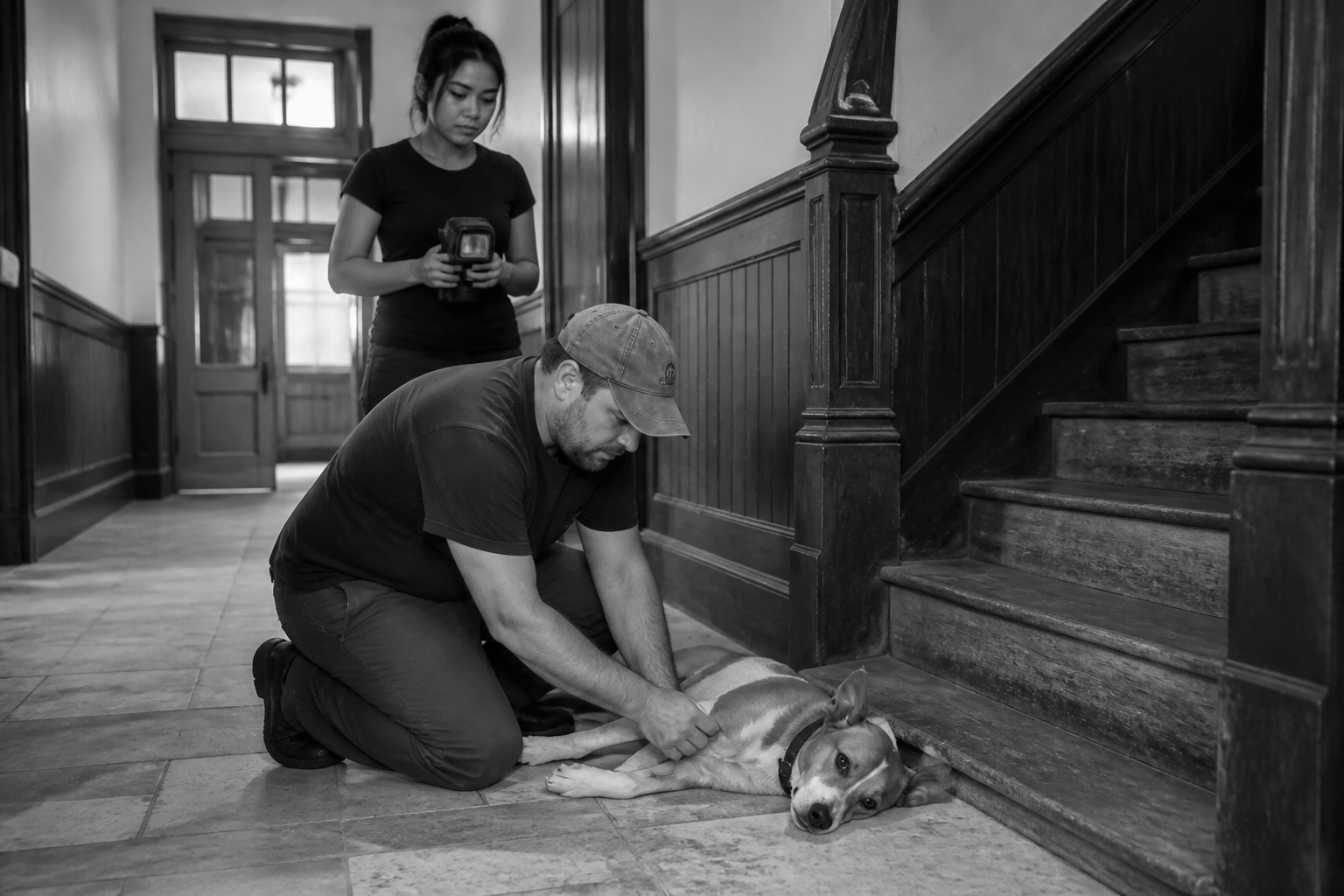
The first-floor hallway smelled of old wood and fresh paint. The restoration had exposed the original long-leaf pine flooring and wainscoting. I ran a laser thermometer along the wall. Cletus sniffed near a restored transom, then abandoned it for a sun-warmed patch of floor.
JUPITER Temperature differential is minimal. Maybe half a degree along the east wall.
JOE They restored everything to 1890 specs. Even the stairs. But they put in an elevator and new HVAC. That creates a complex thermal environment.
A low, rhythmic thudding began. It sounded like stone being lowered onto stone, emanating from the east wall. It lasted approximately twelve seconds. No visible source. Cletus lifted her head, sniffed the air, then flopped back down, uninterested.
JUPITER Audio. Did you get that?
JOE I heard it. Sounds like old pipes or a settling joint.
JUPITER Or a mechanical system cycling. Let me verify.
I opened the audio recorder app. Silence. Joe was already moving toward the sound. Cletus stayed put, watching him.
We took the restored staircase to the second floor. The building was designated a State Antiquities Landmark in 1981 and a Recorded Texas Historic Landmark in 2008, recognizing its role in post-Civil War county organization. The courtroom entrance was a heavy door with an original transom.
In the early morning hours, we were stationed there. Joe crouched by the door. I stood behind him, camera aimed at the mortar lines. Cletus lay at the base of the cupola staircase, twenty feet away, motionless. I’d called her name twice. She didn’t move.
JUPITER Thermographic sweep shows nothing anomalous. Ambient 22.1.
JOE Shh. Listen.
The silence was complete. Then, the courtroom door swung open on its own.
Inside, the room was dark. No figures were present. The door closed softly a moment later.
JOE Whoa.
He tried to rush forward. I grabbed his arm.
JUPITER Don’t. Draft. Or a hinge issue.
JOE Maybe it’s the building settling. I read about old structures shifting at night when the temperature drops.
Cletus remained prone, eyes open, unblinking.
We retreated to the cupola staircase base. Cletus did not move, did not pant, did not respond to treats or Joe’s voice. He crouched beside her, checking her pulse. I shone a light up the narrow stairs.
JUPITER Cletus. Come on. Treat.
No response. Her breathing was even.
JOE She’s exhausted. The overnight shift got to her.
I scanned the stairs with the thermal imager. A 4.2°C temperature differential appeared on the third wooden stair, matching no ambient source. When I stepped onto the first stair, the differential vanished.
JUPITER Thermal differential on the third step. Gone when I approach.
JOE Localized draft or insulation quirk. She’s just worn out.
He scooped Cletus up and carried her back toward the main hall. The moment her paws crossed the threshold from the stair nook into the hallway, she wriggled, dropped to the floor, shook herself, and trotted to my side as if nothing had happened.
JOE See? Change of scenery. Woke her up.
We spent the remaining hours reviewing data. I found localized thermal spikes at original mortar junctions along the east wall, timestamped to coincide with the auditory thudding. The spikes suggested uneven heat retention in the original materials. No electromagnetic spikes. No further audio anomalies.
Joe stared at the ceiling.
JOE It’s not a ghost. It’s just an old building doing old building things. The materials have their own thermal properties.
JUPITER We’re seeing localized thermal variation at original material junctions. It occurs alongside audible building noises. The mortar may retain or release heat differently than newer materials. That’s all.
JOE That’s what I meant.
JUPITER No, you implied something else. That’s not a thing.
JOE It is if you read the right books.
We left at dawn. The courthouse stood quiet in the morning light, its reconstructed cupola sharp against the pale sky. Cletus hopped into the van and curled up on the seat. Joe glanced back once. I saved all the data to a drive labeled THROCK_COURTHOUSE_THERMAL and started the engine.
FIELD NOTES
Jupiter Meteor Nguyen Location: Throckmorton County Courthouse & Jail, Public Square. Objective: Document thermal and acoustic properties post-restoration. Equipment: FLIR E8 thermal imager, laser thermometer, digital audio recorder (unused). Findings: Localized thermal anomalies isolated to original 1890 sandstone-mortar interfaces. Spikes correlate with audible building noises (approx. 12-sec thudding). No EM spikes. Audio recordings captured no anomalies. Notable: Cletus exhibited prolonged immobility at cupola stair base—likely fatigue from overnight activity and environmental stress. Mobility returned upon relocation. Hypothesis: Thermal differentials may be due to material age, composition, and the interaction with modern HVAC systems. No paranormal activity observed. Next test: Compare thermal profiles at 1893 jail mortar lines versus 1890 courthouse mortar. Conclusion: Observed phenomena are physical and environmental in nature. Needs proper building science analysis. Joe insists it’s “atmospherically significant.” Sigh.