Field Report: S. Walker's Hotel (Brick Walker Tavern), Cambridge Township, Michigan
Report filed by: Jupiter Meteor Nguyen Date of Investigation: 2026-09-06
We came to photograph chipped sandstone lintels and document load-bearing brickwork. What we got was a synchronized environmental anomaly—correlated precisely with a documented structural discontinuity.
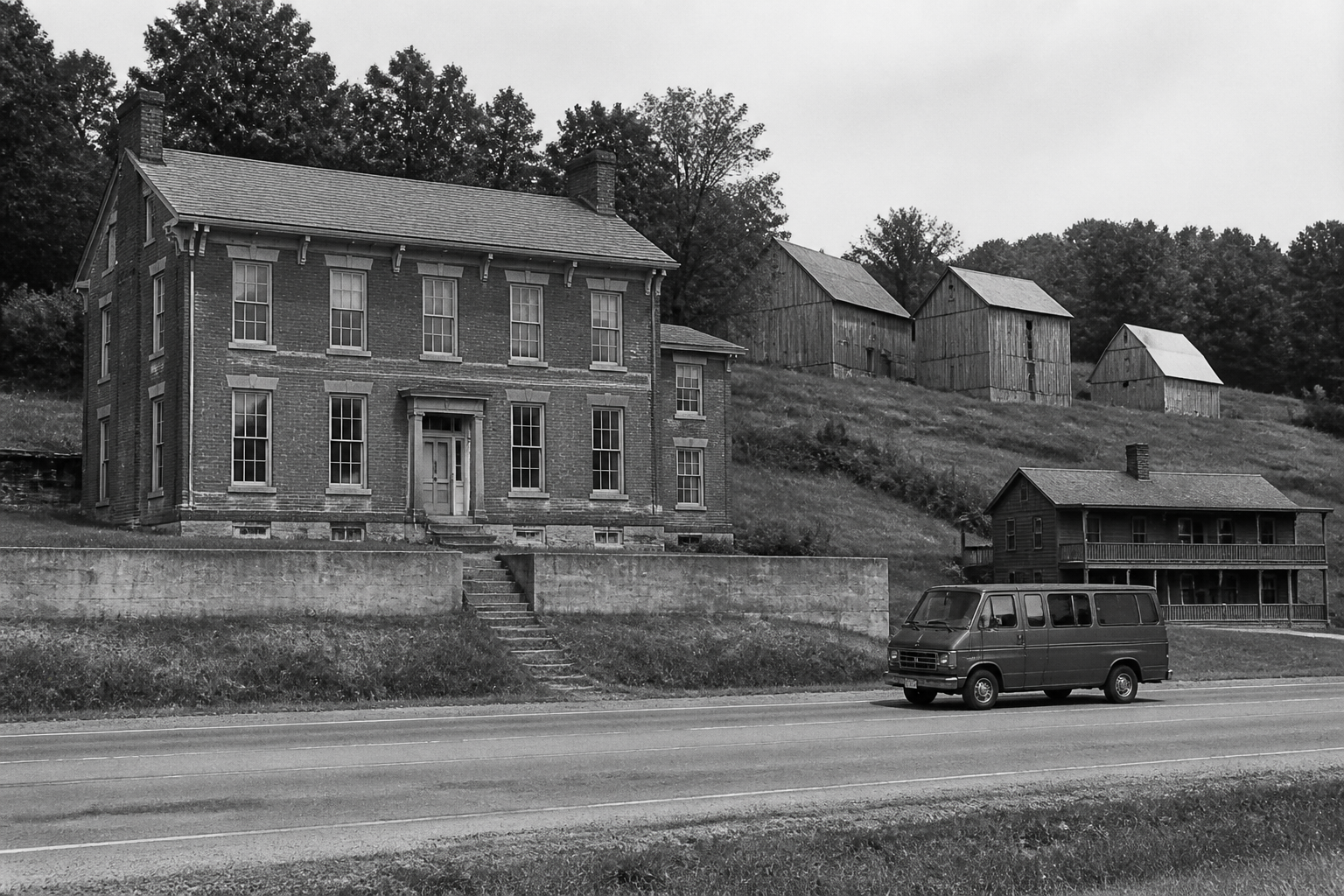
The building sits on a slight rise off US-12, its red brick facade facing M-50 with the symmetrical, sober confidence of Greek Revival. A concrete retaining wall holds back the hill it’s built on; from the highway side, you can see into the exposed fieldstone basement. It was completed in 1853 by Sylvester Walker, meant to serve stagecoach traffic alongside his older, wooden tavern across the road. The third floor held a ballroom, a rare luxury for a rural Michigan tavern.
Joe crouched in the first-floor dining room, his fingers tracing a fine gap between baseboard and floor. Morning light cut through the original six-over-six windows, illuminating dust motes in the still air. I stood with my tablet open to the architectural schematics, cross-referencing room dimensions against Frederick Hewitt’s 1922 renovation records. Cletus lay under the long oak table, chin on her paws, already settled in for a day of professional loafing.
Joe: "Air’s not moving. No draft from the foundation. That’s good. Means the load-bearing walls haven’t shifted enough to open a new airway."
Jupiter: "Baseline environmental scan confirms. Temperature steady, humidity within expected parameters for the materials. No active mechanical systems on this floor since the hotel ceased operation."
A brief shimmer passed across the transom glass above the center entrance—a harmonic ripple in the air, visible for maybe a second. It didn’t register on the audio, but the light bent. Cletus lifted her head, sniffed once decisively, and put it back down.
Jupiter: "Visual anomaly. Transient. Duration 1.2 seconds."
Joe: "Sun hitting old glass. Refraction through uneven glazing. We should still check upstairs. Ballroom’s supposed to be the money spot."
We took the central staircase, its lower treads made of the same locally quarried sandstone as the lintels. Joe went first, one hand on the solid newel post. I followed, recalibrating the handheld spectrometer for the tighter vertical space. Cletus trotted behind, then paused halfway up, her ears swiveling forward for a moment before she deliberately stepped over the third tread from the top.
My sensor registered a brief thermal dip—1.8 degrees Fahrenheit—localized to the stairwell. No corresponding airflow.
Jupiter: "Temperature anomaly. No HVAC source."
Joe: "No ductwork. Not even a chase. Maybe cold air sinking from a higher floor?"
We moved into the second-floor hallway, former guest rooms now stripped of partitions by Hewitt’s renovations. The late-morning sun was diffuse here, softened by the tall windows. I scanned the wall density, mapping it against the 1922 plans. Hewitt, the English-born antiquarian with a theology degree, had bought the place and turned it into a curated antique shop, riding the wave of auto tourism after US-12 was paved in 1926.
Joe: "He kept the bones. Good bones. Load paths intact."
From behind the closed door of Room 7, a sound manifested. A single, sustained note—clear and mid-register. It lasted for nearly five seconds. The hallway air didn’t change temperature. My external microphones recorded nothing but ambient building noise, but the audio file on my phone, when pulled up, showed a faint, clean waveform.
Jupiter: "Audio fragment captured. Internal phone mic only. No external registration."
Joe: "Ventilation shaft? Transference from another room?"
Jupiter: "There are no connecting ducts to that room. The walls are solid brick."
Cletus had paused at the door, sniffed intently at the baseboard, and then turned and walked away, her tail giving a single, dismissive wag.
We continued to the third floor.
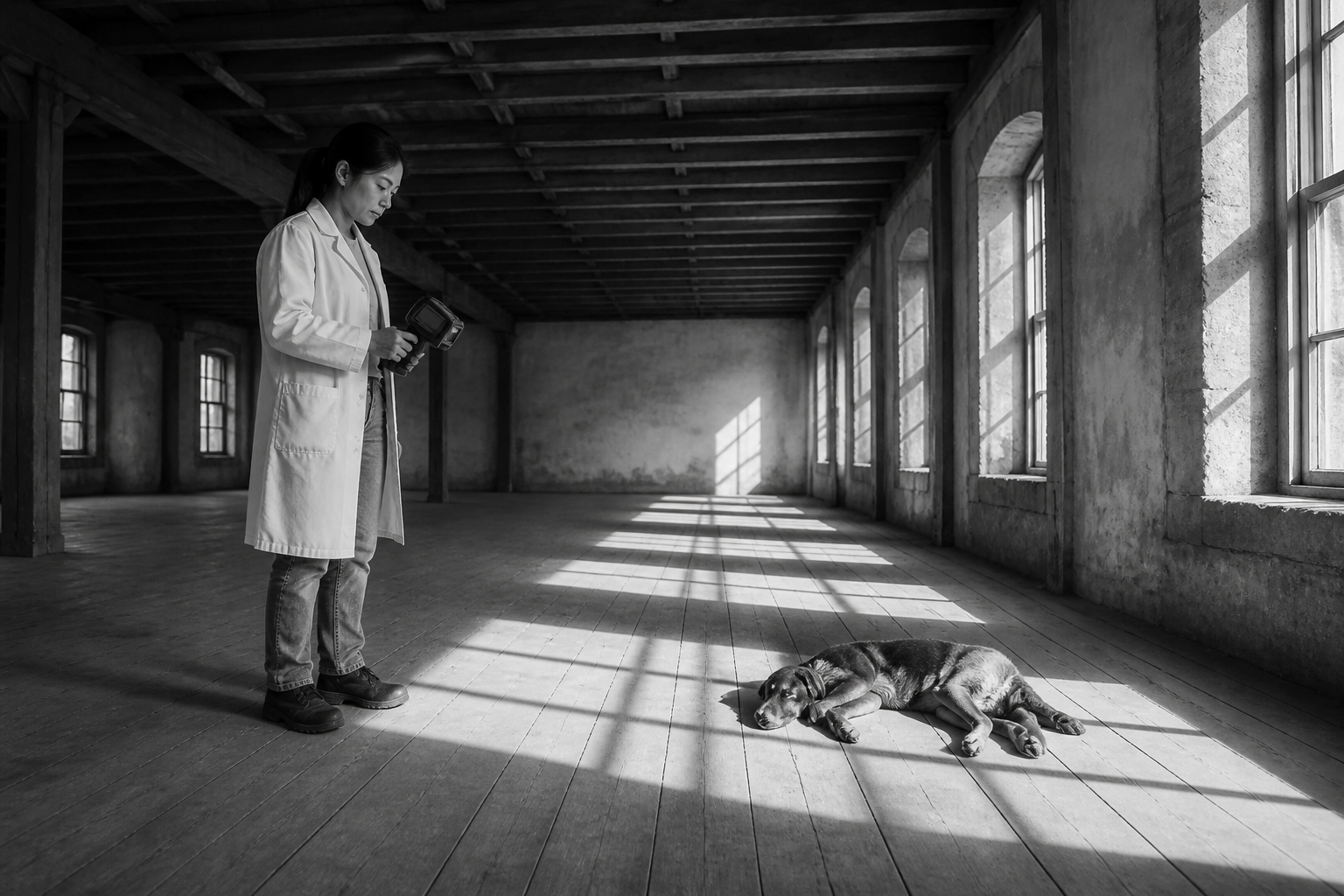
The ballroom was a vast, open space, the ceiling supported by hand-hewn joists. Shadows were beginning to stretch across the wide-plank floorboards. Joe went to the northwest corner to inspect the joist connections. I set up the laser grid near the center of the room, calibrating for acoustic resonance. Cletus immediately began circling a particular patch of bare floorboards near the east wall, her nose to the ground.
The ballroom’s existence was the historical footnote. A luxury. Whether it ever hosted a dance, a wedding, a political rally during Lyman Nearing’s tenure or George Burton’s management, no document says. It was sealed off for years, then reopened as an event space in the mid-2000s.
I powered on the spectral imager.
The sandstone trim along the east wall—the yellow-brownish stone framing the windows—did something. It refracted the afternoon light into layered patterns, like a prismatic fault line had opened within the rock. My imager flagged a network of subsurface microfractures.
Simultaneously, a low-frequency acoustic emission filled the room. It wasn’t loud, but it was present, occupying the same acoustic space as my own breathing.
My sensor chirped. A thermal spike—four degrees Fahrenheit—localized in a five-foot radius directly over a section where a floor joist was missing, a discontinuity in the framing.
Cletus walked into the center of that hot spot. She lay down, right on the warm floorboards, rested her chin on her paws, and became utterly motionless.
The acoustic emission lasted eleven seconds.
The layered refraction in the sandstone lasted perhaps thirteen.
The heat began to dissipate after twenty.
Then it was just a ballroom again. Silent. The light normal. The air still.
Cletus stood up, shook herself off, and walked calmly to the head of the stairwell, where she sat, waiting.
We didn’t speak for a full minute. I reviewed the data streams. No electromagnetic interference. No power surge. No mechanical trigger in any system we could identify. The thermal anomaly was tightly localized and co-located with the structural discontinuity. The audio was a clean, isolated emission, captured on three devices. The visual event coincided with microfractures in the sandstone my imager had flagged—a network of stress patterns dating to the original construction period.
Joe: "I remember… a Time-Life book. One of the big illustrated ones. It had a picture of this… idea. That sometimes a building isn’t haunted. It’s recorded. Like stress patterns in stone can hold an old shape. A temporal overlay. I thought it was just a weird idea. A metaphor."
Jupiter: "We observed a coherent, multi-modal physical event. Correlated to material properties and structural history. There’s no evidence of fraud. No evidence of external interference. No known mechanical cause."
Joe: "It wasn’t the HVAC."
Jupiter: "It wasn’t a ghost."
We packed the gear in near silence, the routine motions of closing cases and stowing cables. Joe’s movements were thoughtful, not hurried. My mind was already parsing the data, constructing hypotheses about cumulative cyclical stress and material fatigue.
Our final act was to leave. As I held the van door open, Cletus paused. She looked back at the hotel’s main entrance, her droopy face impassive. Then she hopped in, circled twice on the seat, and flopped down with a sigh.
Joe started the engine. I didn’t know what we had seen. But I wanted to measure it again.
FIELD NOTES – JUPITER METEOR NGUYEN
Site: S. Walker’s Hotel / Brick Walker Tavern, Cambridge Junction, MI. Anomaly: Synchronized low-frequency acoustic (11s emission), visual (layered refraction in sandstone trim), and thermal (+4°F) event in third-floor ballroom, 14:22 EST. Correlations: - Acoustic focal point, visual refraction source (east-wall sandstone), and thermal epicenter are co-located within a 5ft radius. - Thermal epicenter is directly atop a section of missing floor joist (structural discontinuity). - Spectral imaging confirms network of subsurface microfractures in sandstone matching 1850-1870 toolmarks; these fractures align with anomaly zone. - No active mechanical systems, ductwork, or electrical lines within anomaly radius. - Audio sample is a clean, non-repeating, low-frequency emission. No known source. Hypothesis: Cumulative cyclical stress from historical use and seasonal expansion/contraction has induced complex strain patterns in the sandstone trim and timber framing. A specific confluence of ambient temperature, humidity, and barometric pressure may have triggered a simultaneous release of stored strain energy, manifesting as localized heating, subsonic vibration, and light refraction through compromised material. Next Steps: Monitor local microclimate for recurrence conditions. Perform non-destructive stress analysis on adjacent joists and sandstone elements. Conclusion: A measurable physical event originating from documented structural and material conditions. Unexplained within a conventional model, but not supernatural.