Anomalous Propagation in a Structured Grid
Ghost Crusade X-Treme Field Report — Connecticut Valley Hospital Cemetery
Internship Documentation of Jupiter Meteor Nguyen
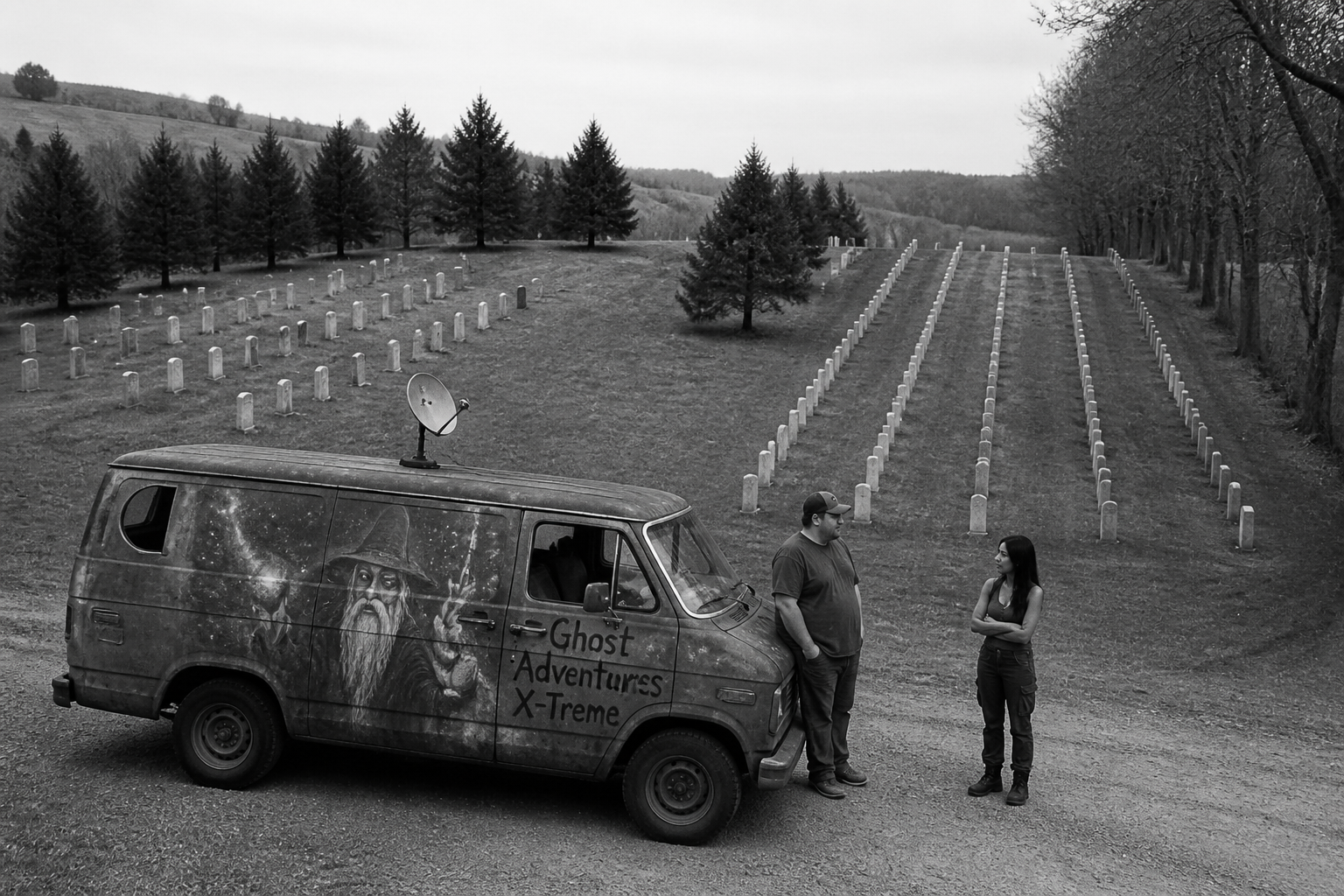
The investigation focused on reports of anomalous vibrations at the Connecticut Valley Hospital Cemetery. The site is isolated on rolling hills east of Silvermine Road, half a mile from the main campus. It is divided by that gravel road: a western triangular parcel established in 1878, and a larger eastern rectangular section added in 1894. Both contain uniform, arched cast-concrete markers set in precise linear rows, bordered by evergreen trees. There are 1,681 numbered graves. Markers from number 199 onward are modern replacements, matching the original design but not historically contributing. The layout is an austere, institutional grid.
We arrived in late afternoon. I set up a three-axis seismometer near Marker #42 in the original western section, burying the sensor in the thin soil between rows. Mr. Davenport stood at the base of the triangular plot. Cletus lay panting in the shade between two rows.
JOE The online report suggested vibrations followed the original grid layout.
JUPITER Understood. I’m calibrating for sub-20 Hz frequencies to test that claim.
The western section was laid out under engineer E. P. Augur’s 1882 plan: staggered linear rows with consistent spacing. A low-frequency thrum pulsed through the gravel. Once. Then again exactly three seconds later. The seismometer’s display spiked, but only on its north-south axis.
JUPITER Did you feel that?
JOE Yes.
JUPITER The pulse is aligned with the north-south row spacing.
The data indicated the pulse originated along the north-south alignment of the 1878 grid. We proceeded to the eastern section to see if the phenomenon was present there.
The eastern section, added in 1894, follows the same north-south alignment. I walked backward down a central aisle, unspooling sensor wire to my audio array. Mr. Davenport followed with a handheld EMF reader. Cletus walked ahead, then stopped at the section’s edge.
JOE Could a repeated structural pattern create a detectable rhythm?
JUPITER It’s a testable hypothesis. I’m adjusting gain on the microphones.
The audio array registered a faint, rhythmic tapping at precise five-meter intervals. The sound was crisp and dry. Triangulation placed the source approximately thirty centimeters above the apex of each marker in sequence. No visible cause was present.
JUPITER Are you hearing this?
JOE Hearing what?
JUPITER Tapping. Above the markers. The array detects it moving down the row.
Mr. Davenport’s EMF reader showed no fluctuation. We moved to Row G in the eastern plot for further testing.
Dusk settled. I set up a laser vibrometer on its tripod, aimed at the face of Marker #841. Mr. Davenport paced slowly along the row alignment. Cletus sat nearby, facing the woods.
JOE If the pattern is strongest here…
JUPITER Please remain still. I require a ninety-second baseline capture.
I initiated synchronized data capture. Over the next ninety seconds, the laser vibrometer registered a wave of micro-vibrations. They propagated sequentially along Row G, each pulse affecting only the space directly above a marker. The pattern matched the documented 1894 placement sequence. No physical movement was visible.
JUPITER A sequential propagation is occurring. It follows the construction order.
Cletus stood, turned, and walked toward Silvermine Road. Mr. Davenport watched her.
JOE We should follow.
JUPITER The capture sequence is complete.
We packed the equipment and followed Cletus on foot.
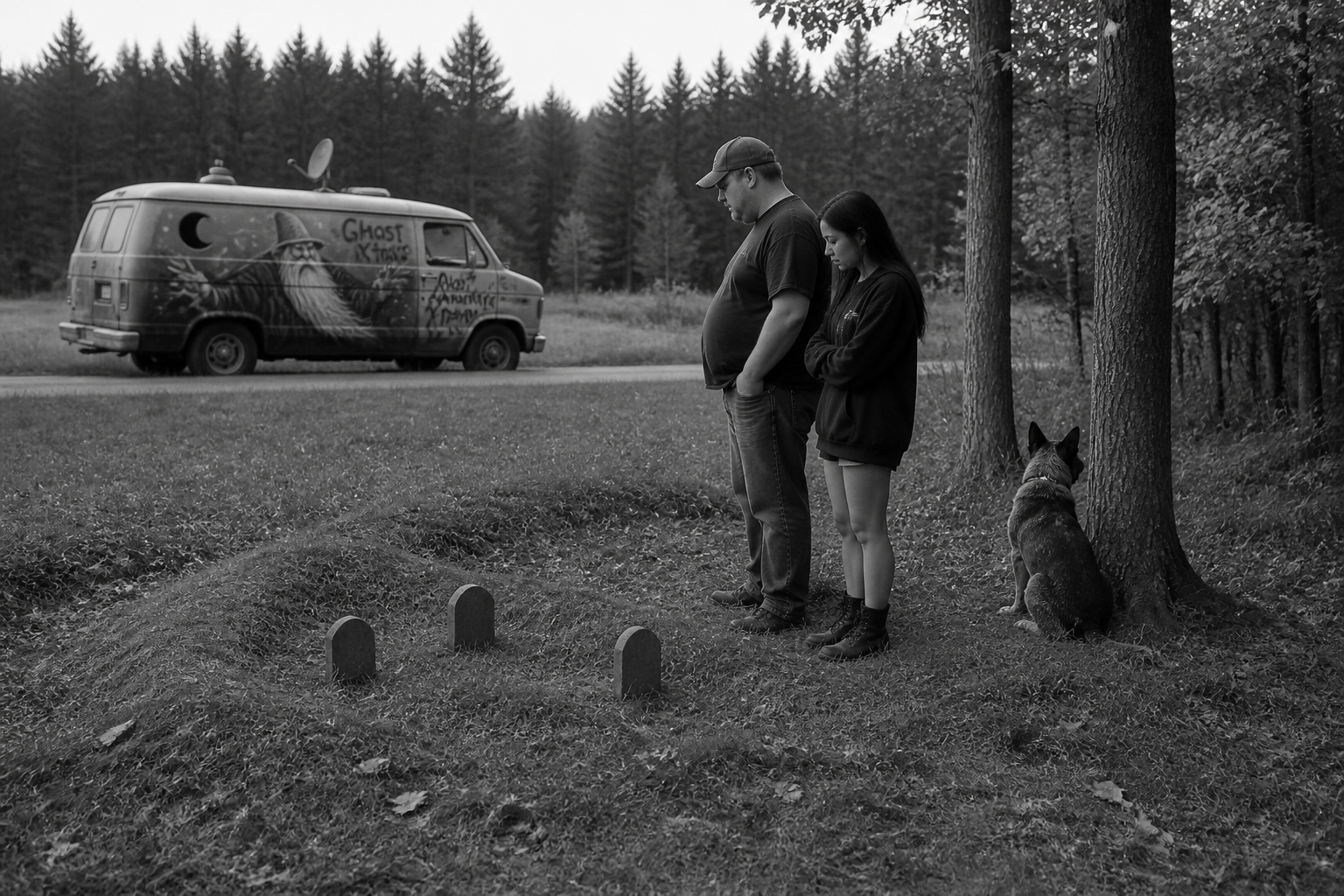
At the edge of the cemetery, near the junction of Silvermine Road and O’Brien Drive, I reviewed my sensor logs. Files from channels four and seven were corrupted. Cletus sniffed at the roadside gravel. My tablet alerted: the remote seismometer registered a final pulse. Triangulation placed its origin mid-air, approximately one meter above some slight turf depressions near the tree line. Duration: 1.8 seconds. Frequency: no match in my database. It did not repeat.
JOE What was that?
JUPITER An airborne pulse. Above this location.
We packed the remaining gear and walked back to the van. No further anomalies were detected.
Aftermath & Data Review
Subsequent analysis traced the initial vibrations in the western section to buried utility lines under Silvermine Road, as confirmed by municipal maps. The airborne tapping and the sequential micro-vibration event above the replacement markers have no identified source. They did not correlate with wind, wildlife, or measured structural movement. Cletus’s behavior was consistent with a trained animal concluding a stationary task.
The collected data shows propagation patterns inconsistent with identified subsurface sources. One audio recording captured a waveform that, when inverted, bears a resemblance to construction-era tamping rhythms—but is airborne, not ground-borne. Why non-historic replacement markers exhibited a response pattern similar to originals is unexplained.
JOE It was a pattern. Something in the layout appears to be propagating a rhythm.
JUPITER We recorded a coherent sequence of airborne micro-vibrations with no identified source. This requires investigation as either an unknown environmental resonance or a complex instrumental fault. I am requesting diagnostic logs from the equipment manufacturer and will review geophysical literature for similar anomalies in rigid grid landscapes.
We departed via Silvermine Road.
FIELD NOTES
Location: Connecticut Valley Hospital Cemetery, Middletown, CT. East of Silvermine Rd, south of O’Brien Dr. Conditions: Temp 14°C, RH 68%, light wind ESE. Dusk to full night. Deployed: 3-axis seismometer (buried), laser vibrometer, omnidirectional mic array, EMF v3, GPS-synced timestamp box. Observed: 1. 90-second sequential micro-vibrations above eastern section markers (Row G), propagating in 1894 placement order. Airborne origin, no visual manifestation. 2. Rhythmic airborne percussion at 5m intervals in eastern section. Triangulated 30cm above marker apexes. 3. Terminal 1.8-sec aerial pulse detected above an area of turf depression near Silvermine Rd junction. No repeat. Data Issues: Corruption on channels 4 & 7. Possible SD card fault or signal interference. Hypothesis: Unknown structural resonance in layered soil, or interference from a latent construction frequency interacting with modern materials. Requires cross-check of E. P. Augur’s 1882 engineer notes for spacing tolerances and original concrete mix specifications. Review literature on acoustic standing waves in rigid grid landscapes. Next Steps: Contact seismometer manufacturer for diagnostics on corrupted logs. Search academic databases for documented "grid resonance" phenomena in geophysics.