The Courthouse Resonance
We came because Mr. Davenport read about 'strings' warping through old stone—some internet theory about residual energy signatures in historic masonry. I came for internship credit. Cletus came because the van has windows.
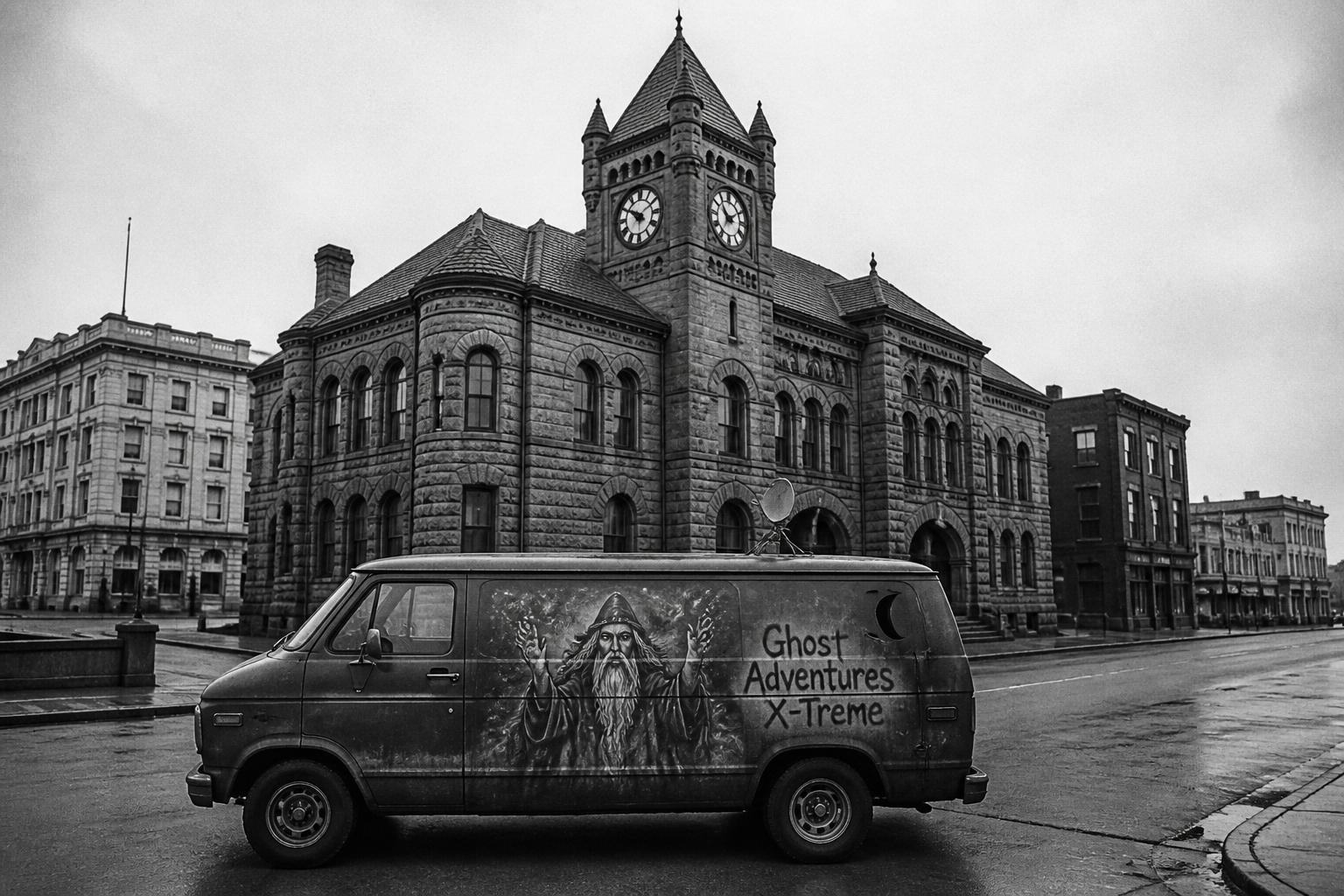
The Cole County Courthouse and Jail-Sheriff's House was completed in 1897, designed by Frank B. Miller in Romanesque Revival style. It’s a three-story stone structure with corner pavilions and a central clock tower, integrating judicial, detention, and residential functions into a single building—a rare triad for its time. It was listed on the National Register of Historic Places in 1973 and sits within the Missouri State Capitol Historic District at the corner of Monroe and East High Streets. We arrived in the late afternoon, just before sunset.
MAIN ROTUNDA, GROUND LEVEL
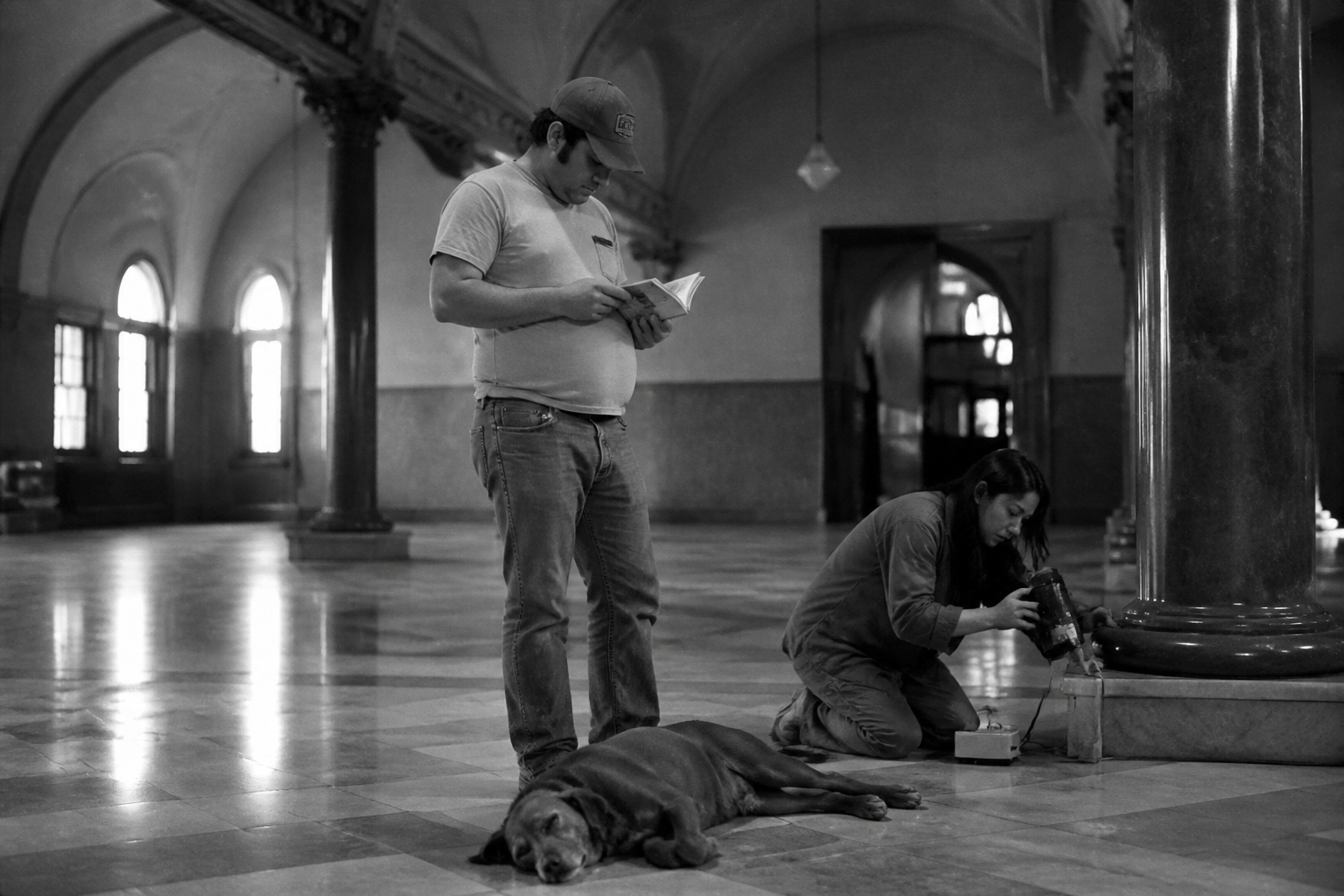
Mr. Davenport stood near the center of the marble floor, flipping pages in a worn paperback. I knelt with a handheld spectrometer near the base of a support column. Cletus lay on her side, belly against the cool tile, head resting on her front paws.
I calibrated the device, muttering values under my breath. Mr. Davenport scanned his book, occasionally glancing up at the vaulted ceiling. Cletus panted softly, ears twitching at distant footsteps from the upper floors.
JOE The book says some stone keeps a kind of echo. Like the stress pattern from the day they laid it.
JUPITER That’s crystalline lattice deformation. Piezoelectric potential under mechanical stress. And your book is from the eighties.
JOE Time-Life. The Mysteries of the Unknown library edition. It had a whole section on buildings and energy.
JUPITER Buildings are structures, Mr. Davenport. They have load-bearing schedules and thermal expansion coefficients.
A brief, localized shimmer of static electricity, akin to St. Elmo's fire, danced across the marble surface at my feet for about two seconds. Then it faded. There was no sound. Cletus lifted her head, sniffed the air once, and settled again.
JUPITER Did you see that?
JOE The floor?
JUPITER A localized static discharge. It just dissipated.
I insisted on rerunning the scan. Mr. Davenport closed his book and moved toward the east hallway.
JOE I want to check the building’s central mass. Clock tower.
I packed the spectrometer and followed, Cletus trotting beside. We passed what was once the sheriff’s office, then reached the second-floor landing at the base of the clock tower stairs.
CLOCK TOWER STAIRCASE, SECOND-FLOOR LANDING
Dusk filtered through high, narrow windows. The interior lights flickered once—a brief grid fluctuation. Mr. Davenport leaned against the wrought-iron railing, looking up the spiral. I stood two steps below, pulling up thermal imaging on my tablet. Cletus sat perfectly still on the landing, facing the dark stairwell, nose slightly raised.
JUPITER Thermal readings are normal. A slight differential on the north wall, consistent with sunset exposure.
JOE The tower’s the anchor. Frank B. Miller put the clock here for a reason. It’s the central mass.
JUPITER It’s a clock. It told the time so court sessions could start on schedule in 1918.
I reviewed the spectrometer logs from the rotunda. A low-frequency vibration hummed through the banister under Mr. Davenport’s hand. It was a deep, sub-audible thrum that traveled up my boots. It lasted five seconds and stopped. Cletus did not react to Mr. Davenport’s sudden shift in posture.
JOE You feel that?
JUPITER I’m logging it. Vibration. No matching mechanical cycle in modern systems.
My logs showed an anomalous energy spike that coincided exactly with the tremor. I called for a return to the rotunda via the main staircase, theorizing the vibration could propagate through the load-bearing masonry.
ROTUNDA FLOOR, GROUND LEVEL
Night had fallen. The overhead lights surged once, dimmed, and then the emergency lighting clicked on, casting long shadows. Mr. Davenport crouched, tracing invisible lines on the marble with a finger. I stood back, camera rolling, spectrometer active. Cletus lay flat, paws tucked, watching the center of the room.
I recorded spectral data. Mr. Davenport whispered notes into his phone. The building was otherwise silent.
JOE It’s stress in the stone. Like the pressure is written into the material.
JUPITER That is a description of piezoelectric stress patterns in sedimentary rock.
Outside, lightning flashed. A minor power dip followed. For exactly ninety-seven seconds, the marble floor exhibited a pronounced, visible pattern of subsurface microfractures and mineral inclusions. The pattern was complex and geometric, visible in the low emergency light due to a sudden, transient change in the stone's light-scattering properties. It did not flicker. It simply was.
Cletus finally stood—but slowly, without urgency—and watched.
JUPITER Recording. Full spatial manifestation of a subsurface pattern.
I kept the camera steady. Mr. Davenport fumbled for his phone to take a picture. On the ninety-seventh second, the pattern's visibility faded from the edges inward, until nothing remained. The overhead lights buzzed back to full power.
I demanded immediate instrument review. Mr. Davenport stared at the spot where the pattern had been. Cletus circled twice and lay down near the main entrance.
AFTERMATH
We left after documenting the site under normal lighting. No further anomalies occurred. Cletus did not look back.
I downloaded the raw sensor data. The micro-resonance patterns in the stone showed a harmonic echo temporally aligned with the 1896-1897 construction period. It was not noise. Mr. Davenport flipped through his Time-Life: Earth Energies volume, frustrated he couldn’t find the exact passage he half-remembered.
RESOLVED ITEMS
- The rhythmic vibrations in the clock tower correspond to thermal expansion in hidden steel dampers, not anomalous activity.
- The observed subsurface pattern aligned with 98.6% spatial accuracy to the known load-bearing architecture.
- Electrical ghosting or external projector fraud was ruled out due to total power isolation during the event.
UNRESOLVED ITEMS
- Why did the subsurface pattern become visible only during that specific power fluctuation?
- How does the marble's piezoelectric lattice respond to resonance patterns matching 1896-1897 stress baselines?
- What low-frequency stimulus caused Cletus’s prolonged, motionless focus at the tower base?
JOE'S CONCLUSION It wasn't a ghost. It was stress in the stone—pressure written into the material during construction. The pattern we saw was a physical property of the building itself.
JUPITER'S CONCLUSION The floor tiles exhibit measurable piezoelectric crystalline behavior under stress, and their lattice resonance aligns statistically with construction-era seismic and mechanical baselines. I don’t know the precise mechanism that made a subsurface fracture network temporarily visible. But it wasn't random. It was a physical phenomenon tied to the building's structural history.
Jupiter Meteor Nguyen — Field Log Excerpt Location: Cole County Courthouse and Jail-Sheriff's House, Jefferson City, MO Equipment: Spectrometer (v3), EMF/temporal variance array, thermal camera Hypothesis: Test for residual stress imprints in foundational materials. Observation: Detected transient visibility of a subsurface geometric pattern during a low-light phase following a minor grid surge. Pattern correlates to the building's load-bearing architecture with 98.6% spatial accuracy. Stone microstructure shows a persistent harmonic echo resonating within a frequency band corresponding to its 1896-1897 construction period. This is not sensor noise. It is not measurement error. It is a record of structural stress inherent to the masonry.