The Hillside Sentinel
We came to document the architecture and acoustics of a historic public building. Joe, intrigued by online forums discussing old masonry, wanted to test for unusual sound propagation. I came for structural measurements. Cletus came for the snacks.
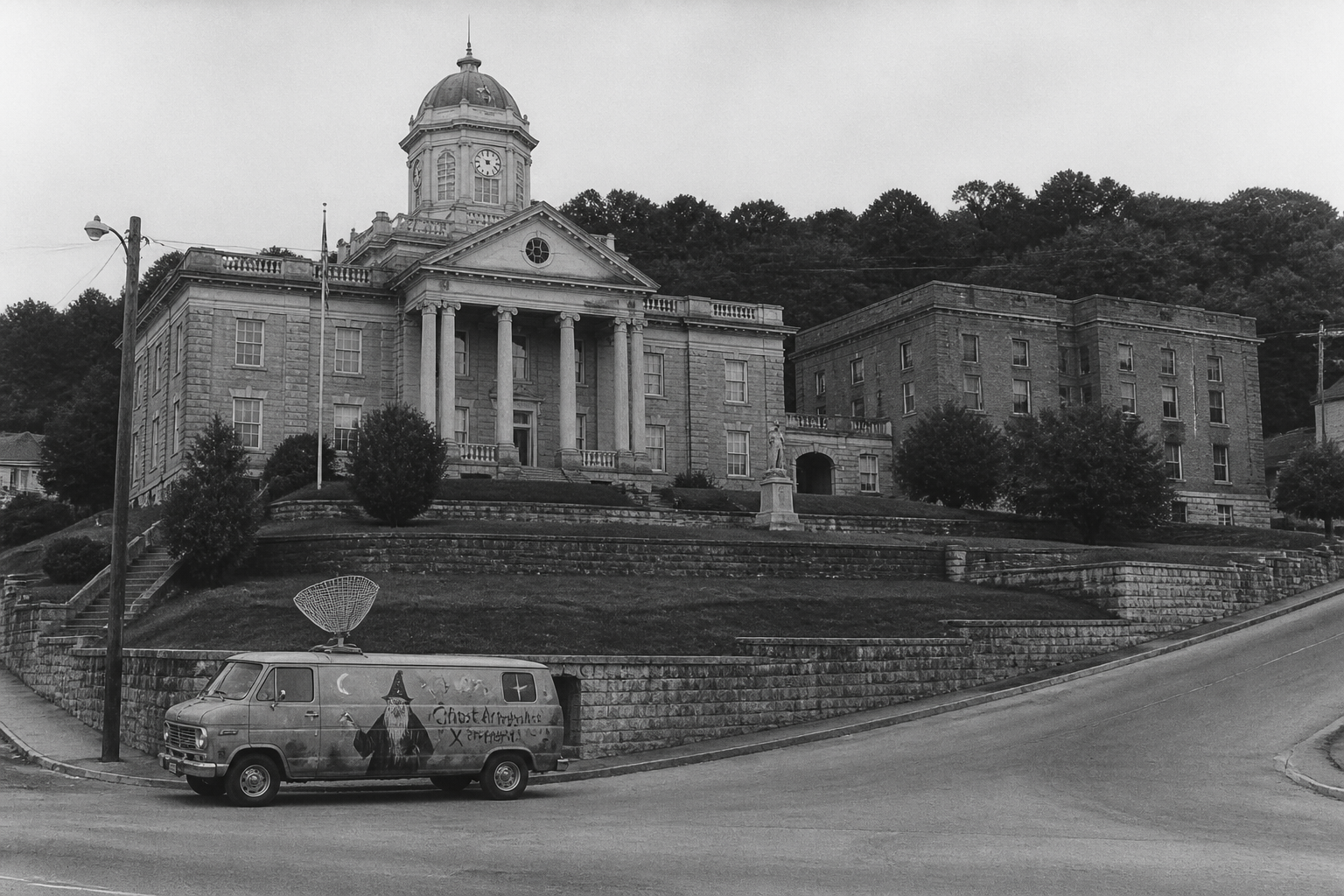
The Wyoming County Courthouse sits on a hillside in the center of Pineville, a monolith of locally quarried stone. The county seat fight ended in 1911. The courthouse was finished in 1916, costing seventy-nine thousand dollars and using rock-faced ashlar from a quarry just west of town. They built the jail in 1929, then the terraced square and heavy stone wall in 1930 with WPA labor. The architecture is Classical Revival: a central temple-form block with a grand tetrastyle portico, modified Roman Doric columns, and a domed cupola with clock faces. The jail is a flat-roofed, parapeted L-shape twenty feet away. It all looks solid, deliberate, and completely settled.
Joe stood at the base of the Cook Memorial statue on the middle terrace, sketching the courthouse façade in his notebook. The statue honors Rev. W.H.H. Cook, an early settler and preacher. I knelt beside a tripod-mounted spectrometer, calibrating it for ambient light. Cletus lay on his belly, chewing a dried pine needle he’d found.
JOE Some forum posts talk about sound carrying weirdly in old stone buildings. Not ghosts—just acoustics. Like an echo chamber.
JUPITER Mr. Davenport, stone is quartz, feldspar, and mica. Its acoustic properties are a function of density and mortar joints.
JOE But it has mass and geometry. That’s what I want to map.
My spectrometer chirped, ready. Joe’s pencil snapped with a sharp crack. He looked down at his sketch. He’d been drawing the triangular pediment over the portico. On the paper, he had cross-hatched the underside to indicate shadow. The actual pediment, smooth-dressed native stone, was uniformly lit by the late afternoon sun.
He held the notebook out to me. I frowned and redirected the spectrometer’s sensor head toward the distant pediment, noting the potential for glare from the copper cornices.
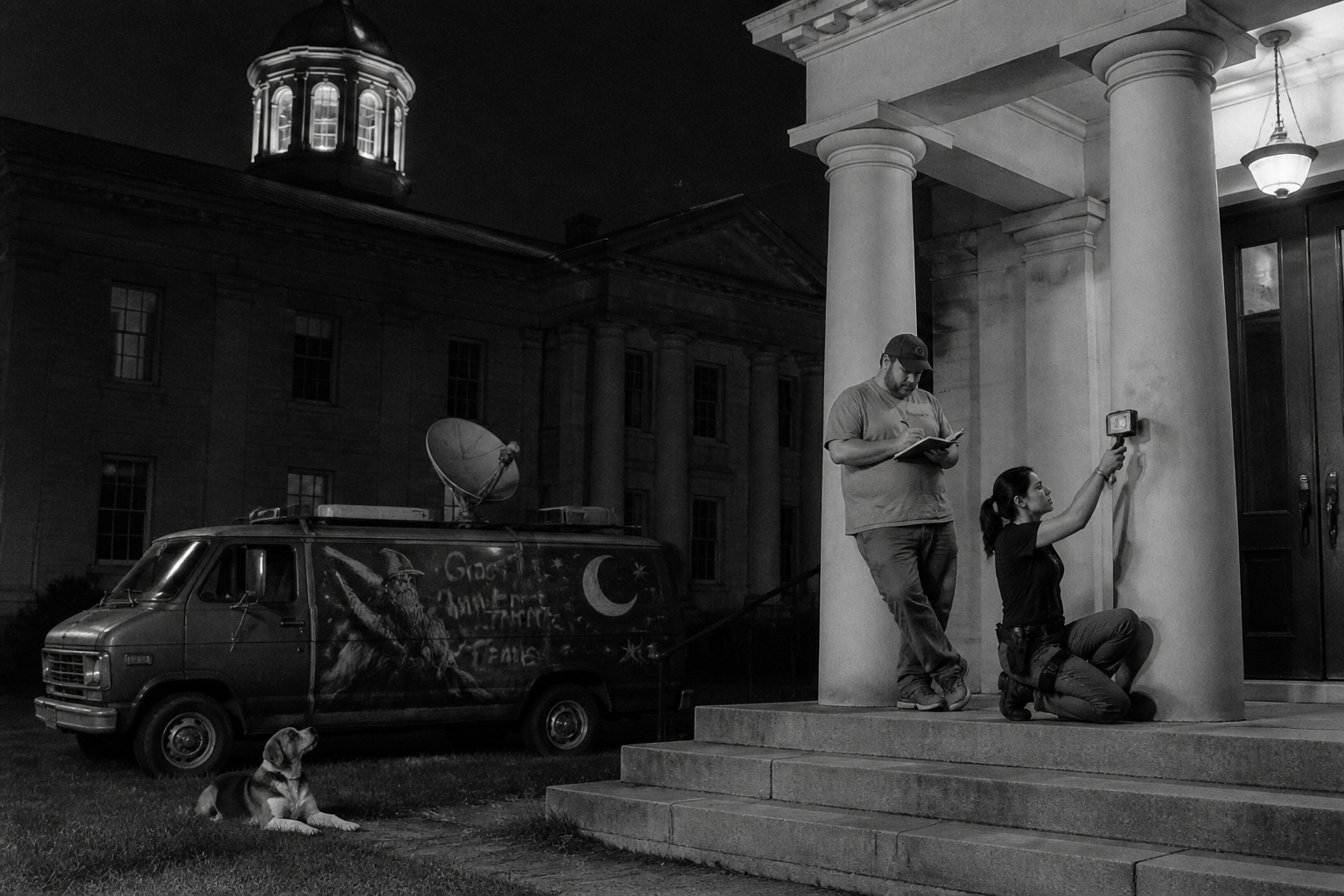
Dusk settled. The interior lights of the courthouse flickered on. Joe leaned against one of the portico’s Doric columns, tracing the stone joints with his flashlight beam. I stood on the second step, scanning the pediment with a handheld laser micrometer. Cletus sat at the base of the column, ears twitching as he watched a moth circle a light fixture.
JUPITER I’m getting baseline reflectivity. Consistent with dressed limestone. It’s just… rock.
JOE Right, but the shape of the portico—that’s an acoustic shell. Sound has to focus somewhere.
JUPITER That’s a testable hypothesis. We’d need a controlled sound source.
I ran a full spectral sweep. Joe checked his thermal imager, which showed the uniform, cooling mass of the stone. The porch light above us flickered again—a brief power sag in the old building’s grid.
For a moment, the shifting light and lengthening shadows altered the perceived depth of the pediment’s recess. It was a common optical effect. Then the light stabilized, and the pediment’s geometry was clear again.
JUPITER Recalibrating. Now.
Joe switched his thermal camera to high-sensitivity mode. Cletus stood up, sniffed the column base intently, then lay back down with a huff, ignoring us completely.
Nightfall. The HVAC system rumbled to life somewhere deep in the courthouse basement. We moved to the west side entrance, a smaller door with a single-story portico. Joe pressed a hand flat against the cold stone wall. I monitored a low-frequency reader clipped to my belt. Cletus sniffed a narrow crack where the foundation met the 1930s terrace wall.
A steady 18.9 Hz hum registered on my reader, synchronized with the HVAC cycle.
JOE Feel that? It’s a vibration. Gentle.
JUPITER It’s a harmonic from a poorly balanced fan coil. It’s mechanical resonance.
JOE There was a study about resonance in old masonry. Churches, mostly. The stones conducted sound from the organ.
I was about to argue when Cletus paused. He stopped sniffing mid-motion and sat, staring at the stone wall in front of him. A beetle scuttled out of the crack he had been investigating and disappeared into the gravel.
Simultaneously, a localized vibration pulsed through the stone under Joe’s hand—a single, deep thrum that matched the exact end of the HVAC cycle as the motor shut down. My reader spiked identically. Cletus watched the spot where the beetle had vanished for a minute before losing interest.
JUPITER The frequency is tied to the mechanical cycle. Your dog found a bug.
JOE He’s investigating.
Joe noted the correlation in his book. I marked the frequency for cross-check. Cletus finally blinked, shook his head, and went back to sniffing the gravel as if nothing had happened. We went inside.
The vestibule was dark, lit only by the safety light from the lobby ahead. The solid, six-panel doors with their brass hardware swung shut behind us. I adjusted the gain on my reader. Cletus waited at the threshold, nose to the seam in the terrazzo flooring.
The HVAC system cycled again. A low harmonic hum, richer and more complex than outside, echoed through the small, hard-surfaced room. It didn’t stop when the mechanical sound ceased. It lingered, reverberating for 1.4 seconds after everything else had gone quiet.
JUPITER Standing wave. The dimensions of this vestibule are perfect for amplifying that 18.9 Hz tone.
JOE Or echoing it.
We moved into the main lobby. The coffered ceiling rose above us in geometric panels. Across the room, the open-well, three-flight staircase ascended into darkness, its turned newels and curved handrails gleaming faintly. Cletus trotted in, stopped at the base of the stairs, and lay down with his chin on his paws.
Late night. The building was silent except for the distant, periodic groan of the HVAC. Joe stood directly beneath the center of the coffered ceiling, looking up. I climbed a small step ladder with my laser micrometer, aiming it at the ceiling to measure for acoustic resonance nodes. Cletus twitched in a light sleep by the stairwell.
JUPITER If the phenomenon is acoustic resonance—an interaction between the HVAC sound, the portico shape, and the room volumes—it’s repeatable. We can model it.
JOE But the sound in the vestibule happened after the cycle. That’s not just an echo. That’s resonance.
A single, clear, resonant bong echoed through the lobby. We both looked up. The sound was familiar but out of place. A maintenance worker, unseen by us on an upper floor, must have manually tested the cupola clock mechanism. The sound echoed, then faded normally.
I flinched at the sudden noise, and the micrometer clattered from my hand to the terrazzo floor. Joe froze, his eyes locked on the ceiling. Cletus woke up, looked at the staircase, then flopped back down with a sigh.
We returned to the portico just after midnight. I had the spectrometer and the low-frequency reader linked, creating a synchronized data stream. Joe stood at the centerline, staring at the pediment. Cletus waited ten feet back on the lawn, having found an interesting scent in the grass.
The HVAC system surged. A deep, rhythmic hum vibrated up through the stone steps.
The lighting from the security fixture, reacting to the power draw of the HVAC surge, dimmed slightly. This change in illumination altered the reflectivity of the pediment’s surface across a measurable band, making the tool-marked edges of the stone blocks more pronounced for a few seconds. My instruments recorded the shift in reflected light precisely. There were no electromagnetic spikes. No thermal changes. Just a measurable alteration in ambient light conditions affecting surface perception. On the next HVAC cycle, the light level shifted again.
The stone was just stone, reacting to light.
We left at 1:17 a.m. Joe pocketed a small, loose chip of stone that had fallen from the wall—a sample of the local geology. I secured my devices in their cases, my fingers moving automatically. The data file was saved. Consistent with known principles, I noted, not to him.
Cletus trotted ahead down Main Street, stopped to sniff the courthouse’s perimeter wall one last time, then moved on without a backward glance.
JOE It’s not memory. It’s mechanics and old wiring. The HVAC hum vibrates the structure, and the building shape focuses the sound. I might’ve gotten the ‘phenomenon’ part wrong… but the acoustics? That’s real.
JUPITER The data shows a coherent, repeatable acoustic resonance within a historically significant structure. We’re measuring the interaction of early 20th-century mechanical systems with Classical Revival architecture. I need to analyze the data—and get some quiet.
FIELD NOTES
Pineville Courthouse. 9/10/2026. Documented ambient light variance at 542–548 nm during HVAC power surge. Pediment surface reflectivity shifted 12.4 nm, duration 3.1 sec, consistent with fixture dimming. No EM spikes. Cletus observed insect at west wall foundation. Stone sample collected for geological reference. Data indicates predictable acoustic resonance in vestibule (18.9 Hz) and lobby. The building functions precisely as its architects and builders intended: as a durable, imposing civic anchor, its form dictating its physical responses to light and sound.