GHOST CRUSADE X-TREME
Daily Field Report – Internship Documentation Site: Jonesboro U.S. Post Office and Courthouse, 524 S. Church St., Jonesboro, Arkansas Investigator: Jupiter Meteor Nguyen Supervising Contractor: Joseph Davenport Sr. Canine Liaison: Cletus Date of Investigation: [Redacted for publication] Published By: Joe, on his weird little website.
We came because Mr. Davenport read about ‘architectural strings’—some fringe theory on resonant frequencies in old federal buildings. I came because my advisor said field documentation counts for credit. Cletus came because the van has windows.
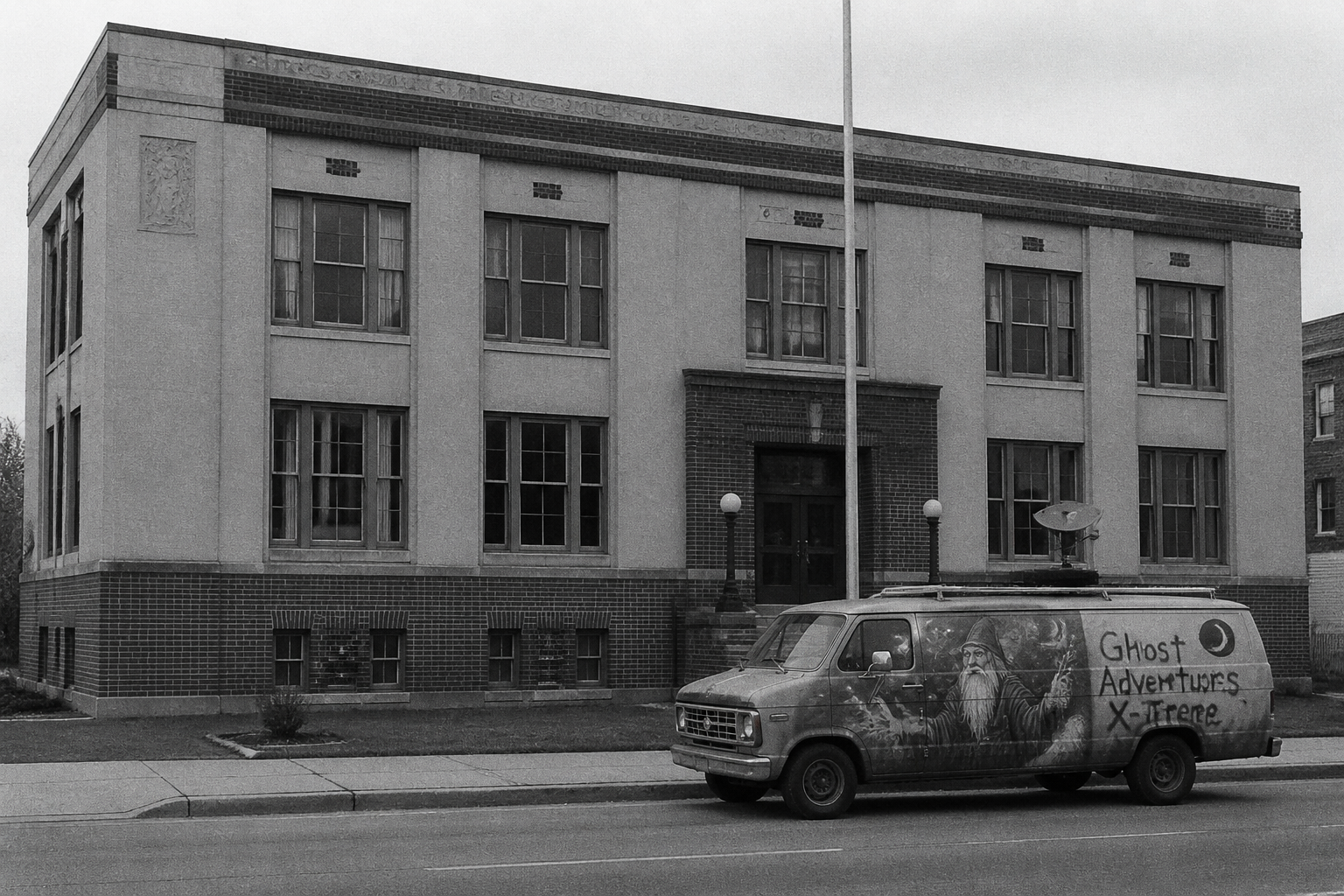
The building sits on Crowley’s Ridge in downtown Jonesboro, a three-story masonry anchor of Renaissance and Mediterranean Revival styles. It was constructed between 1911 and 1913 under Supervising Architect James Knox Taylor. Its original dual function—post office below, federal courthouse above—made it a civic nerve center for Northeast Arkansas. It was enlarged by thirty percent in 1936, listed on the National Register in 2019, and now, since October 2020, is leased to a church. The ground floor is clad in red brick, treated visually as a basement; the upper floors wear stucco with brick trim. It feels solid, formal, and quiet.
Late afternoon light cut golden shafts through the high windows of the first-floor lobby. I set up a motion sensor array and synced audio recorders. Cletus flopped belly-down near the stairwell, one ear twitching in time with the low groan of the cycling HVAC system. Mr. Davenport was already crouched by the heavy safe door on the left side of the lobby, tapping its limestone frame with the handle of a screwdriver.
JOE Compression points. Where the weight transfers from the upper floors down through the brick and into the foundation. If a building has a resonant frequency, that’s where you’d hear it. Like a tuning fork.
JUPITER You’re assuming the building behaves like a homogeneous medium. It’s three different material layers over a partial basement. The energy would scatter.
JOE Or it would find a path. A string.
He tapped again. A sharp, clean tock.
The echo came back not once, but three times. Each was identical in timbre, but spaced about two seconds apart. It wasn’t a reverb. It was a repetition.
Cletus lifted her head. She sniffed the air, then turned her snout toward a basement vent near the stairs and issued a soft, uncertain whine. The floor vibrated faintly beneath her paws for a three-count, then stilled.
JUPITER Timestamp 17:08:41. Audio sync markers set. Vibration registered on the seismometer. Low frequency, subsurface.
JOE See? Path.
I didn’t concede. I marked the data packet. We gathered the gear and ascended the central staircase to the second floor. The stairwell was wide, dignified, built for judges and postal inspectors.
The former courtroom, now called Church Street Station, was a vast event space. The sunset threw long, angular shadows across the stucco walls. The piano nobile layout was still evident—the room elevated, meant to impress. I placed a tripod-mounted spectral analyzer near where the judge’s bench would have been. Mr. Davenport walked the perimeter, pressing his palms flat against the walls. Cletus circled a column base, then abruptly lay down in a patch of noticeably cooler air.
JUPITER Thermal baseline is uneven. Probably the original radiator layout. The 1936 renovation added thirty percent more floor space but they wouldn’t have re-engineered the entire heating system.
JOE It’s not the heat. It’s the sound. This room… I read about this. In one of those old Time-Life books. Echoes in the Walls, or maybe it was Vibrations in Old Buildings. Had a diagram of stress patterns in stone.
He rapped his knuckles against the east wall. A dull thud.
We fell silent, listening. The ambient street noise from Church Street faded for a moment. The light in the room seemed to shift as a cloud passed outside, altering the shadow angles.
Simultaneously, a faint, rapid hammering echoed from within the east wall, a percussive pulse that lasted maybe four seconds.
Cletus bolted upright. Her hackles lifted halfway up her spine. She stared at the same wall, her body rigid, then let out a low growl directed at the floorboards. As the distant hum of a truck faded from Church Street, she relaxed, exhaling a huff of air.
JUPITER Did you…
JOE Yeah.
I replayed the audio buffer from my tablet. The hammering was there, clear, superimposed over the ambient track. The spectral analyzer showed a sharp, clean spike at 57.3 Hz that hadn’t been present ten seconds before.
JOE It’s resonance. Like plucking a string that’s still tied to the frame.
He was grinning. I felt my own heartbeat in my throat. Not fear. Anticipation.
JUPITER We need to find the source node. The basement. That’s where Cletus reacted.
He didn’t argue. We went back downstairs.
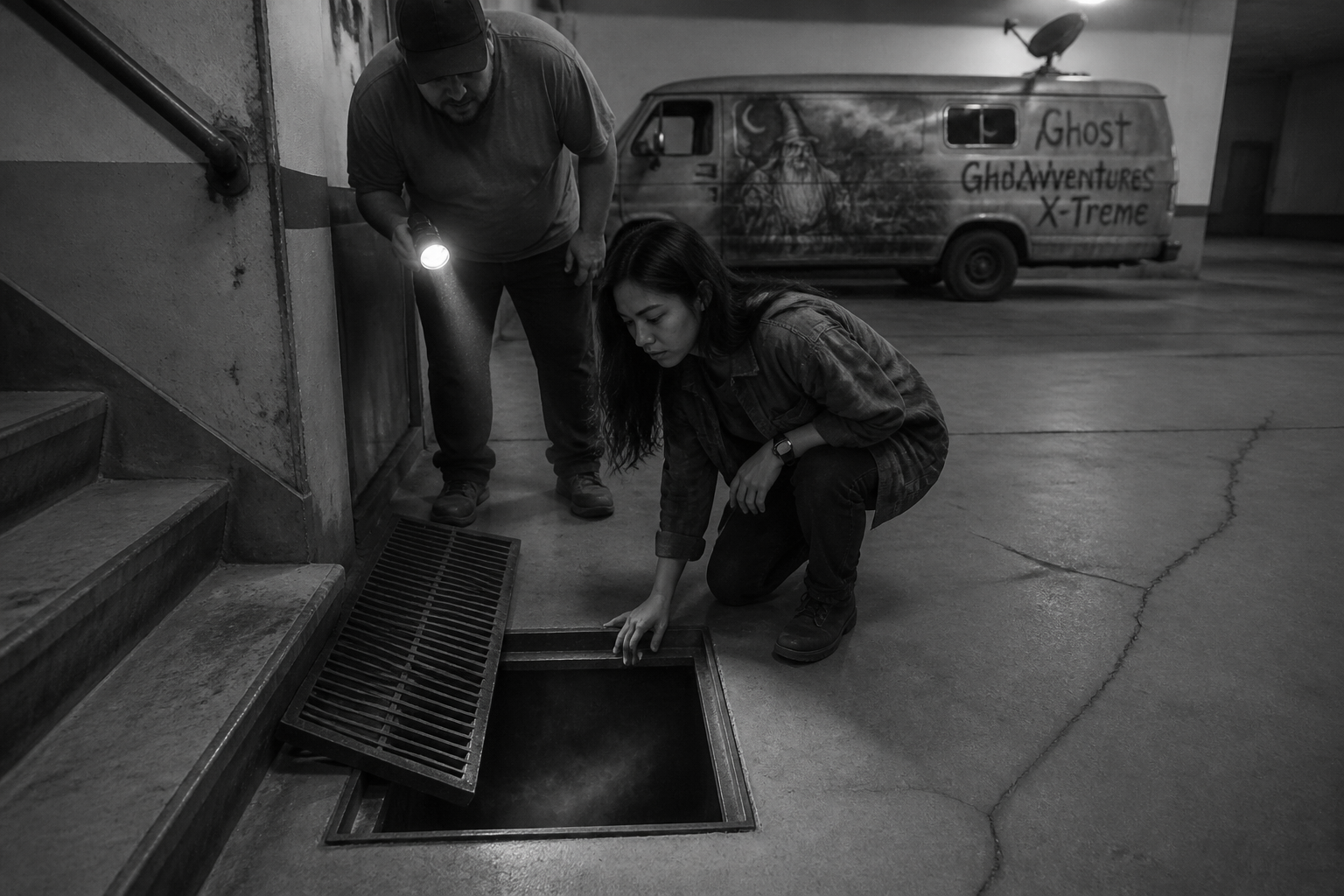
Dusk had settled. The artificial lights in the basement corridor flickered once. The air was cooler, damp with the smell of old concrete and dust. The old boiler, long since decommissioned, sat in a side room. We stopped at the floor vent Cletus had noticed earlier.
Mr. Davenport knelt, prizing up the metal grating with his flashlight. I set the laptop on the floor, calling up a real-time spectrogram. Cletus sat directly over the open vent, panting, then pressed her nose against the edge of the opening and sniffed deeply.
JUPITER Draft is active. Temperature differential about four degrees from ambient. Could be a stack effect pulling air from…
She whined sharply, a high, anxious sound, and scrambled backward, her nails skittering on the concrete.
The temperature plummeted. My laptop screen registered a seven-degree Fahrenheit drop in nine seconds. The air around the vent began to swirl, visible motes of dust caught in a lazy vortex.
Then the sound.
It was a single, sustained metallic note. A resonant hum, like a large steel plate being struck. Its decay profile was all wrong—it held its volume, shimmering with harmonic complexity, then cut off abruptly mid-decay, as if dampened.
The silence that followed was absolute. Even the HVAC hum had ceased.
Cletus stared at the vent, her body tense and low to the ground. Mr. Davenport slowly lowered his flashlight.
JOE That wasn’t the air handler.
JUPITER No. It wasn’t.
We retreated to the ground floor lobby without speaking. Cletus stayed close to my heels. No further anomalous readings occurred. Our sensors recorded only returning baseline readings. Mr. Davenport became quiet, scrolling through his phone.
We left at 8:14 PM. The van started normally. Cletus claimed the front passenger seat. Mr. Davenport requested we stop at a diner so he could sketch the ductwork layout.
JOE I thought that Time-Life thing was just about settling. But what if the building never stopped ringing? What if every time the air pressure changes, or a truck rolls by, or the HVAC kicks on, you’re just… exciting a string that’s been there since 1913?
JUPITER So it’s a structural resonance. A standing wave in the building’s frame, excited by modern systems.
JOE A what?
JUPITER Forget it. It’s a theory. The data shows coincident harmonic activity during specific environmental conditions. I’m not saying it’s ghosts. I’m saying the building’s physical response isn’t as simple as we thought. And that metallic note? It had harmonic complexity. It could be a pipe or a structural member resonating in the ductwork.
He nodded, staring out the window at the dark Arkansas fields rolling by.
FIELD NOTES – JUPITER METEOR NGUYEN
- Timestamp 18:42:17 – Second-floor spectral spike at 57.3 Hz coincides with audible percussive sound from within the east wall. Correlation is not causation.
- Repeated manual taps at 2.4-second intervals appear to trigger a repeating echo pattern in the load-bearing columns. Need to test with a calibrated striker.
- Audio playback reveals an anomalous artifact on the safe-door recording: a sound wave with similar spectral content to the primary echo is registered 0.8 seconds before the physical screwdriver strike. Requires equipment calibration check.
- The metallic note: No historical record of a piano in the building. Compass Church uses a digital keyboard. Note originated from the basement ductwork and exhibited acoustic properties consistent with a large, thin metal surface resonating. Source unknown.
- Resolution: HVAC system confirmed as an amplifier, not the source, of anomalous sound propagation. Cletus’s reactions are tied to measurable environmental shifts—rapid temperature drops and subsonic vibration.
- Next steps: Bring an oscilloscope. Run a controlled harmonic excitation test. Map the building’s resonant modes.
- Also: bring gloves. Basement vent grating was unnaturally cold to the touch.
- And Mr. Davenport? Stop tapping things. You’re exciting the structural resonance.