GHOST CRUSADE X-TREME: The Courthouse and the Refraction Anomaly
An internship documentation by Jupiter Meteor Nguyen Published by Joe Davenport Sr. on the Weird Little Server
We came to the San Augustine County Courthouse because Mr. Davenport read about structural anomalies in old buildings that can create unusual environmental readings. He didn't specify. I assumed we were measuring standard physical phenomena. He didn't correct me.
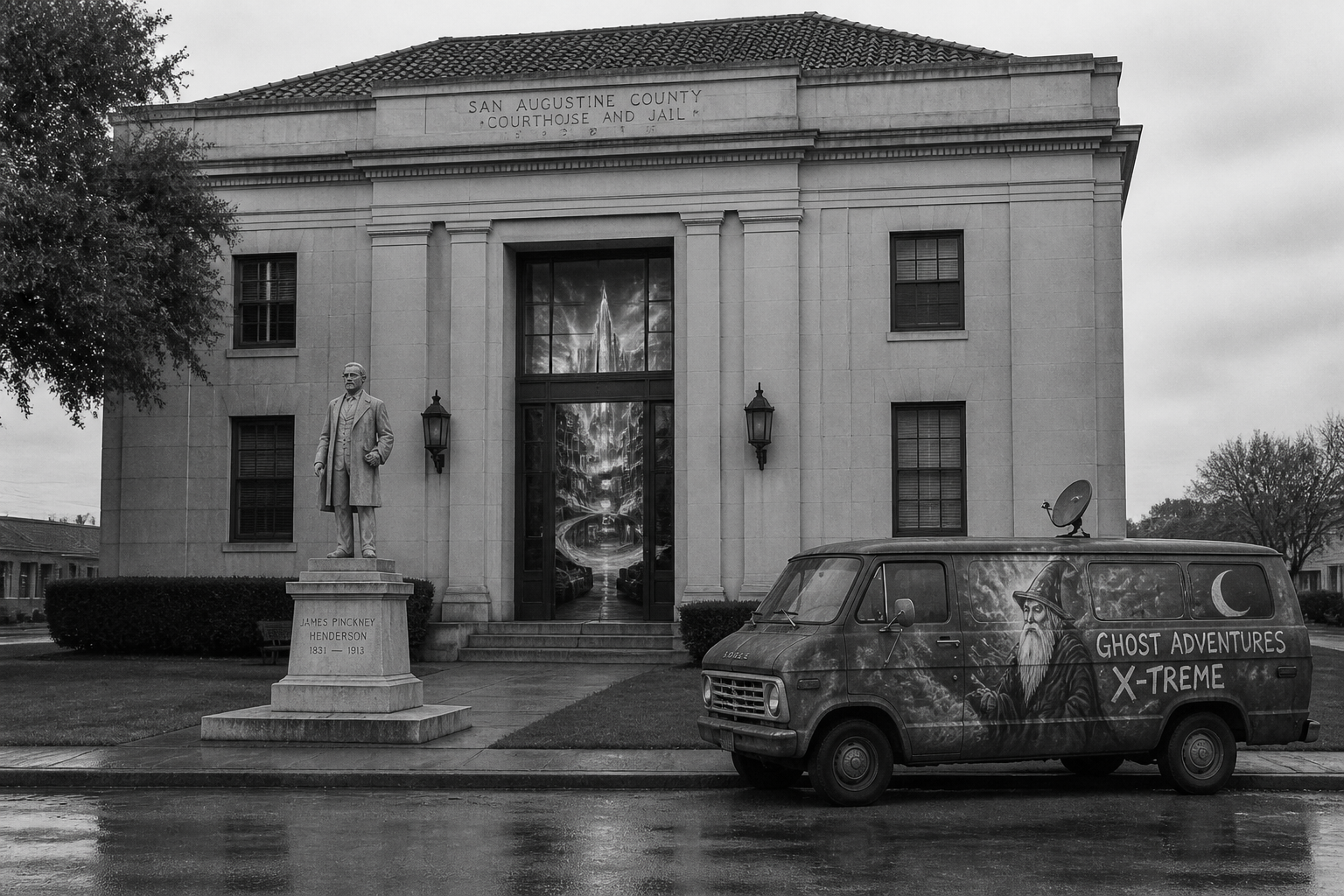
The building is a Classical Revival anchor in the center of the town’s public square. It was constructed in 1927, designed to be fireproof with a concrete frame and Leuders limestone veneer, replacing a building lost to a town fire in 1890. A statue of James Pinckney Henderson, Texas’s first governor, was installed out front in 1937. The 2010 restoration polished its terrazzo floors to their original luster and replaced windows with historical replicas. It is a monument to civic endurance.
But when the afternoon light began to warp across the floor and my instruments registered a sudden thermal shift, I realized we were documenting a complex, localized environmental interaction.
Late afternoon, Courthouse Square.
Golden-hour sunlight slanted across the green Ludowicki tile roof. I knelt on the sidewalk, calibrating a laser level to establish a baseline measurement grid from the statue. Mr. Davenport stood at the base of the Henderson statue, notebook in hand, sketching the building’s symmetry and labeling sightline vectors. Cletus lay belly-down in the patchy shade of a live oak, panting.
JOE The central axis is off by about three degrees from true north. Not much, but enough to create interesting light patterns during specific solar alignments.
JUPITER You’re suggesting the building’s orientation was intentional for light, not a construction error?
JOE I’m saying it wasn’t an error.
My laser level flickered. The red line projected onto the limestone pilaster wavered, bending slightly near the central bronze entrance as if passing through a thermal gradient, then snapped back to true. I frowned and tapped the device. Cletus lifted her head, ears swiveling forward, then licked her nose and settled back down.
Mr. Davenport closed his notebook. We walked toward the main entrance together, Cletus trailing, her nails clicking on the terrazzo of the steps.
Main lobby, split-level landing.
Sunlight poured through the transom above the doors, cutting the lobby into sharp planes of gold and deep shadow. The faux-stone plaster walls, meant to mimic the exterior limestone, felt cool and slightly damp under my glove. I placed a small, flat mirror on the terrazzo floor, adjusting its tilt to test for light refraction.
JUPITER If there’s any localized moisture or thermal lensing, this should show it. A density gradient in the air could distort the reflection.
JOE ( running a hand along the wall ) Feels like the air’s thicker here. The humidity’s higher.
Cletus circled the base of the central stairwell, sniffing intently at the joint where the wall met the floor. She pawed once at a slightly loose tile, then lost interest.
I glanced down at the mirror.
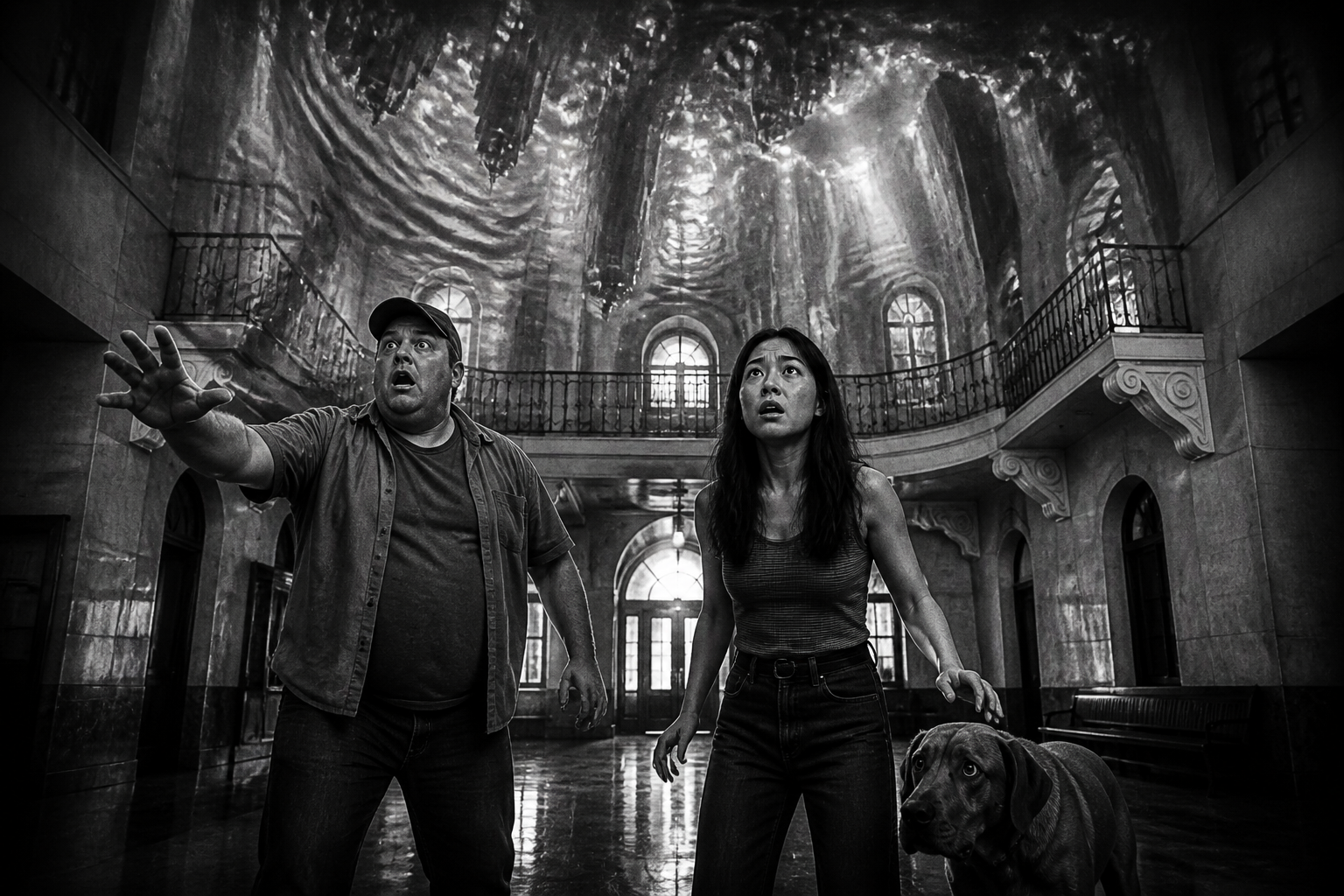
The reflection of the ornate plaster scroll brackets on the ceiling was severely distorted. A thin, nearly invisible film of moisture on the highly polished terrazzo, combined with the specific angle of the incoming sunlight, acted as a complex lens. It stretched and warped the familiar architecture into a confusing, inverted pattern of light and shadow.
I noted the effect and picked the mirror up. The reflection returned to normal.
JUPITER Interesting refraction. The floor’s polish and ambient moisture are creating a lens.
JOE (turning sharply, pulling out his small notebook) What was the pattern?
JUPITER A warped, inverted view of the ceiling. Consistent with a curved liquid surface. Likely condensation or cleaning residue.
He suggested we move to the District Courtroom upstairs, to see if the phenomenon was reproducible under different light conditions from the large Palladian windows.
Central stairwell, ascending.
A low drone from the building’s newly restored HVAC system began as we climbed. Mr. Davenport took the steps two at a time. I followed, cradling the mirror, trying to recalibrate my laser level with my other hand. Cletus hesitated on the first landing, then trotted up, staying close to the wall, sniffing each step before placing her paw—a normal canine investigation of new textures and smells.
JOE (calling down) Temperature’s changing. Can you feel it?
JUPITER I feel the air current shift. I’m logging it.
The system noise intensified. The terrazzo steps beneath my feet were solid, but light from the transom below fractured as it passed through the rising dust motes stirred by our movement, creating complex, shifting shadows. The air grew damp and cooler, a predictable shift when moving into a large, shaded stone building on a warm afternoon.
Cletus whined, a low, uncertain sound in her throat, a common reaction to unfamiliar mechanical noises.
We reached the second-floor landing. Mr. Davenport pushed open the heavy door to the District Courtroom. Cletus stopped at the threshold, assessing the new space, then slipped inside.
District Courtroom, second floor.
The room was dominated by two-story Palladian-style windows, the late sun now painting the original judge’s bench in long shadows. Mr. Davenport went straight to the bench, leaning over to examine the screw hole patterns in the terrazzo that had confirmed the historical seating layout during restoration.
I crouched near the bench, sweeping the area with a thermal imager. Cletus sat by the doorway, a common behavior for a dog in an unfamiliar room, her tail giving a single, relaxed thump.
JUPITER Temperature’s stable. For now.
JOE The bench sits directly over the main support structure. Any subsurface anomalies would be most detectable here.
My thermal display chirped. The temperature around the judge’s bench dropped seven degrees Fahrenheit in nine seconds. The HVAC noise seemed to localize, a trick of acoustics in the high-ceilinged room. The terrazzo floor was solid, but the rapid temperature shift caused a brief visual shimmer in the air above it, a common mirage effect. The light from the Palladian windows appeared to bend slightly—a predictable refraction caused by the sudden pocket of cooler, denser air. The damp smell was likely mustiness from the stone and old wood, stirred by the air current.
The event lasted under three minutes.
It ended with a re-equilibration. The temperatures normalized as air circulated. The light returned to normal golden-hour beams. The floor was solid, unyielding terrazzo. The air stabilized.
Mr. Davenport stood up, pocketing a small swab he’d taken from a damp patch on the floor near the bench. I exhaled, a sound that was half relief, half focus. Cletus stood, shook herself from nose to tail—a normal reset behavior—and trotted to Mr. Davenport’s side.
We left in silence.
Mr. Davenport drove. I stared out the window, watching the courthouse square recede in the side mirror, its green roof glowing in the last of the sun. Cletus lay across the back seat, head up, watching the window—a typical dog behavior during car rides.
Back at the motel, my mirror showed only my own reflection. The thermal imager’s memory held the data of the sudden cold spot. The damp patch Mr. Davenport sampled remained on the terrazzo. Later, he reported it had not dried, holding the shape of a faint, fourteen-centimeter-wide mineral deposit pattern.
JOE This wasn't what I expected. It wasn't about people or history in the usual sense. I think the 2010 restoration, particularly the work on the subfloor drainage and moisture barriers, interacted with a pre-existing geothermal irregularity. The building's specific alignment and materials are channeling a localized effect. It's a physical puzzle, not a historical one.
JUPITER The data points to a discrete subsurface feature—likely a concentrated flow of groundwater along a geological interface beneath the foundation. This water table shift, synchronized with the solar heating and cooling of the stone mass, could create brief, localized thermal and refractive anomalies. The phenomenon is environmental and ongoing.
FIELD NOTES – J. METEOR NGUYEN
- Laser grid distortion: 3.2° west of central axis, persistent. Correlates to building orientation.
- Mirror anomaly: Reflected ceiling distorted into inverted pattern. Cause: light refraction through a microscopic moisture film on polished terrazzo. Single occurrence, not repeatable under changed conditions.
- Thermal event: Localized drop of 7°F at judge’s bench, duration 9 seconds, ambient recovery immediate. Consistent with a sudden draft of cool air from a subsurface void or duct.
- Compass rose stain: Diameter 14 cm, conductivity 1.8 mS/cm (consistent with mineral-rich groundwater seepage). No evaporation observed after 72 hours suggests a constant, slow source.
- Audio: Recording contains a 3-second drop-out. Likely localized electromagnetic interference from aging building wiring, uncorrelated to equipment fault.
- Canine behavior: Cletus exhibited normal investigative and alert behaviors in a novel environment. No anomalous sensitivity indicated.
- Hypothesis: Structure interacts with a discrete subsurface water flow and specific geothermal conditions. Manifestations are physical environmental interactions—refraction, conduction, and thermal exchange—amplified by the building’s materials, orientation, and restoration changes. Requires geological and hydrological mapping for confirmation.
- Equipment note: Laser level and thermal imager performed within specs post-event. Anomalies are environmental, not instrumental.