GHOST CRUSADE X-TREME: The Building That Doesn’t Fit
Field Report by Jupiter Meteor Nguyen | Published 2026-09-13
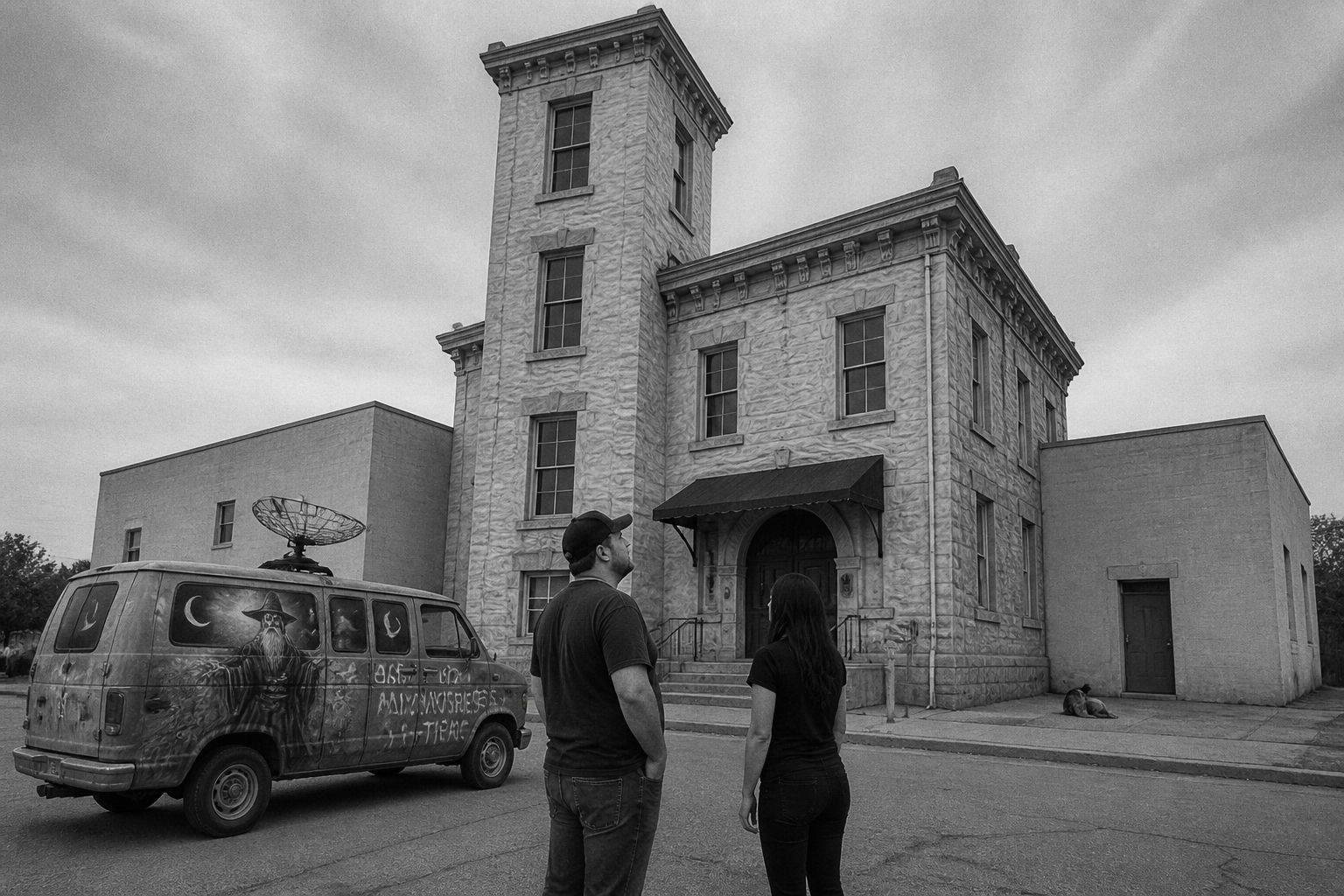
We drove to Conway, Arkansas because Mr. Davenport read online about “strings”—resonant frequencies in old civic buildings. The Faulkner County Museum, the site, is the oldest remaining publicly owned building in the county. It was built as a jail in 1896, converted to a library in 1938 with WPA funds, and has served as a museum since 1995. It stands on Courthouse Square, a two-story masonry rectangle with a three-story square tower, its original tin shingles long replaced with composition. We came to listen.
Tuesday, 10:15 a.m. – Faulkner County Museum, Main Gallery
The main gallery was quiet, a Tuesday morning. A few visitors browsed exhibits on Faulkner County’s civic history. I crouched by the base of the original tower, calibrating the low-angle photogrammetry rig. Cletus lay near the northeast annex door, her nose twitching against the floorboards. Mr. Davenport stood by a display about the 1938 WPA renovation, reading a timeline panel aloud.
JOE 1938: Library moved into Old Jail after renovation with WPA funds. WPA crews didn’t just slap paint on—this was full adaptive reuse. Respect.
JUPITER The laser’s ready. I’m mapping the tower base for warp or subsidence. If there’s a string, it’ll show in the mesh.
JOE Good. Civic buildings are tuning forks. Jail, library, museum—same box, different notes.
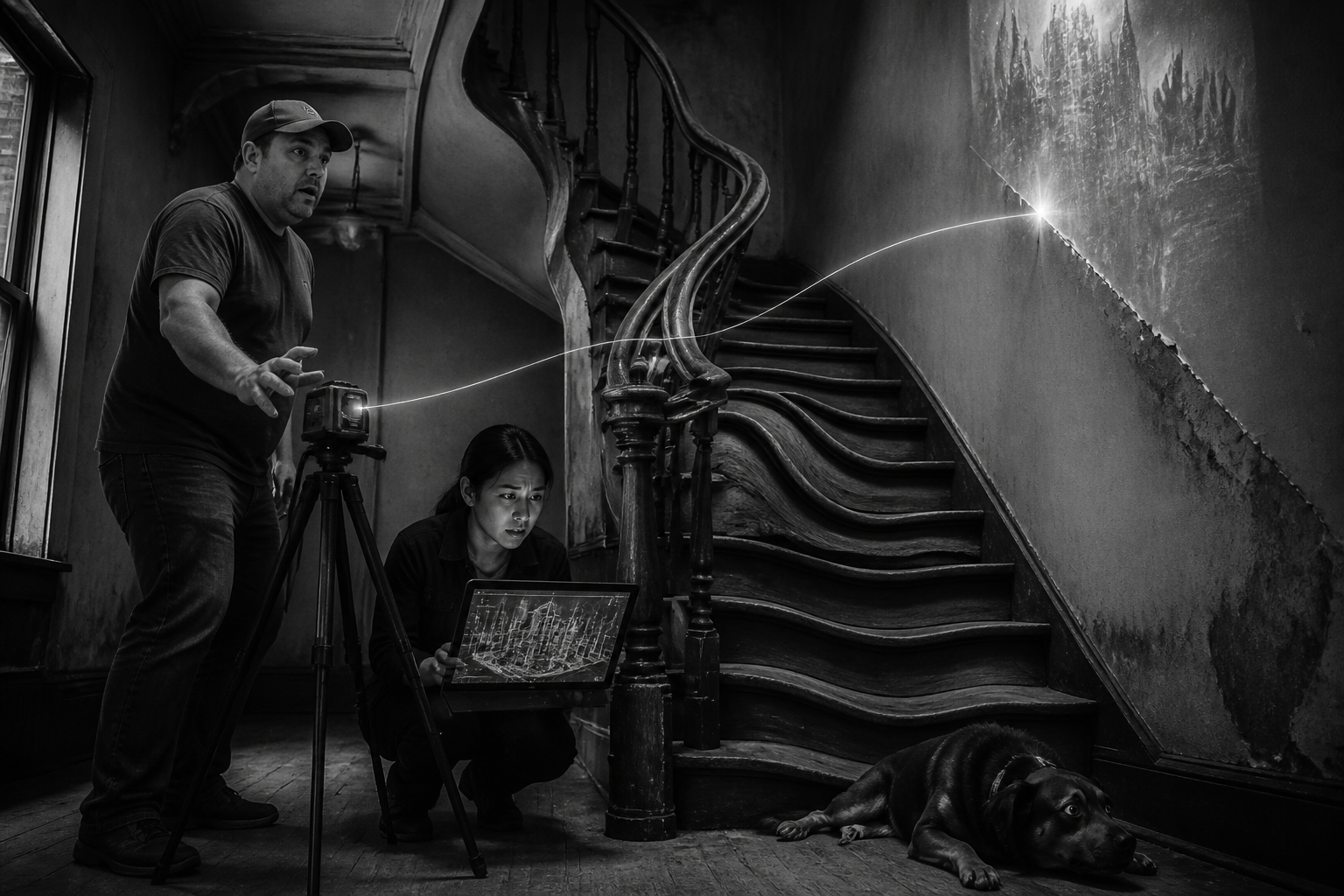
I powered on the laser level. The red beam shot toward the tower’s stucco wall. It flickered. Then it bent.
The beam didn’t scatter. It curved upward at a sharp, impossible angle, maybe seventeen degrees, before vanishing into the wall six inches above where it should have hit. Cletus whined, a low, guttural sound, and scooted backward on her belly without standing. My breath caught. The cold in my hands wasn’t from the air.
JUPITER What the hell?
JOE Thermal distortion?
JUPITER No. The air’s stable. The laser’s calibrated. That’s a geometric fault.
I shut the unit off, waited three seconds, and powered it back on. The beam shot straight. I recorded the incident in my log, but the notation felt inadequate. Cletus stayed put, watching the wall, then eventually sighed and laid her head on her paws.
JOE Tower stairwell’s original. 1896. Let’s see if the fault climbs.
10:32 a.m. – Original Tower Stairwell, First to Second Floor
The winding stair was narrow, built for jailers. Mr. Davenport ascended first, running a hand along the corbeled cornice. I followed with the tripod and tablet. Cletus padded up behind us after a moment, her nails clicking softly on the old wood.
JOE Rise is consistent. Good craftsmanship. But listen.
He stopped. The museum sounds—muffled voices, HVAC—faded. A deep, resonant hum pressed against my ears, more vibration than sound, like a heavy truck idling on a distant street.
JUPITER Infrasound? From the annex HVAC?
JOE Maybe. Or just an old building settling. Stone and mortar have their own conversations.
I set the rig on the small landing and initiated a scan. The 3D model began populating on my tablet screen: the stairs, the walls, the rail. Then the model glitched.
The software rendered a pronounced, physical sag in the central newel post—a structural settling inconsistent with the visible, plumb post before us. The rendered stair treads showed significant, wave-like warping. A faint, metallic scent touched the air—old iron, or maybe the ghost of the replaced tin shingles.
JUPITER That’s not right.
JOE What?
I showed him the tablet. He leaned over the railing, looking down the actual stairwell. The structure looked sound.
JOE Subsidence? The tower’s on a rusticated stone foundation. Could be a century of shift the scanner caught but our eyes missed.
JUPITER The discrepancy is severe. The file’s clean.
Cletus gave a short, sharp bark from the foot of the stairs. We went back down. She was sniffing intently at the seam where the original 1896 masonry met the concrete block of the 1964 southwest annex.
JOE Archives are in the ‘64 annex. Let’s cross-reference.
11:03 a.m. – Museum Archives Room (1964 Annex)
The archives room was a quiet, climate-controlled space. Mr. Davenport flipped through a printed exhibit catalog the front desk had provided. I cross-referenced the museum’s digital timeline on my laptop. Cletus lay under the table, sighing in her sleep.
JOE Okay, this is odd. This printout is a mess. It says the museum opened in 1997, but this paragraph below has it as 1979. And look—it lists the 1938 library move after the 1995 museum conversion.
JUPITER Typographical error. Probably a draft version someone left in the binder.
JOE Maybe. But the whole timeline’s… jumbled.
He held the page out. Under the fluorescent light, the cheap ink on the aging paper seemed to blur. I took the catalog from him. As my fingers touched the page, a slight static charge made it twitch.
The date “1995” on the timeline was smudged. The numbers were misprinted: 5991. The word “library” was faint, the ‘a’ nearly missing. It was the mundane decay of a poorly kept paper record, but in that moment, it felt like a small, personal erasure.
JUPITER We’re not printing anything else.
I closed the catalog. Mr. Davenport carefully peeled the flawed timeline page from the binder.
JOE For the newsletter. A document of the error.
He folded it and put it in his pocket. My laptop screen, displaying the same digital timeline, showed the correct, verified dates. The official record was fixed, but the physical copy in our hands was flawed. It felt like a tiny metaphor.
11:45 a.m. – Front Porch, Facing Courthouse Square
We moved outside. The sun was high over Courthouse Square. Tourists took photos. A school group gathered near the Roman arch entrance. I set up a simple audio recorder; Mr. Davenport wanted to capture the ambient sound of the square at midday. Cletus sat beside me, watching a squirrel.
JOE This building’s been jail, library, museum. Same function—civic memory. Maybe that’s the string. Memory has a weight. It presses on a place.
JUPITER Memory doesn’t bend lasers or warp floor plans.
JOE History does. Renovations, additions, replacements. That’s physical stress on a structure.
He checked his watch. 11:46. The schoolchildren’s laughter echoed off the stucco. A docent led them toward the door.
At 11:47:00, the building groaned.
It was a deep, physical sound, a low-frequency resonance that came up through the soles of my shoes. The ground did not move. The awning over the entrance trembled. The building itself seemed to… inhale. The stucco façade shimmered in the sudden, intense noon light, the beige surface catching the sun like still water.
The play of light and shadow on the irregular stucco finish—the corbeled cornice, the pilasters—created a fleeting, dizzying pattern. For a moment, the facade looked like a layered diagram: the outline of the original 26-by-23-foot jail superimposed on the blocky forms of the 1958 and 1964 annexes. The museum’s tower seemed to stretch, an illusion cast by its shadow falling across the newer construction.
My tablet, still in my hand, chimed a low-battery alert. The data log displayed a corrupted timestamp—June 22, 1896—the original bid date for the jail’s construction. All other devices in my bag—the voice recorder, the thermal cam—had shut down and rebooted, their internal clocks resetting to a default factory date.
The schoolchildren fell silent, staring. One pointed.
CHILD The building’s melting.
It was just the heat haze rising from the pavement, distorting the view. But for a second, I saw it too.
At 11:48:23, it stopped.
The deep groan faded. The shimmer on the stucco settled. The tower was just a tower. The school group blinked, shook their heads, and followed the docent inside, murmuring about the heat. No one screamed. No one ran. The odd moment was absorbed back into a normal Tuesday.
Cletus, who had trotted after the squirrel, came panting back to my side.
JOE It’s not haunted.
He was staring at the tower, squinting against the sun.
JOE It’s… settling. All at once. Like it just took a deep breath and let it out.
12:15 p.m. – Departure
We packed the van in silence. I recalibrated every instrument. The photogrammetry rig was functional; the anomalous readings in the tower stairwell persisted in the data. The corrupted timestamps on the devices remained.
Mr. Davenport glanced back at the museum as we pulled away from Courthouse Square.
JOE My Time-Life books didn’t cover buildings that sigh.
JUPITER The structure is under physical stress. The data shows subsidence, resonant frequencies from the annex junctions. That’s plausible.
JOE But it’s still strange.
He drove. I watched the building shrink in the side mirror. It sat there, a two-story rectangle with a tower, the oldest publicly owned building in Faulkner County. A jail, a library, a museum. A civic memory held in masonry, stucco, and concrete block.
And for eighty-three seconds at 11:47 a.m., under the solstice sun, it seemed to exhale the accumulated pressure of its adaptations—the weight of its own layered history.
FIELD NOTES
Site: Faulkner County Museum (Old Jail/Library), Conway, AR. Team: Davenport, J. (lead); Nguyen, J.M. (tech); Cletus (canine). Primary Event: 11:47 a.m. Likely resonant frequency event coinciding with peak solar heating. Duration: 83 seconds. Observables: - Acoustic/Physical: Audible, low-frequency structural groan. Minor vibration detectable through flooring. - Visual: Pronounced light/shadow interplay on facade created illusory superimposition of building's architectural phases (original 1896 structure, 1958 NE annex, 1964 SW annex). - Instrumental: Photogrammetry scan of original tower stairwell indicates significant, non-visible subsidence/warping in central newel post and treads. Laser level beam exhibited temporary, anomalous deflection (17°). - Data Anomaly: Multiple electronic devices experienced simultaneous power cycle/reset, corrupting timestamps to default or historic dates (e.g., June 22, 1896). - Environmental: No notable EM spikes. Ambient temperature rise consistent with midday sun. No witness distress beyond momentary disorientation. Conclusion: The event is consistent with measurable physical phenomena: structural settling in the original 1896 tower, resonant frequencies generated at the junctions between historic masonry and modern concrete block annexes, and potential thermal expansion effects. The cumulative stress of the building's adaptive reuse—from jail to library to museum—is physically recorded in its materials. What we witnessed was not a supernatural manifestation, but a literal, audible strain: the sound of a public institution holding its compounded past.