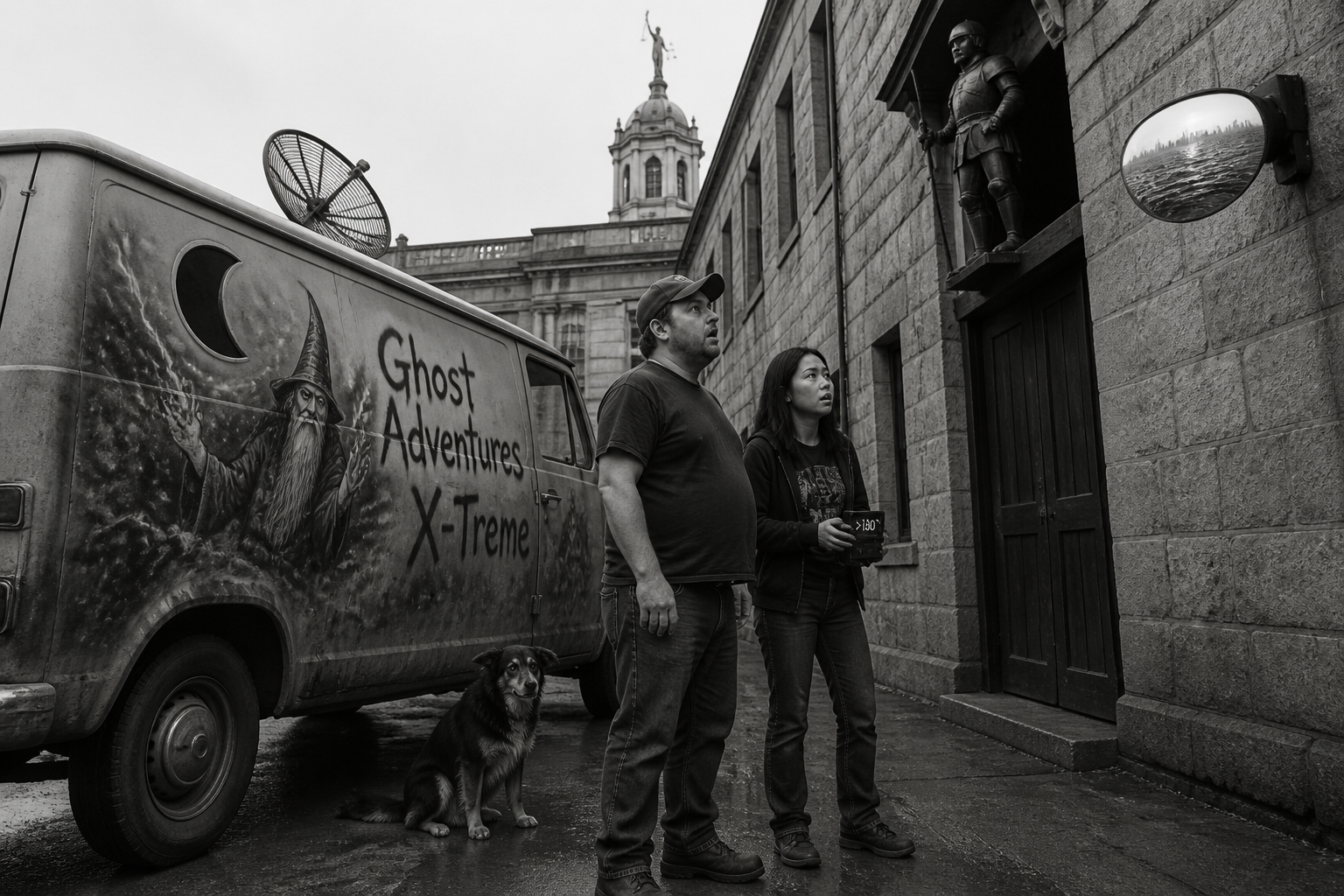
Ghost Crusade X-Treme Newsletter Site Documentation Log: Butte County Courthouse By Jupiter Meteor Nguyen, Internship Documentation Log #15
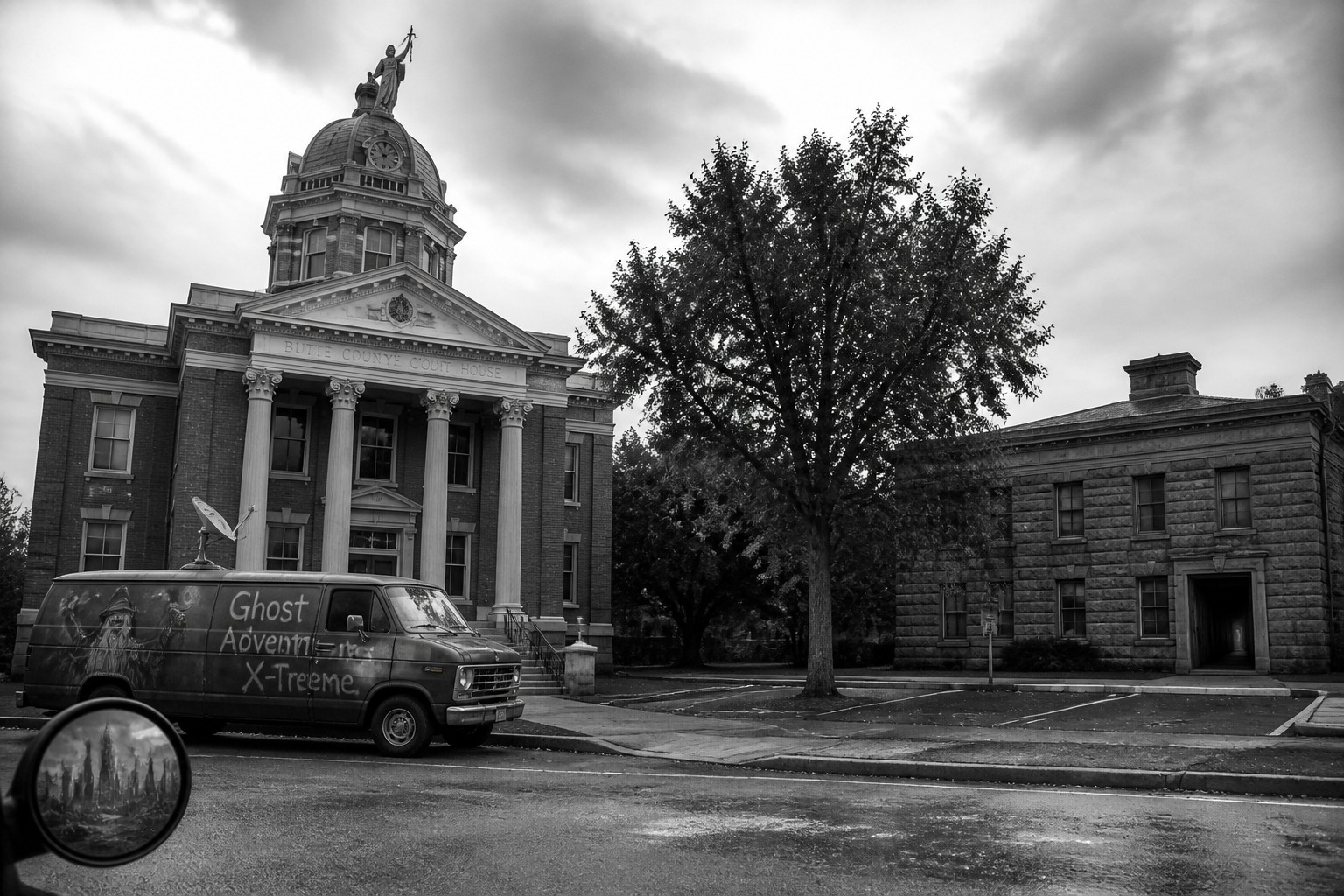
We drove to Belle Fourche, South Dakota because Mr. Davenport said he wanted to visit a historic courthouse with unusual architectural details. I agreed, as the site offered clear examples of early 20th-century construction techniques. The Butte County Courthouse, completed in 1911 and designed by C. A. Randall in a Beaux Arts style, was a physically substantial structure. Its native Hot Springs sandstone foundation and brick walls were built by Phillips & Bartlett, a testament to civic ambition in rural South Dakota.
Late afternoon light cast long shadows from the seven mature deciduous trees out front. I knelt near the foundation of the portico, calibrating my laser level against the sandstone quoins. Mr. Davenport stood at the base of the steps, consulting a printed site plan. Cletus snuffled around the base of one of the four ionic, non-fluted columns.
JOE Read about this place. Interesting craftsmanship. The stonework has character.
JUPITER The construction is standard for the period. I’m establishing baseline measurements.
I aimed the laser at the joint where the column met the portico’s wooden arch. The device emitted a consistent tone. The display read 90.1°. I recorded it and moved to the next point. Cletus paused, ears twitching forward, then resumed her investigation of a scent near the landscaping.
We moved inside as dusk approached. The central reception area was preserved from 1911: oak wainscoting, cherry flooring, and a four-lamp brass chandelier with Beaux Arts detailing hanging from the original metal ceiling. I stood beneath it, scanning for thermal gradients. Mr. Davenport examined the wainscoting. Cletus lay flat on the cool tile, panting softly.
A shadow from the chandelier lay on the east wall. As the sun’s angle changed, the shadow lengthened and its edges softened slightly, a normal effect of indirect, fading light. Cletus lifted her head, watching the change, then settled again.
JUPITER Temperature gradient is stable. No significant drafts in this section.
JOE The air feels still. Heavy.
I noted the observation but my instruments registered standard atmospheric pressure.
We took the stairs to the second floor. The original sheriff’s living quarters were down the east hall, long since out of use. The windows on this side had been sealed with brick during past renovations. Mr. Davenport walked ahead, flashlight beam bouncing. I followed, taking readings. Cletus lagged behind, sniffing along the carpet’s edge near one bricked-up portal.
JOE Feel that? A draft. From the sealed wall.
JUPITER It’s an old building with multiple additions. Air movement through interstitial spaces is plausible.
I aimed the laser down the hall. The beam, visible in the dusty air, held straight. A faint, transient reflection—perhaps from a piece of mica in the brick or a distant exterior light—glimmered within the masonry for an instant. Cletus sneezed, shook her head, and turned back toward the stairs.
JUPITER The structure is sound. No measurable deflection.
We decided to survey from a higher vantage point. The octagonal cupola, topped with its cast-concrete statue of Blindfolded Justice, was accessible by a narrow spiral staircase. Full twilight had fallen. Cletus refused to follow. She sat at the bottom of the stairs, whining softly. Mr. Davenport went first. I followed.
The metal staircase creaked underfoot, a normal acoustic for an old, enclosed structure. I aimed the laser up the central void. The display showed consistent vertical alignment. All readings were within expected parameters for a building of this age and material.
A low-frequency vibration, likely from distant traffic or a building system, resonated through the iron stairs for a moment. I looked up. Through the opening to the cupola, I saw the silhouette of the Justice statue against the darkening sky. Its position appeared unchanged. The vibration ceased. My laser level continued to function normally.
Mr. Davenport was quiet on the descent.
We regrouped in the parking area between the courthouse and the two-story jail built by stonemason John A. Scotney. The night was clear. I checked my devices. All data logs were intact and timestamps were correct. Mr. Davenport stared at the jail’s entrance. Cletus circled us, sniffing the air, then trotted to the van.
JOE Look.
Above the jail’s original entrance was a miniature knight, its origin unknown according to the records. It was stationary.
We watched for several minutes. Cletus sat down, her attention drifting to a moth near a security light.
JOE We should go.
JUPITER Agreed.
We got in the van. Cletus jumped into the back seat and lay down. I reviewed my data logs. Mr. Davenport was quiet for the first few miles. Then he spoke, his voice low.
JOE It’s a solid old building. Well-made. But you can feel the years in the stone. The history.
I didn’t reply. My instruments had recorded a series of standard environmental readings within a historic structure. They had measured nothing that contradicted known physical models. The building was exactly what it appeared to be: a century-old courthouse and jail. Any perceived anomalies were within the range of normal environmental stimuli and sensory interpretation. The data was inconclusive.
FIELD NOTES
Device Logs Nominal. All timestamps accurate. - Laser Level: All angle returns within expected tolerances for structural settlement. No persistent anomalies. - Thermal Imager: No significant thermal anomalies detected. Baseline temps stable. - Audio Recorder: Full log intact. Ambient building noises (creaks, distant HVAC) captured. - Canine Behavior: Cletus exhibited brief alertness to routine environmental sounds (distant dogs, wind in trees) and avoided the confined spiral staircase, consistent with her temperament. - Environmental: No abnormal EM readings. Low-frequency vibration detected once, source undetermined but consistent with urban background. - Summary: Data collected reflects a survey of a historic building undergoing normal diurnal temperature shifts and exhibiting minor, expected settlement. All recorded phenomena have plausible physical explanations. No definitive cause for subjective experiences reported by team member can be established from instrument data.