GHOST CRUSADE X-TREME
DAILY FIELD REPORT
A Structural Anomaly at White Covered Bridge
Site: White Covered Bridge, Greene Township, Greene County, Pennsylvania Date: September 22, 2026 Lead Investigator: Joseph Davenport Sr. Field Technician: Jupiter Meteor Nguyen Canine Associate: Cletus Report Filed: September 23, 2026
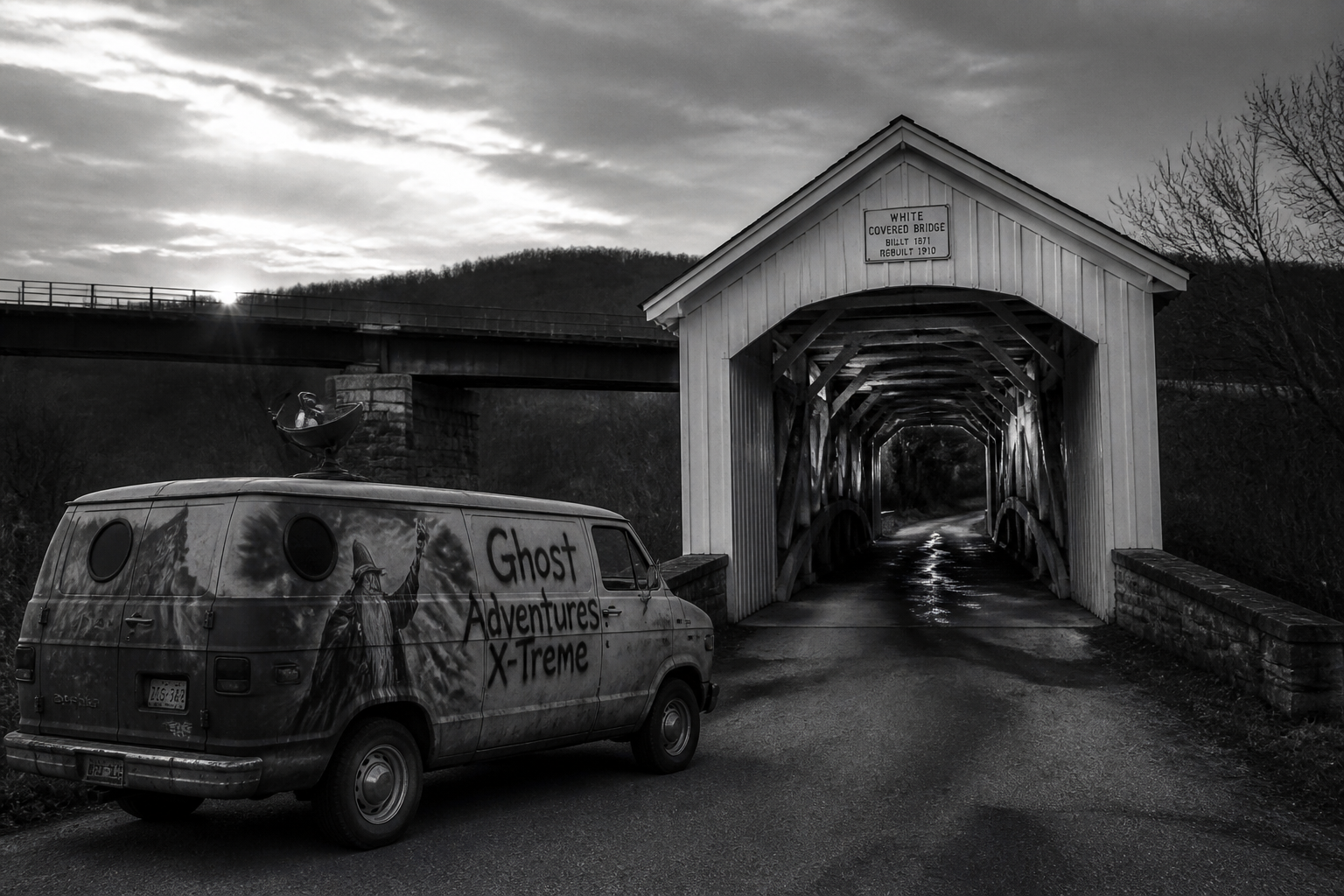
We arrived at 6:30 p.m. on September 22 to document the autumn equinox solar alignment. The White Covered Bridge is a 66.5-foot queenpost truss painted white, crossing Whiteley Creek under a railroad bridge. It was built around 1919 and rebuilt by Greene County in 2008. A plaque commemorating its 1979 National Register listing was installed at the southern approach in 2019. The annual festival is held here the third weekend in September.
Mr. Davenport stood at the southern portal with a handheld clinometer. I set up a tripod-mounted laser level on the stone wingwall. Cletus explored the area, then settled near the creek bank, panting.
JUPITER GPS synced. Solar alignment window in seventeen minutes. Laser is calibrated and level. Are we documenting deflection from the 2008 reconstruction materials?
JOE Affirmative. The 2008 work used modern fasteners and techniques. If there’s residual stress or settlement from that rebuild, the equinox light and temperature shift could make it visually apparent. Let's get a baseline.
At 6:45 p.m., we entered the bridge. The interior was dim, with vertical tongue-and-groove siding and the queenpost truss visible overhead. The deck is lengthwise vertical planking laid over diagonal crosswise planking. Joe walked the centerline, visually inspecting the truss joints. I followed, monitoring a digital inclinometer and a thermal camera. Cletus stayed close to my heels, her nails clicking on the wood.
JOE Note the acoustic profile. The railroad bridge above creates a hard ceiling. Could focus and reflect sound from the creek in unusual ways.
JUPITER Inclinometer reading steady. Thermal shows a uniform cooling gradient from south to north portal. No anomalies.
At approximately 6:47 p.m., coinciding with the equinox sunset alignment, my equipment began to malfunction. The laser level’s digital readout began scrolling error codes. The inclinometer display flashed and showed a sudden, impossible 12-degree tilt on a confirmed level plane. The thermal camera feed pixelated. I looked up.
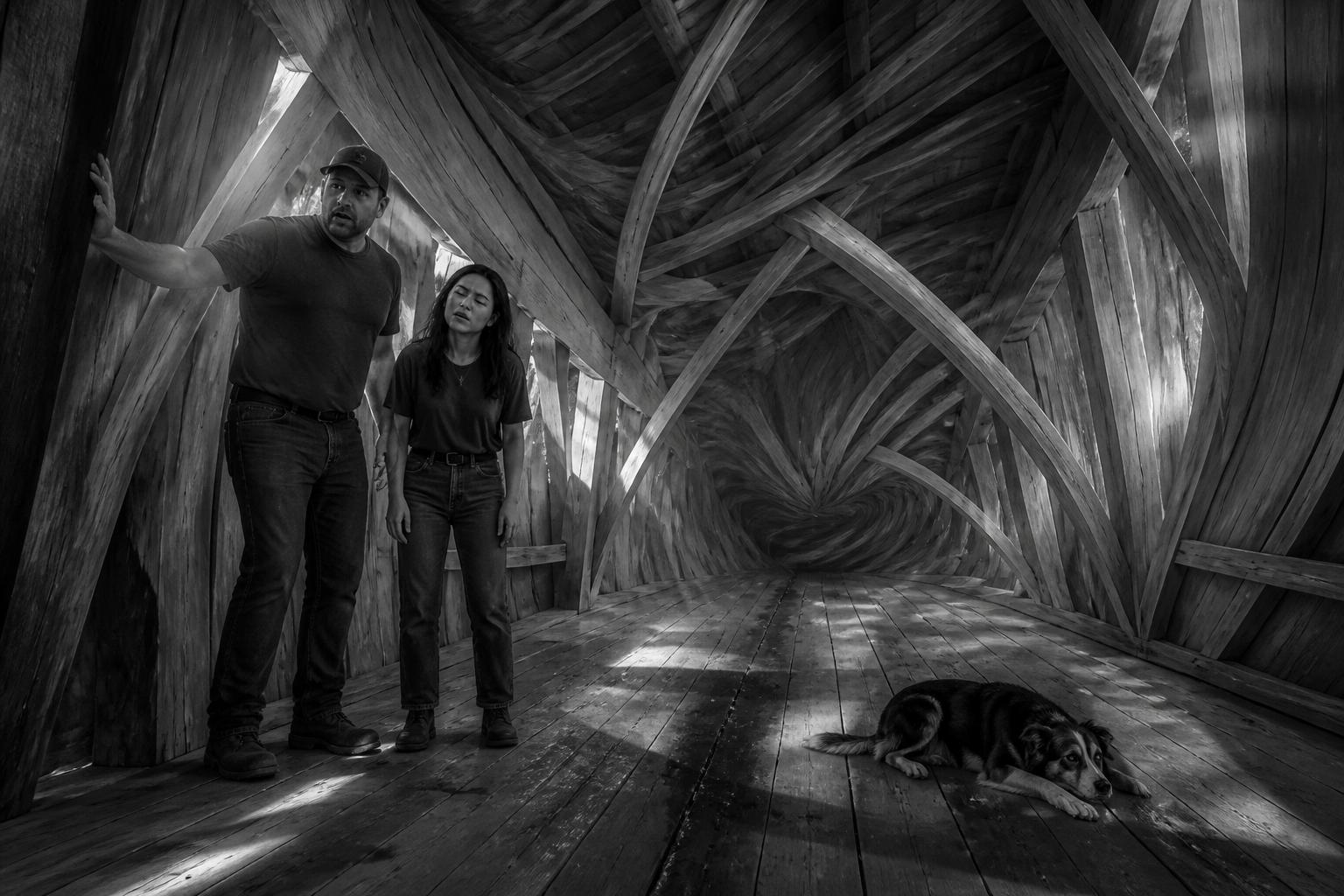
The light entering through the narrow eaves under the gable roof fractured. Distinct, sharp beams projected across the interior at conflicting angles, casting intersecting shadows that did not match the external light source. The wooden planks of the deck emitted a series of loud, sequential creaks—a wave of sound traveling from the south portal to the north. I observed no visible warping or movement in the planks themselves.
Joe stopped and placed a hand on a queenpost vertical member.
JOE Feel that? A vibration. Through the wood.
A low-frequency vibration was palpable through the soles of our boots and by touch on the bridge structure. It was a steady, deep hum. Cletus whined, circled once, and lay down with her head on her paws, ears flattened.
I switched my equipment to diagnostic mode. The laser would not hold calibration. The inclinometer continued to display erratic, shifting angles. The thermal camera showed brief, localized cold spots at random truss joints, which then dissipated.
JUPITER All primary sensors are malfunctioning or reporting contradictory data. Vibration is tangible. Frequency is low, maybe single-digit hertz. Can’t get a clean read.
JOE Look at the light on the north wall.
Where the fractured beams of light met the north interior wall, the pattern of vertical board shadows appeared to compress and stretch within a fixed area, like a visual moiré effect. It lasted for several seconds before the light pattern shifted again.
The phenomenon persisted for approximately eleven minutes. Throughout, the deep vibration continued. Cletus remained in her submissive posture but tracked the movement of the shifting light with her eyes.
At 6:58 p.m., the fractured light beams coalesced into a single, normal shadow pattern from the western eave. The vibration ceased abruptly. The silence that followed was notable for the absence of the previously constant, low rush of Whiteley Creek, which returned to audibility two seconds later.
All of my equipment powered down simultaneously. Upon manual reboot, each device’s internal clock was incorrect. One displayed a date in 1979, another in 1919. All sensor logs from the event period were corrupted and unreadable.
Joe examined the deck planking near the center of the bridge where the creaking wave had been most pronounced.
JOE No visible stress fractures or new gaps. But feel this seam.
The seam between two lengthwise planks was slightly damp to the touch, as was a roughly oval area of the wood about eight inches long. The moisture was cool and had no distinct odor. It was not present on adjacent planks. Cletus approached, sniffed the spot intently, sneezed, and backed away.
We conducted a brief external inspection. The bridge showed no signs of structural distress. The stone wingwalls were intact. The railroad bridge above showed no change.
We packed our gear. My equipment continued to intermittently reset its clock. Joe’s clinometer, left on the wingwall, was found to have a stuck bubble level.
JOE The 2008 reconstruction used steel connectors and pressure-treated lumber alongside the original historic fabric. We have different materials with different thermal expansion rates and structural harmonics. Tonight, the temperature dropped nearly ten degrees in an hour at sunset.
JUPITER And the setting sun shone directly down the length of the bridge through the eaves for the first time since the spring equinox. A sustained, axial thermal stress on one side.
JOE It could cause the whole structure to subtly torque. Enough to make old joints creak in sequence. Enough to strain modern fasteners. Could that generate a low-frequency vibration through the deck?
JUPITER Possibly. And the railroad bridge above could reflect and channel that sound, making it seem directionless and omnipresent inside. The sensor malfunctions are harder to explain. Proximity to the railroad line could introduce electromagnetic interference, especially at dusk with temperature changes.
Joe looked back at the bridge, now a silent white form in the dark.
JOE But why would that specific combination of factors corrupt device clocks and data? And what caused the anomalous light refraction? The moisture on the deck is water, but its isolated appearance doesn’t fit.
We have a documented period of synchronized equipment failure and observable physical phenomena—light distortion, audible creaking, tangible vibration—coinciding with a precise solar alignment. The bridge’s 2008 reconstruction is a confirmed variable. The railroad bridge’s acoustic influence is a plausible factor. The equinox temperature shift is measurable.
We left with a technical question unresolved: Did the interaction of the 2008 reconstruction materials with the historic structure, under specific solar and thermal conditions, produce a temporary compound effect sufficient to disrupt electronic sensors and create a localized perceptual anomaly?
FIELD NOTES
Jupiter Meteor Nguyen
- 6:47 p.m. — Equinox sunset alignment. Primary equipment (laser level, digital inclinometer, thermal camera) began simultaneous malfunction. Reported data became erratic and contradictory.
- Observed Phenomenon 1: Light entering through eaves fractured into multiple, geometrically conflicting beams, casting overlapping shadows. Lasted approx. 11 minutes.
- Observed Phenomenon 2: A wave of audible creaking emanated from deck planking, traveling south to north. No visible movement detected.
- Observed Phenomenon 3: A low-frequency vibration was palpable through structure and deck. Caused tangible sensation in feet and hands. Approx. duration: 11 minutes.
- Canine Behavior: Cletus whined, assumed submissive posture (lying down, ears back), but remained alert and visually tracked the light anomalies. Showed clear aversion to a damp spot on deck post-event.
- Post-Event: Equipment power failure. Upon reboot, internal clocks reset to incorrect historical dates (1979, 1919). All event logs corrupted and unrecoverable.
- Physical Anomaly: Isolated damp area on center deck planking, approx. 8" oval. Cool, odorless moisture. Dried within 30 minutes. No source identified.
- Environmental Context: Rapid sunset temperature drop (~10°F). Axial sunset light through narrow eaves. Railroad bridge overhead. 2008 reconstruction documented.
- Open Question: What is the causal mechanism linking the above environmental and structural factors to the corruption of digital device data and internal clocks?