Weird Little Server Field Report: Eleutherian Mills Date: September 18,5026 Primary Investigator: Jupiter Meteor Nguyen Documentation for: PHY 499 – Independent Study Internship Site: Eleutherian Mills, New Castle County, Delaware
The Flumes That Remember
We came to Eleutherian Mills to investigate a reported spatial anomaly within its water channel system. The site’s documented geometry—specifically its network of millraces and flumes—presented a compelling subject for structural analysis.
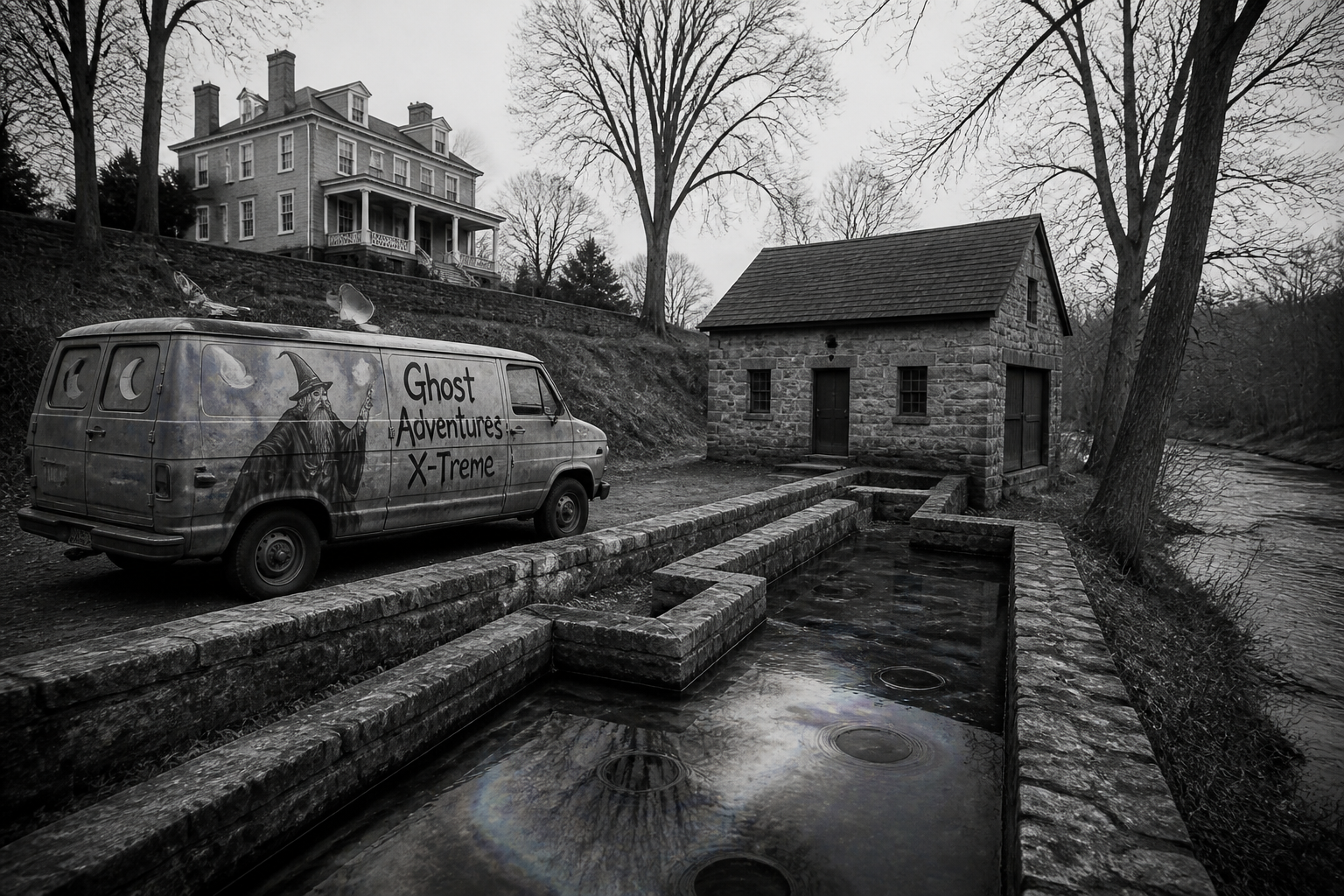
The main house was completed in 1803. It’s a two-and-a-half story Georgian structure of stuccoed stone, perched on a hill overlooking the Brandywine Creek. Its iron grillwork porch, moved from the front façade during renovations, faces the water. From there, you see the formal garden planted over the ruins of the original saltpetre refinery, and downstream, the preserved stone shells of twenty-one powder mills. Their design was pragmatic: three heavy stone walls to contain an explosion, a light fourth wall to vent the force harmlessly across the creek. Everything here was built to channel and control force—water via the millrace and flumes, blast via architecture.
Late morning light was high but cool, a breeze coming off the creek. Mr. Davenport leaned on the iron grillwork, peering downstream with a notebook. I stood near the doorway, calibrating a laser level. Cletus lay on the warm stone step, one ear flicking at a distant birdcall.
JOE Alignment’s the thing. They didn’t just dig a ditch. They built a channel system—dam, millrace, individual flumes to each mill. Water doesn’t just flow; it gets directed, focused. If you’ve got a resonant space…
JUPITER You think a two-century-old water channel is amplifying a spatial anomaly.
JOE I think they built with stone and water, and stone remembers strain. We’ve seen that. This is… water remembers flow. Paths get worn in. Not just dirt. In the shape of things.
He tapped his compass against the grillwork. The needle spun slowly clockwise, then settled. It didn’t point north. It pointed directly at the stable, converted now to a restroom facility.
JUPITER Your compass is off.
JOE It’s not. Check yours.
I pulled mine from my kit. Its needle also drifted, then locked onto the same bearing. Cletus lifted her head, whined once—a low, uncertain sound—then laid it back down with a sigh.
JUPITER Local magnetic anomaly. Iron in the stone, maybe. Or the old rail line.
JOE Maybe. Let’s walk the race.
We followed the path downstream from the house. The millrace was designed to feed the powder mills. Twenty-one of them once stood here, their heavy walls still lining the creek. The air smelled of damp stone and old leaves.
Mr. Davenport walked ahead, counting his strides between the openings of the dry flumes. I followed with a spectrum analyzer. Cletus trotted behind, then stopped abruptly at a bend where the stone channel turned ninety degrees.
JOE Seventeen paces. Next junction should be… there. But look at the angle.
I looked. The stone walls of the flume met in a clean right angle. But as I stared, the junction seemed to shift—the inside corner appearing simultaneously sharper and more obtuse, a lattice of perfect ninety-degree turns that somehow refused to close into a coherent shape. The water in the channel, a shallow trickle, flowed in unnervingly straight segments, refusing to curve with the bend.
JUPITER That’ use a perceptual artifact. Parallax and shadow.
JOE Measure it.
I aimed the laser level. The projected line hit the opposite wall cleanly. But when I walked to where it landed and looked back, the line was now hitting a point three feet to the left of where I stood. The geometry was not holding. Cletus backed away from the channel edge, her tail dropping low.
JUPITER Okay. That’s… not parallax.
JOE It’s like other structural anomalies we’ve logged. But fluid. It’s in the water path.
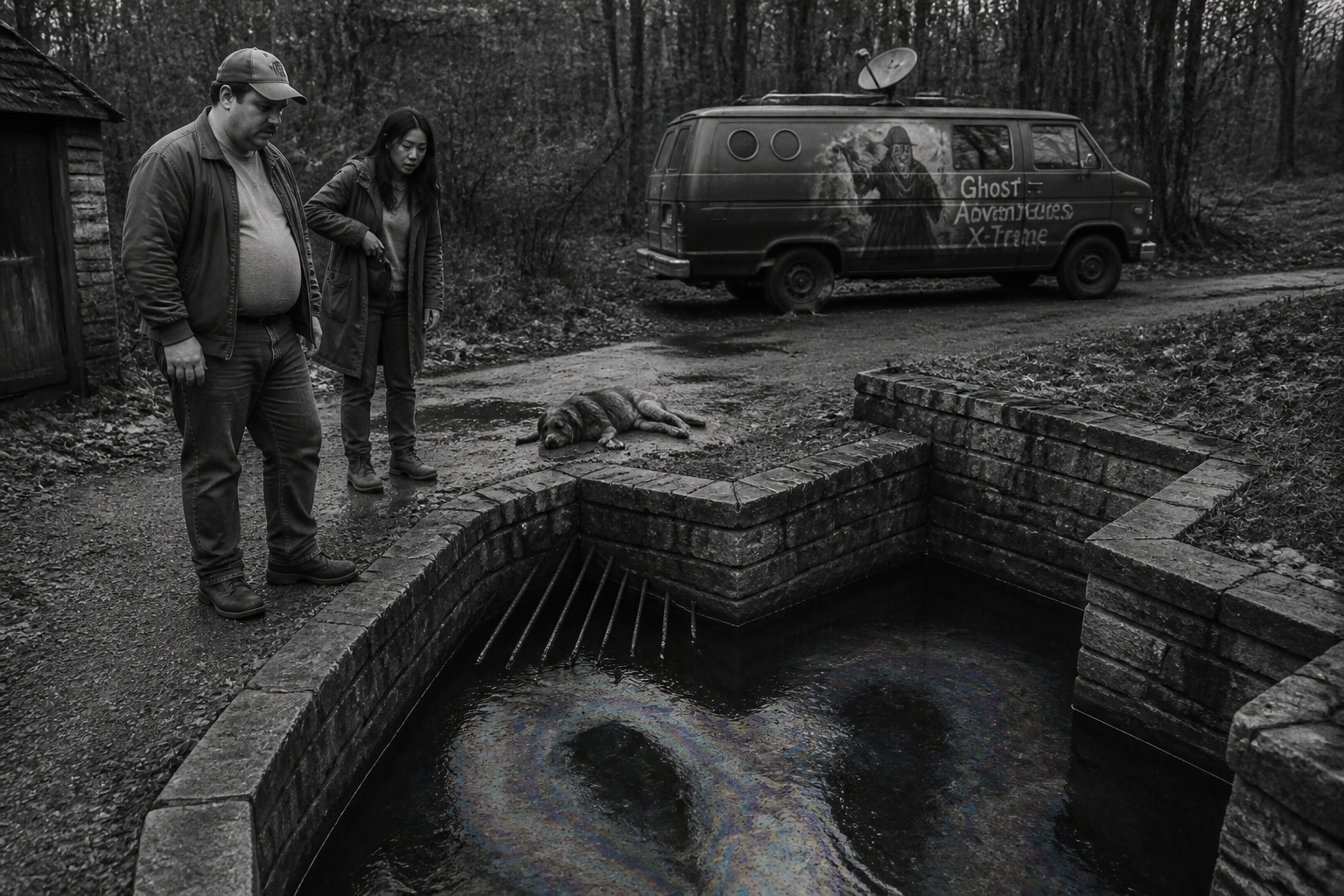
We moved further down, to where a culvert ran beneath the old stable. The air grew dimmer, the light choked by overhanging trees. A cast-iron grate covered a pool of stagnant water. Mr. Davenport knelt beside it.
JOE Original 1802 construction. For runoff.
JUPITER Thermal scan shows a major differential.
I held the imager up. The air temperature read 72°F. The surface of the water beneath the grate shimmered with an oil-slick iridescence and registered 34°F. Shadows moved just below the surface—not human shapes, but barrel-shaped, radially symmetric forms, drifting slowly in the still pool.
Cletus, who had lain down ten feet away, perked up. She stared at the water, then let out a sharp, distressed whine and scrabbled backward on the gravel path.
JOE Whoa.
JUPITER It’s a thermal inversion. But there’s no energy source. It’s… sustaining.
JOE It’s not a historical artifact. It’s like… a structural irregularity. Something that doesn’t conform to this geometry.
He looked genuinely disturbed, his usual certainty frayed. I set up a time-lapse camera facing the grate.
The last scene was inside the machine shop, a restored stone building. Late afternoon light slanted through high windows, illuminating wall-mounted shelves empty of tools. Mr. Davenport ran a hand over some recently reinstalled 19th-century stone tiles.
JUPITER Data logger’s picking up a sub-harmonic. Building from the flume network. Peaking at a low frequency.
JOE It’s synchronized. Not random.
Cletus, sniffing the base of the southeast wall, suddenly circled a small ventilation grille and urinated on the stones beside it.
Mr. Davenport walked to the window. Outside, in the gravel, faint geometric patterns seemed to be pressed into the ground—repeating, fractal shapes resembling frozen, impossible architecture. He placed his compass on the windowsill. The needle rotated counterclockwise, a full 360 degrees, for exactly seventeen seconds before freezing.
The harmonic on my readout spiked.
JOE It’s tonight. The equinox. Alignment.
JUPITER You think it’s celestial?
JOE I think something here is governed by alignment.
We returned to the main house as the sun dipped. I positioned myself outside on the porch, monitoring a frequency counter. Mr. Davenport stood inside at the base of the original 1803 winding staircase. Cletus did not follow us in. I saw her through the window, lying motionless on the gravel path near the stable, atop the frozen, iridescent ripple in the earth.
The moment the digital readout on my counter hit the exact astronomical marker for the equinox, three things happened simultaneously.
First, a low harmonic vibration emerged from the stone of the house itself, a subsonic thrum I felt in my teeth. The iron grillwork of the porch began to rotate, not breaking its masonry bonds, but turning smoothly through a full 360 degrees.
Second, downstream, the water in the millrace ceased flowing. It rose, against gravity, into a perfectly still, disk-like lens hovering a foot above the channel, reflecting not the darkening sky, but a stark, non-Euclidean lattice of black stone.
Third, every camera we had deployed—the time-lapse, my handheld, Mr. Davenport’s phone—captured a single, identical frame at that exact second. The image was a double exposure: the solid, Georgian lines of the main house superimposed perfectly over a vast, underlying structure of cyclopean masonry. The angles of the underlying structure did not match the house above; they intersected, penetrated, and ignored it. It was a glimpse of a foundation that was not its own.
Then, silence.
The grillwork stopped, back in its original orientation. The water disk collapsed with a sound like shattering glass, and the millrace resumed its gentle flow. The vibration ceased.
I went inside. Mr. Davenport was still at the staircase, his face pale.
JUPITER The cameras…
JOE I saw it. In the window reflection. Just for a second.
He walked past me, out of the house and down the path toward the machine shop. I followed. He went directly to the vent Cletus had marked, stood before it for a long moment, then turned away.
JUPITER What is it?
He didn’t elaborate. We gathered the equipment. My stone tablet—a data-logging slate I’d placed at the base of a flume—was gone. Not stolen. Just absent, as if it had never occupied that space. All my device timestamps were corrupted, many reset to dates in the early 1800s.
Cletus still lay on the gravel. She did not respond when called. We left the site without speaking, loading the van. Ten minutes down the road, I saw her in the side mirror, trotting steadily behind us. I stopped. She jumped in without a sound and curled up on her seat.
Mr. Davenport didn’t say a word all the way back to the motel.
This isn’t a historical haunting. It’ s a persistent structural field—masonry and water retaining and re-emitting deep, coherent stress patterns across time. The boundary between past and present isn’t linear here; it’s geometric. The flumes don’t just channel water. They preserve a shape, and that shape is now detectable.
FIELD NOTES – J. Nguyen - Site: Eleutherian Mills/Hagley Yard, DE. - Anomaly: Non-Euclidean lattice formation in flume geometry, synchronized with equinox alignment. - Physical Manifestations: 360° rotation of fixed iron grillwork; hydro-static disk formation in millrace; thermal inversion pool (ΔT ~38°F) with subsurface radial shadows. - Data Corruption: Multiple device timestamps reset to 1810-1833 range. One deployed data tablet unrecoverable (non-local displacement). - Harmonic Signature: Sustained low-frequency subsonic pulse, peak at celestial event. - Hypothesis: Site architecture (channeled water, blast-vent design) acts as a resonant interface with a deeper geometric substrate. Manifestation is coherent and physical. - Recommendation: No further physical probes. The phenomenon is structural. - Personal Note: Mr. Davenport is shaken. The data did not conform to expected models. Cletus remains offline.