Monroe Township Hall-Opera House Site Visit
Date: 2026-09-21
Site: Monroe Township Hall-Opera House, Johnstown, Ohio
Observer: Jupiter Meteor Nguyen
Log: Entry 14
We arrived to conduct an equinox check. We left with a question we didn’t know how to ask.
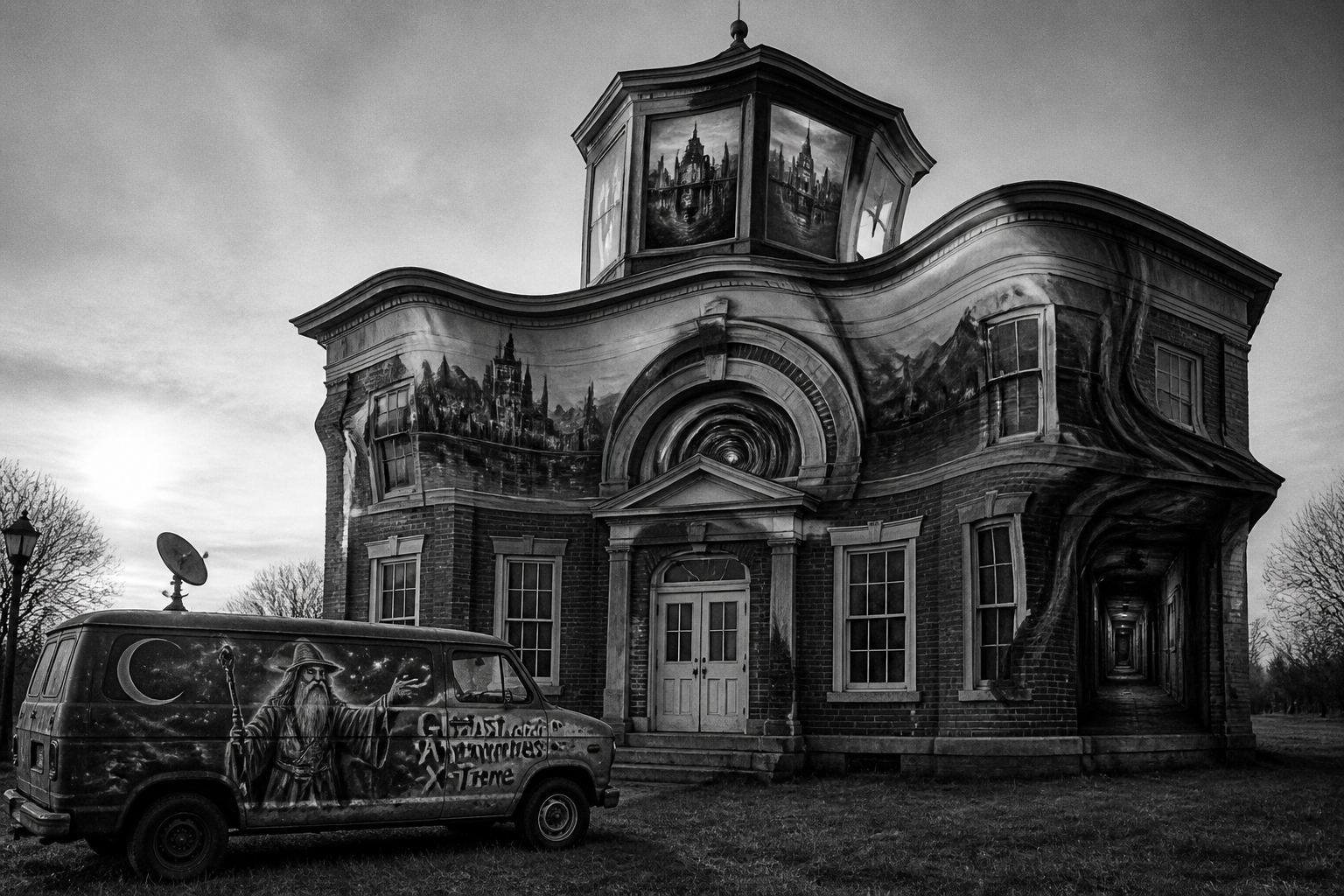
The Monroe Township Hall-Opera House was dedicated to the village on January 1, 1885, a civic building meant to stand forever. It is a two-story brick structure with an ornamental cupola restored in 2010. The second floor is a 325-seat opera house, one of over fifty that once dotted Ohio. Only five remain. The original backdrops, including a Swiss Alps mural, were painted by Armbruster and Son in 1885. They are still in use.
The building was conceived as the civic center of Johnstown. Today, it houses the Johnstown Historical Society and hosts community events. Its history is documented, its restoration celebrated. We came to see if the equinox brought any measurable change to a place so settled in its purpose.
JUPITER Baseline readings are normal. The air is still. No draft from the front doors.
JOE It’s the cupola. The bell. Thirteen-hundred pounds. They used it for funerals. For the end of the war.
He stood near a glass case displaying 1885 opera programs. Cletus lay on the cool tile near the entrance. Then I felt it—a low hum, more vibration than sound, felt in the floorboards.
The air in the main hall grew noticeably colder as we climbed the central staircase to the opera house.
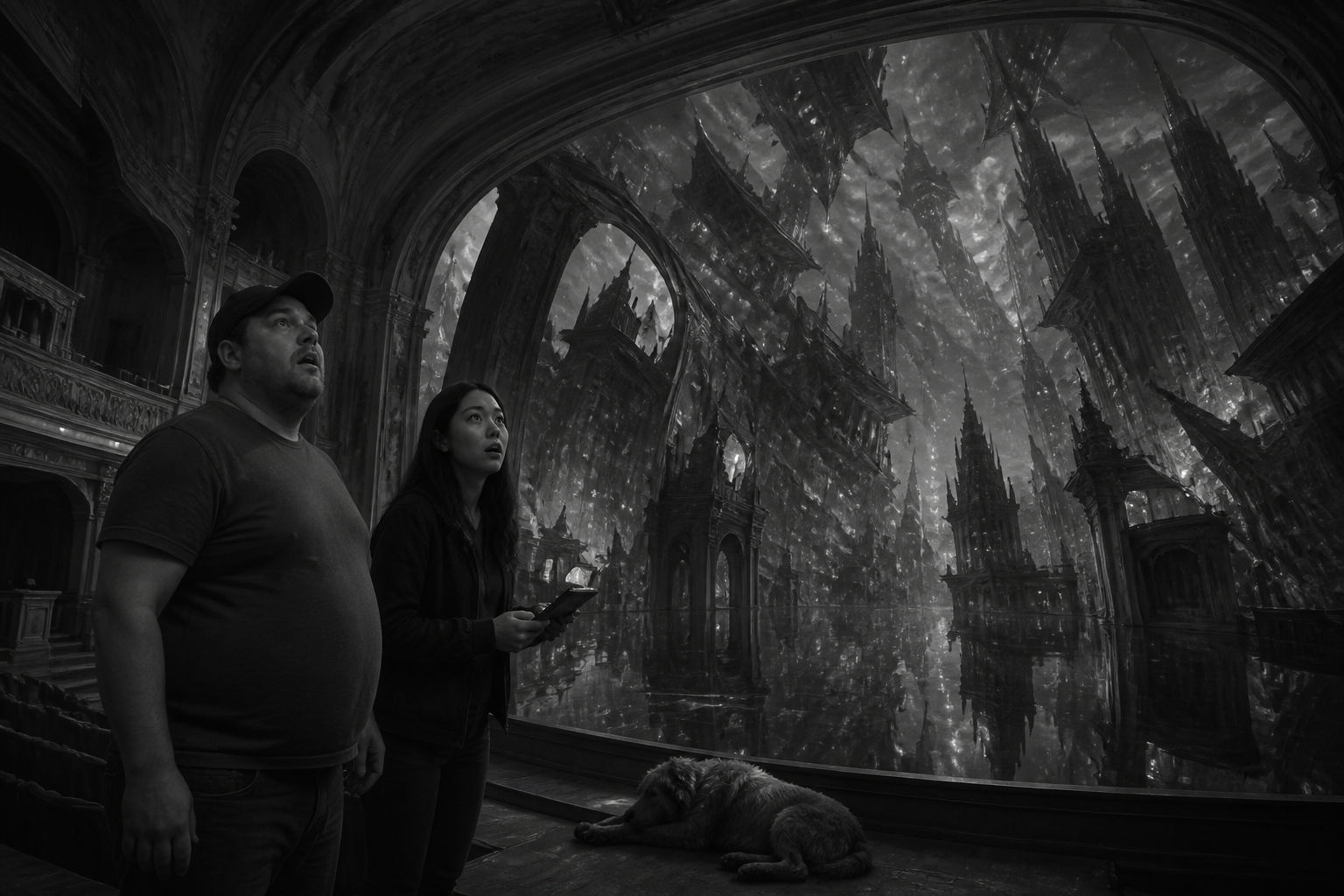
The seating area was a quiet cavern of empty wooden chairs facing the proscenium arch. The Swiss Alps mural dominated the stage backdrop—snow-capped peaks under a faded blue sky. I stood in the center aisle. Cletus trotted ahead, then stopped at the edge of the stage. Her ears perked forward.
JOE Look at the mural.
The light in the room seemed to shift. The colors of the painted Alps deepened, the contrasts sharpening as if under a different sun. The perspective of the peaks appeared to change, not vanishing, but rearranging. The air carried a faint, clean scent, like stone after rain.
From somewhere in the building, a deep resonance sounded, a single tone that seemed to come from the structure itself.
We walked closer to the stage. The proscenium arch, the frame around the stage, held my attention. Its lines seemed to warp subtly, not breaking, but bending the space within them. The stage floor, for a moment, did not look like wood, but like a still, dark surface.
It reflected the room—the chairs, the balcony—but the reflection was wrong. The angles were offset, the geometry of our own space echoed back in a distorted, impossible layout. It was like looking into a flawed mirror. The hum in the floorboards intensified into a tangible pressure.
Then, a return to stillness.
The pressure lifted. The arch was just a frame. The stage floor was plain wood. The mural was the familiar Swiss Alps. Joe and I stood, disoriented. My equipment was silent.
Cletus was now at the foot of the staircase leading to the cupola. She was alert, watching us.
JUPITER My watch. It’s…
JOE What?
JUPITER It’s 9:38. There’s a discrepancy in the log.
Joe was looking at the stage. The Armbruster & Son backdrops hung in place. The Swiss Alps mural was there, as it has been since 1885.
JOE They’re still here. Everything is as it was.
I checked the equipment. The logged data was inconsistent. Several sensor timestamps were mismatched.
JUPITER We should go.
We packed the gear. Joe called Cletus, and she followed. We walked down the stairs, through the quiet museum, and out the newly painted front doors. The spring sun was bright. The restored cupola stood solid against the Ohio sky.
Joe looked back at the building, then at the notes in his hand.
JOE What do we tell the Historical Society?
JUPITER We tell them the equinox check is complete. The building is as they maintain it.
We drove away. In the rearview mirror, the Monroe Township Hall-Opera House looked exactly as it always has: a two-story brick building with a prominent cupola. A place for dances, meetings, and plays.
Some observations resist a clean report. Some questions are just the shape of a place, waiting in the lines of its architecture.
FIELD NOTES
9:14 a.m. – Baseline readings normal. Low-frequency vibration detected. Ambient temperature stable.
9:32 a.m. – Observable shift in ambient light and acoustics within the second-floor opera house. Faint scent of clean stone.
9:37 a.m. – Period of pronounced spatial disorientation. Lasting approximately 37 seconds. No corresponding equipment anomalies recorded.
9:38 a.m. – Post-observation status: All original 1885 stage backdrops, including the Swiss Alps mural, are present and intact. Site environment returned to baseline. Sensor logs contain minor timestamp inconsistencies.
Note: The 2010 cupola restoration is publicly documented and structurally sound. The building continues its intended use as a civic and historical center.