The Weight of What Stands
We came to measure a courthouse. We left measuring an anomaly.
Filed: September 21, 2026
Site: Lawrence County Courthouse, New Castle, Pennsylvania
Investigation Lead: Joseph Davenport Sr.
Technical Lead: Jupiter Meteor Nguyen (intern)
Ambient Support: Cletus
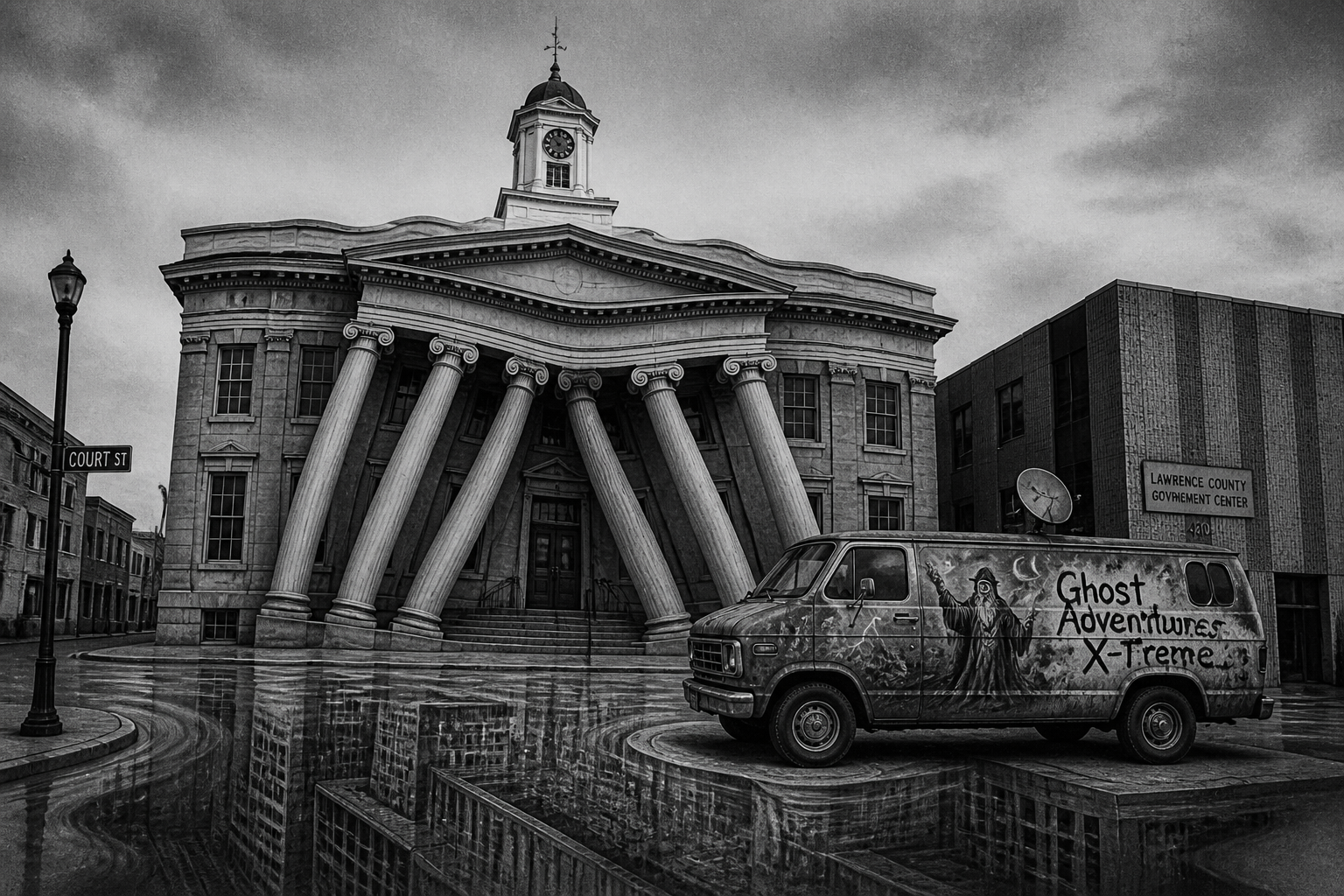
The Lawrence County Courthouse is a Greek Revival statement in sandstone, six Ionic columns holding up a portico that’s watched Court Street since 1855. It was built to be a civic anchor, symmetrical and sure. The original cupola was lopped off in the 1950s, leaving a flat roof for decades until a new one—complete with a carillon—was hoisted into place in 2002, a gesture of municipal nostalgia. The 1977 Government Center juts off its northwest side like a modern afterthought. We were there because Mr. Davenport read something online about “structural strings” resonating in old civic buildings. I was there to measure shear.
Late morning sun cut sharp shadows across the portico steps. I knelt on the marble threshold, calibrating the portable rheometer. Cletus lay flat in the column’s shade, panting softly. A few county employees passed by, giving our little tableau a polite, practiced nod.
Mr. Davenport stood at the base of the central column, running a hand over the cool stone.
JOE
Solid. They knew how to lay a foundation. Built between 1850 and 1855. That cupola up there? The original one got torn down in the ‘50s. People missed it. Took a public fundraiser to put this new one up in 2002.
JUPITER
Fascinating. Can you move your boot? I need a baseline reading right where you’re standing.
He stepped aside. I placed the rheometer’s plate flush against the polished floor just inside the threshold. The digital display flickered to life, showing ambient stability. The carillon in the new cupola chimed eleven o’clock, clear and normal.
JOE
Places like this, with all the additions, they can develop… let’s call it a structural signature. Layers of construction stacked up.
JUPITER
It says that, does it? In those words?
JOE
More or less. I read an article. Talks about geometry holding onto… well, you’d call it data.
I didn’t dignify that with a response. I instructed him to hold the main door while I brought the equipment inside.
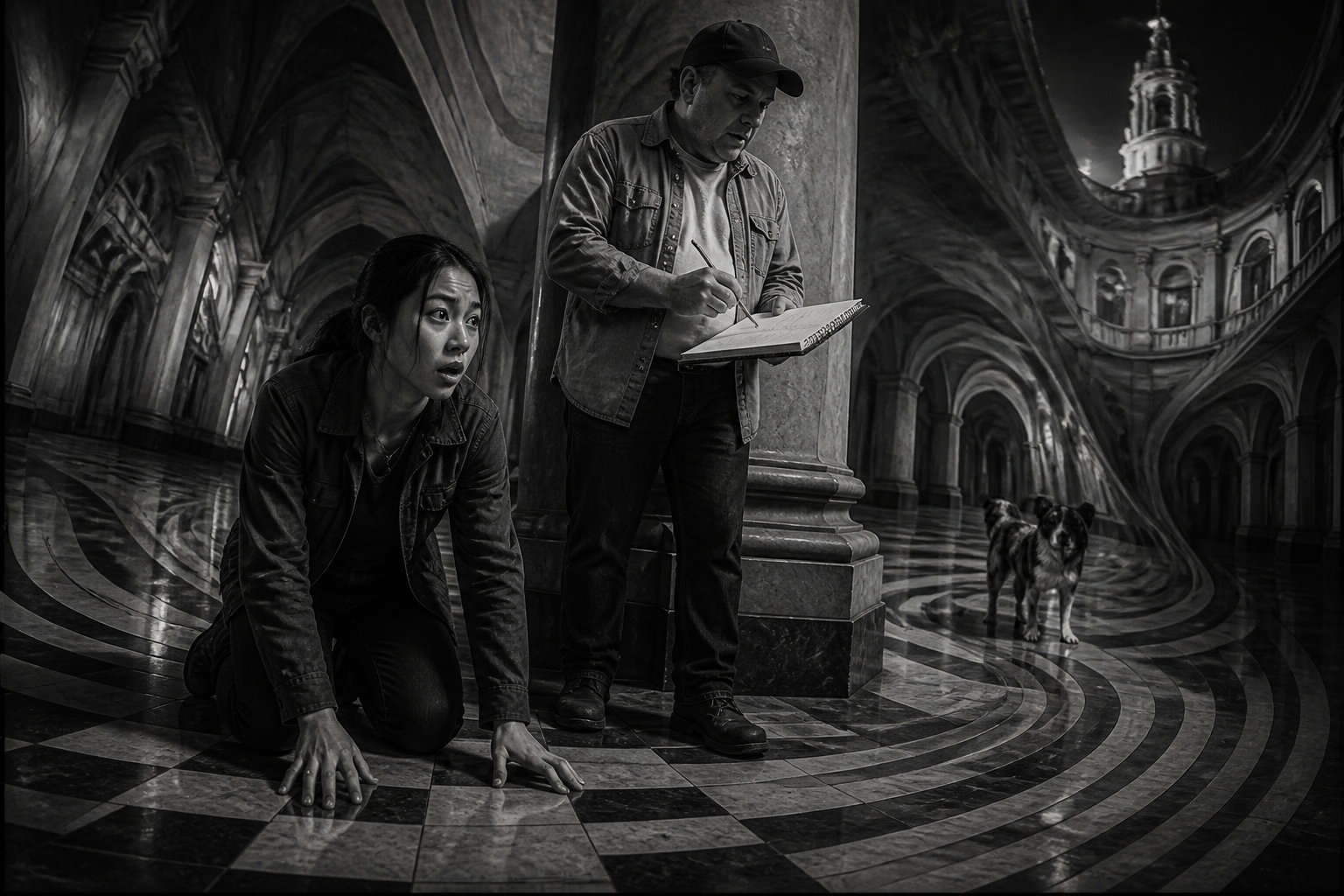
The central hall was cool, polished, and empty. The air smelled of lemon-scented cleaner and old paper. I placed the rheometer on the floor near a massive support pillar. Mr. Davenport pulled out a laser level, checking alignment back to the portico columns. Cletus trotted in after us, circled once, and lay down by the pillar.
JUPITER
The core symmetry has been preserved through every addition. 1885, 1914, 1947. The bones follow the original plan.
The rheometer’s display, which had been holding steady, suddenly danced. The shear value fluctuated—12.4 MPa, then 0.8, then 15.1—in a vector that shouldn’t have existed. I frowned and tapped the screen.
JUPITER
That’s not right.
JOE
What’s not right?
JUPITER
The shear force. It’s coming from a direction that isn’t there. And it’s… high.
As I spoke, the red dot of the laser level on the far wall wavered, drifting an inch left, then snapping back. The floor beneath my feet felt perfectly level.
I crouched to reboot the rheometer. The diagnostic screen flashed, then settled on a data file. The timestamp read: 1885-04-17.
JUPITER
Corrupted metadata. Great.
JOE
1885? That’s the year they started the big addition. Let me see that.
He leaned against the support column, peering over my shoulder. Cletus stood up abruptly. Her ears perked up. Her head turned, looking toward the entrance.
JOE
Hey, girl. You hear something?
The moment he spoke, the air in the hall changed.
It didn’t get colder so much as denser, like the pressure had shifted. The polished floor tiles didn’t crack or move, but the light reflecting off them seemed to warp, the pattern of shadows shifting in a way that was disorienting.
I looked toward the entrance. The six Ionic columns of the portico, visible through the open door, appeared distorted through the air, as if viewed through imperfect glass. My eyes shot upward. The ceiling, the cupola above it, seemed to shiver in place.
A low vibration rose from the floorboards, subtle but present. I tried to speak, to ask what was happening, but my voice felt thin.
Mr. Davenport was staring, focused, at his sketchbook, which was open in his hand. His pencil was moving quickly across the page.
My left hand, resting on the rheometer, felt a sudden, sharp pressure, as if the air had tightened around it. I watched as a hairline mark—clean and faint—appeared across the back of my hand. There was no blood. No pain. Just the sight of a new line on my skin.
Cletus didn’t run. She stood alert, her posture tense, her eyes fixed on the west wing corridor.
Just as suddenly as it began, it ended.
The vibration stopped. The disorienting shift in the light vanished. The columns outside appeared normal. The ceiling was solid plaster.
The entire event had lasted thirty-seven seconds.
The overhead lights flickered once and steadied. I gasped, the sound loud in the sudden silence. I looked at my left hand, cradled against my chest. The mark across my knuckles was still there, a fine line. It didn’t pulse. It just was.
Mr. Davenport was staring down at his sketchbook, his face a mask of concentration. He turned the book toward me.
It was a diagram. A complex, overlapping sketch of the courthouse's footprint. Lines denoted the original 1850s structure, the 1885 addition, the 1914 wing, the 1947 connector, and the 1977 Government Center. But the angles were wrong. The lines representing the additions did not align correctly with the core structure; they were off by degrees, creating a compound geometric error at the building's heart. It was a blueprint of a foundational misalignment.
JOE
The additions… they don’t line up. Not perfectly. The center of the building is under a constant, low-grade torsional stress from decades of piecemeal construction. It’s been holding this shape for over a century.
Cletus finally moved, shaking herself. She padded slowly down the west wing corridor, which led toward the junction with the 1977 Government Center. We followed.
The west wing was a connecting addition from 1947, linking older expansions. The air near the junction with the modern building was noticeably cooler. I pulled a thermal gun from my belt. The wall read 16°C. The rest of the hall was 21°C.
My other instruments, still powered on, began to chirp. The rheometer was emitting a steady pulse. The data log now showed the same anomalous timestamp repeating on several lines: 1885-04-17.
Cletus stopped in front of a section of wall where the 1947 masonry met the older stone. She sniffed along the seam.
JUPITER
We need to leave.
JOE
But the data…
JUPITER
My data is anomalous and my hand is marked. We’re leaving. Now.
He hesitated, looking back toward the central hall, then down at the diagram in his sketchbook. He nodded sharply.
JOE
Cletus. Come on.
Cletus turned and trotted after us.
We exited through the grand portico. The sun was still high. Court Street was quiet. I looked at my left hand. Mr. Davenport kept glancing at his sketchbook. Cletus didn’t look back at the courthouse.
Nobody spoke until the van’s engine roared to life.
JOE
That wasn’t in the engineering briefs. I thought I understood how these things settled. But that diagram… the stress must be phenomenal. And I can still feel the pressure change.
I stared at the courthouse receding in the side mirror, its new cupola gleaming in the late morning sun.
JUPITER
The data’s anomalous, the timestamp’s corrupted, and I’ve got a mark on my hand. But the worst part? I think we just measured a century of architectural drift held in perfect, precarious balance.
FIELD NOTES
Lawrence County Courthouse. Greek Revival. Built 1850–1855. Cupola removed 1950s, replaced 2002.
Today: 37-second anomalous event. Shear force of 12.4 MPa in non-standard vector. Instrument timestamp corruption shows '1885-04-17' (year of major addition). My left hand—superficial mark across knuckle, no blood, no pain. Device logs show repeating error code. Joe’s sketch reveals compound geometric misalignment between original structure and subsequent additions (1885, 1914, 1947), suggesting latent structural stress at the building's core. Cletus was alert, focused on west wing junction. Thermal anomaly detected at junction with 1977 Government Center (16°C vs. ambient 21°C).
All observations pertain to current site conditions and documented construction history. No prior injuries referenced.