Daily Ghost Crusade X-Treme Published by Joe Davenport Sr. on the Weird Little Server Documentation by Jupiter Meteor Nguyen, Internship Credit Log
The House That Remembers
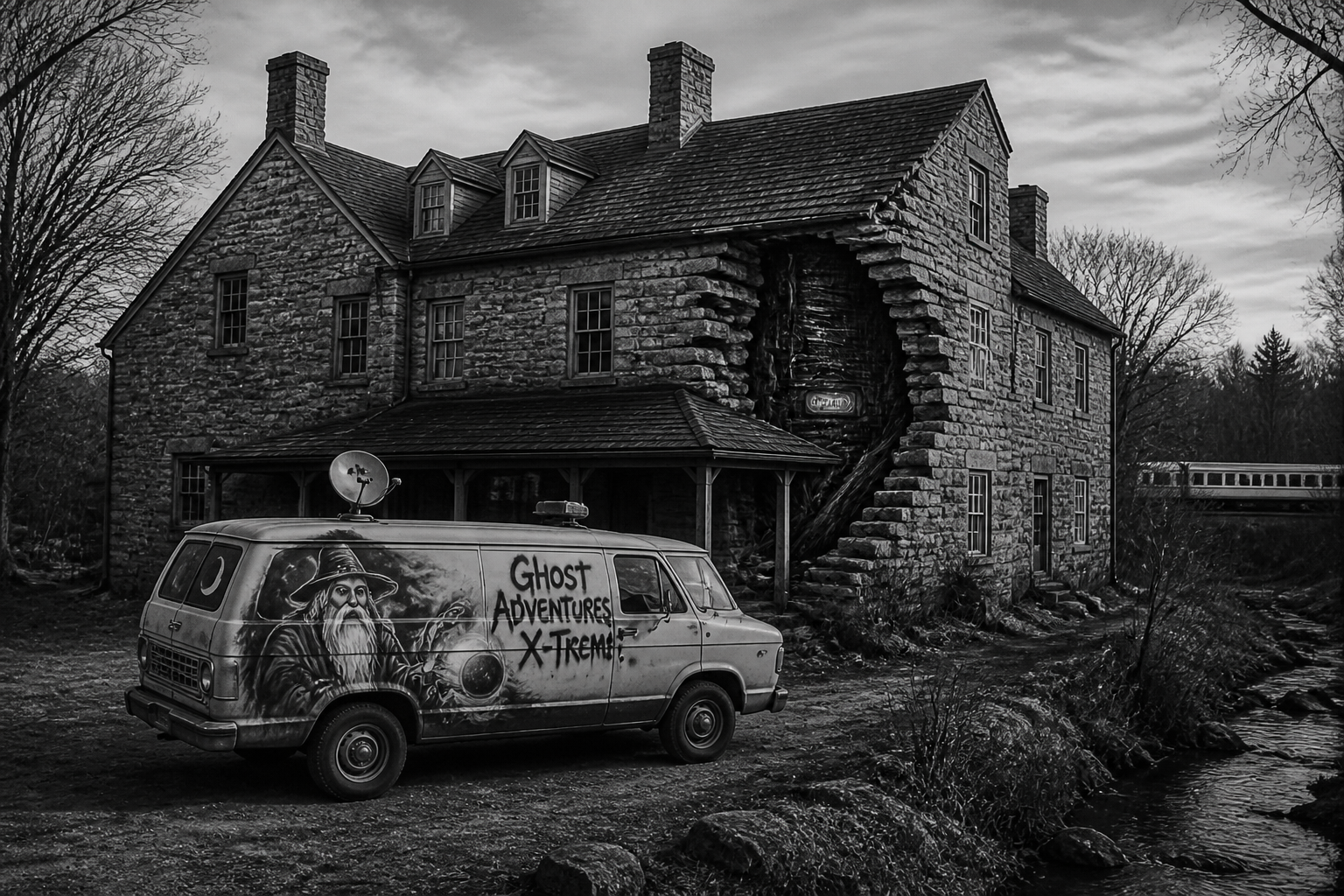
The Miller-Leedom-Dickinson House stood warm in the late afternoon sun, its fieldstone walls glowing like coals. Joe called it ‘Harford Hall’—a name he picked up from the current owner, Anthony Morinelli, though it’s not in any official record. I didn’t correct him. We were here because he’d read online about ‘strings phenomena’ in old mill foundations—something about stress patterns in layered construction. I was here because my advisor said fieldwork counted as credit.
The property is a three-part stone mass built into the hillside near Cobbs Creek. The core dates to 1725, with additions in 1750 and 1800. From 1810 until the early 20th century, it was the heart of a grist and saw mill operation. The dam washed out around the time the mills closed. George Dickinson bought the place in February 1879; the lane became Dickinson Mill Road. It was listed on the National Register this past February. Current owner Morinelli found a charred beam inscribed ‘B. Leedom’ during renovations. That’s the verified history. No tragedies, no murders. Just stone, water, and work.
Joe leaned against the hipped-roof porch railing, his cap tilted back. I knelt by my open equipment case, calibrating the sonic resonator. Cletus lay panting on the warm stone step, watching a squirrel.
JOE See how the additions don’t line up perfectly? That 1725 section, then the 1750 bump-out, then the 1800 wing. It’s like geological strata. Stress builds in the seams.
JUPITER It’s called coursed rubble fieldstone. Two-foot-thick walls. Mortise and tenon beams. It’s built to handle stress.
JOE Not this kind. The book talks about layered construction creating… what’d they call it? Phantom load-bearing. The memory of weight.
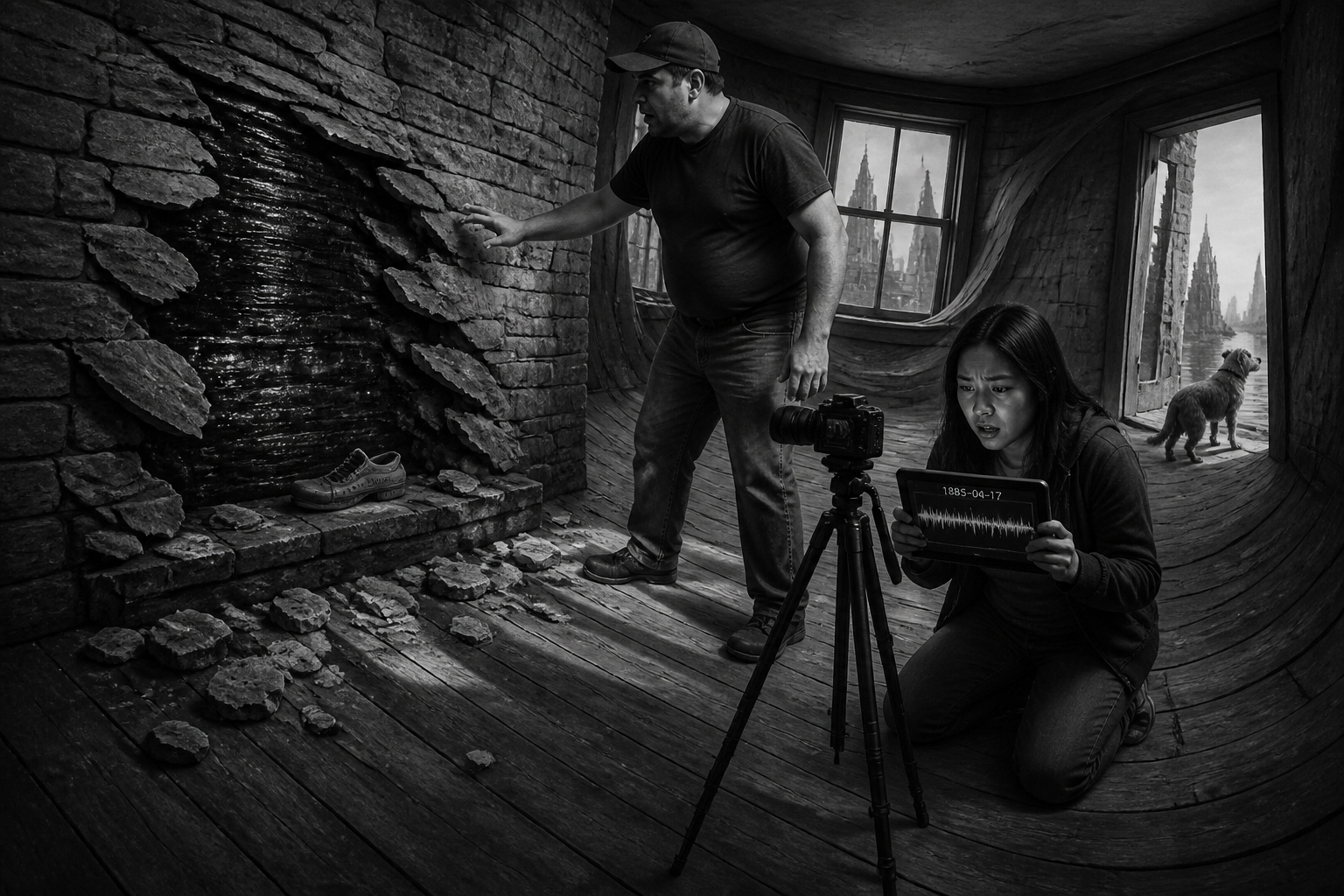
The resonator emitted a high-pitched whine. The display corrupted, showing a spiral waveform. My tablet flickered. All timestamps reset to ‘1885-04-17’. I sighed, a frustrated noise from deep in my chest.
JUPITER Device failure. Timestamps are corrupted to April 1885.
JOE Or calibrated.
Joe pushed off the railing and moved toward the east wall of the original section. Dusk was approaching, stretching long shadows from the trees. I followed with the laser level. Cletus padded beside us, then stopped at the base of the two-foot-thick stone wall. She sniffed deeply at the mortar line.
Joe ran a hand along the stone.
JOE Adze marks. Right here. Hand-hewn. They built this to last centuries.
JUPITER Thermal variance is minimal. The masonry’ s holding temperature like a bank vault.
The laser level’s beam flickered. For a moment, the wall seemed to pulse inward—a slow, subtle contraction, like a single deep breath. The mortar lines between the stones appeared to flow, a liquid shimmer lasting maybe a second. Cletus shifted her weight and yawned.
A low hum began, felt in the teeth more than heard. The air thickened, carrying a scent of damp stone and wet earth.
JOE You smell that?
JUPITER Yes.
We moved inside as the last of the sun vanished. The main room was dominated by a large fireplace. The house has no basement; its bank-house design is integrated into the hillside for stability. Joe stood before the hearth, examining the mortar with his fingertips. I set up the tripod, activating the full resonator array. My devices powered on, all displays still frozen on ‘1885-04-17’. Cletus followed us in and settled by the door.
JOE Baseline reading?
JUPITER If by baseline you mean ‘chronologically unmoored,’ then yes.
The fireplace stones began to shift.
It wasn’t a collapse. It was an unbuilding. Each course of stone peeled back in sequence, like pages in a heavy book being turned by an invisible hand. They moved with physical continuity, sliding aside without dust or grating, revealing a dark cavity behind the hearth. The cavity was lined with petrified wood, glossy and black.
Inside rested a single wooden shoe. It was untouched by time, the wood dry, the surface smooth. Carved into the instep was a clear inscription: A. B. Leedom.
The room distorted.
The walls rippled, not as an illusion but as a physical reconfiguration of space. The pine floorboards under my feet warped upward into a shallow slope. The air vibrated at a deep, subsonic frequency—17 Hz, my resonator confirmed before the screen filled with static. And then the vision emerged.
Not a ghost. Not a person. A memory.
It was the mill. Seen as if through a heat haze or rushing water. Heavy stone walls, the great waterwheel turning, sacks of grain piled high. The flickering image was vast and layered, showing different eras superimposed—the log foundation, the fieldstone additions, the bustle of industry. The scent of damp earth and grain dust became overpowering.
The event lasted thirty-seven seconds.
Then, silence. The vibration ceased. The walls settled back into their proper planes. The fireplace stones slid back into place, sealing the cavity—but the wooden shoe remained, solid and real on the hearthstone.
I realized I was clutching my left forearm. The skin was unmarked.
Joe picked up the shoe. He turned it over in his hands.
JOE Augustus B. Leedom. Samuel’s son. He ran the mill after his dad, just for a few years before Dickinson bought it. This is his.
JUPITER It was behind the stone. In a space that didn’t exist ten minutes ago.
My tablet screen remained frozen on ‘1885-04-17’. Joe pulled his old copy of The Forgotten Foundations from his bag.
JOE The book… it talks about structural memory. How repeated stress and use can get encoded in materials. I thought it was a metaphor.
JUPITER That wasn’t a metaphor. It was a reconstruction. The house isn’t haunted. It’s remembering its own history. Its work.
Joe looked from the book to the shoe, his expression unsettled.
JOE A playback. But of what? The mill’s entire history?
We didn’t leave in silence. I packed my equipment. Cletus trotted to Joe’s side, her tail wagging. She stopped once on the path to sniff the air where the damp scent still lingered faintly.
Joe turned to me at the van.
JOE That 17 Hz pulse. It’s not just stress in the walls.
JUPITER It’s recursion. The structure is occupied by a memory. A persistent one.
FIELD NOTES: Jupiter Meteor Nguyen Site: Miller-Leedom-Dickinson House, 570 Mill Road, Haverford Township, PA. Time: 17:42 –75°F, 68% RH, no wind. Gear: Sonic resonator (active, waveform corruption), laser level (intermittent failure), tablet (timestamp corruption to ‘1885-04-17’). Observations: 17 Hz subharmonic detected prior to event. Visual spatial distortion lasting 37 seconds. Structural ‘unbuilding’ of fireplace revealed physical artifact: one wooden shoe, inscribed ‘A. B. Leedom’, no decay. Sustained scent of damp earth and stone. Cletus exhibited no unusual behavior. All digital metadata remains corrupted. Hypothesis: The house is not a haunted site. It is a complex, layered structure exhibiting an anomalous but non-supernatural physical event. The discovered artifact appears to be a genuine historical object, likely concealed during construction or alteration. The date 1885-04-17 remains unexplained but correlates with the period of the Leedom family’s ownership. Further documentary research is recommended.