Ghost Crusade X-Treme: Daily Investigation Report Site: New Castle Armory, 820 Frank Ave., Shenango Township, Lawrence County, Pennsylvania Date: [CURRENT DATE] Investigation Team: Joseph Davenport Sr., Jupiter Meteor Nguyen, Cletus Narrative by: Jupiter Meteor Nguyen, for internship documentation
Filed under: Structural Anomaly / Environmental Resonance
We came for a federal public works project. We left with thirty-seven seconds of impossible geometry and a timestamp that shouldn't exist.
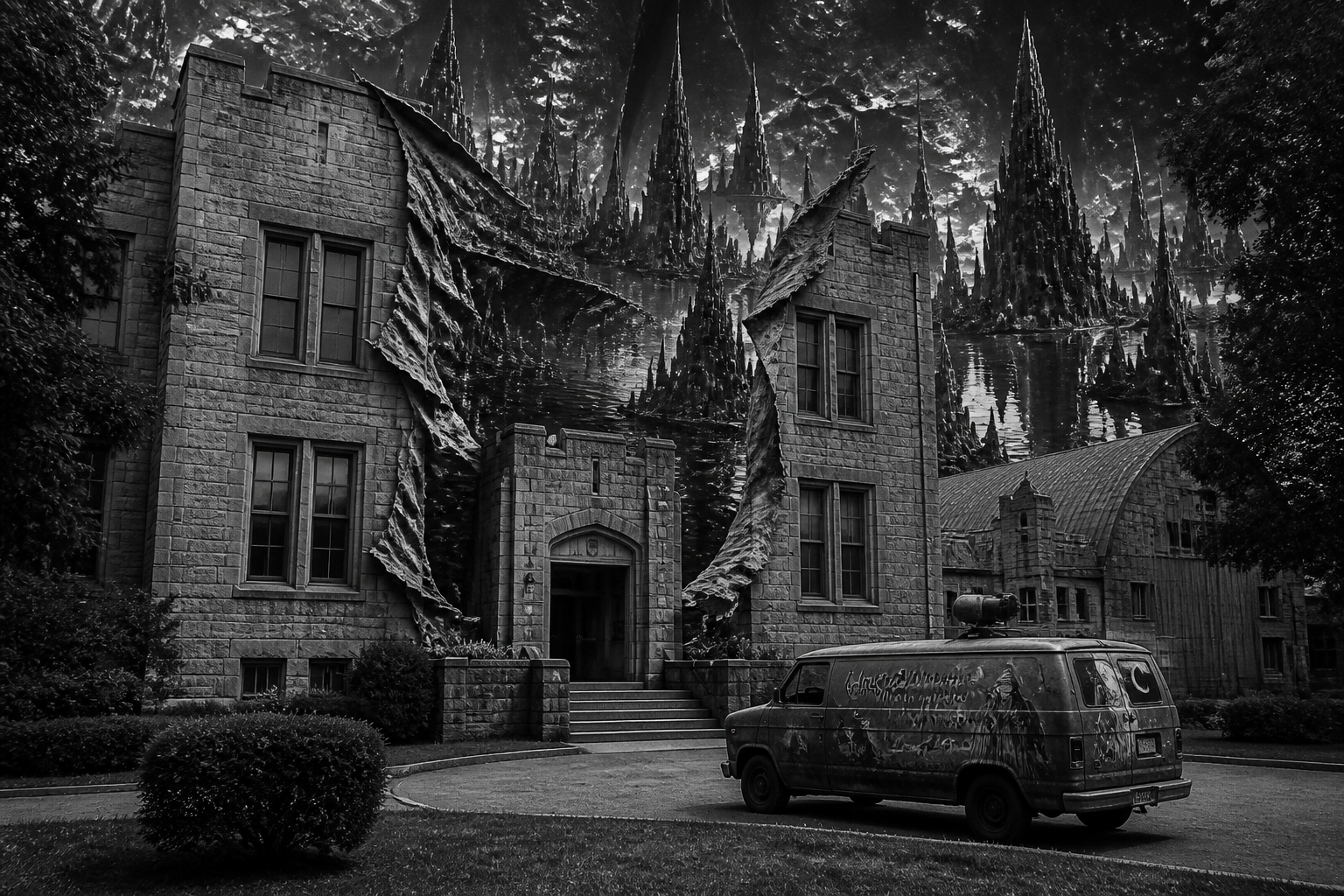
The New Castle Armory is a two-story stone building on six acres in Shenango Township. It was built in 1938 with federal public-works money, designed by the Thayer Co. in a clean Art Deco style. Its I-plan layout connects an administration building directly to a riding hall and a former stable. It’s on the National Register. There are no records of tragedy, death, or scandal here. Its history is bureaucratic and functional. Mr. Davenport had read about a “strings phenomenon” online—reports of unexplained vibrations and pressure changes in stone civic buildings—and that was our reason for being there. It was not an HVAC call.
10:15 a.m., Administration Building Main Lobby
The overcast morning light came in dim through the tall Art Deco windows. The air was still and exactly 68 degrees. I knelt by my open equipment case, calibrating the laser grid for spatial mapping. Mr. Davenport stood near the central entrance, running a hand along the stone masonry. Cletus lay on the cool tile floor, panting slightly after the walk from the van.
JOE Symmetry. You can see where the federal budget went. Every line has a purpose.
JUPITER The purpose was housing the National Guard. The purpose was not producing resonant anomalies.
JOE Says you. Thayer Co. knew how to lay stone. If a building holds any memory, it’s in the joints.
He pulled out his notebook, labeled Phantom Architecture Notes. I powered on the laser grid. The emitters flickered to life, casting a network of red lines across the lobby floor and up the far wall.
The beams flickered—once—as if refracted through water.
10:17 a.m.
I stared at the tablet screen. One laser beam, the one aimed at the junction of the west wall and the ceiling, had bent. The data stream showed it had curved backward into the stone and then returned to the emitter. The timestamp on the corrupted return packet read 1924-09-12.
JUPITER That’s not possible.
JOE What’s not?
JUPITER The grid is reporting a beam path that violates line-of-sight. And it’s timestamped 1924. The armory wasn’t built until 1938.
Mr. Davenport stepped back from the wall. Cletus lifted her head, ears pricked forward. I recalibrated the emitter. The beam snapped back to its proper line, but the corrupted data packet remained in the log.
JOE A pre-build echo. I read about that. Not a ghost. A… structural memory. Like the building’s blueprints got laid down on top of something else.
JUPITER Or the instruments are glitching because of the stone’s mineral content. Let me run a diagnostic.
Cletus stood up abruptly. Her tail went low, not tucked, but tense. She backed toward the main door, sniffing the air in short, sharp bursts.
JOE Temperature shift.
He was right. A faint, cold current of air was moving down the central corridor leading to the riding hall. It wasn’t coming from the vents.
10:20 a.m., Central Corridor
Mr. Davenport led, walking slowly with his hand out, feeling for the air current. I followed two paces behind, scanning with the handheld thermal array. Cletus lagged, stopping every few feet to sniff at the seams between the floor tiles. She whined softly after pausing at one particular crack.
The corridor was a functional, military-design connection—stone walls, tile floor, high ceiling. The thermal array beeped.
JUPITER Temperature drop. Twelve degrees. Localized. Three feet ahead of you.
He stopped. The thermal display showed a perfect sphere of 56-degree air hanging in the middle of the corridor. No airflow pattern led to it or away from it. On the adjacent wall surface, the sensor flagged a faint, iridescent residue. It looked like the sheen on old motor oil.
JOE No vent. No leak.
He crouched, shining his flashlight at the base of the wall. The cold spot seemed to press against my skin from six feet away.
A low chime echoed through the corridor. It didn’t come from a speaker. It sounded subterranean, like something ringing in a deep well. The overhead lights dimmed, just a fraction.
JOE Okay. That’s new.
He stood up and moved forward, flashlight beam cutting through the gloom. I kept the thermal array trained on the cold spot. It was holding steady. The chime faded, leaving a muffled silence that felt thicker than the air before.
10:23:37 a.m.
We regrouped in the lobby. My tablet battery, which had been at 78 percent, was now failing. The digital clock on the wall read 10:23, but the seconds weren’t ticking. Cletus had bolted outside; through the window, I could see her pacing in tight, anxious circles on the gravel.
JUPITER All my clocks are frozen. The grid is offline.
JOE Look up.
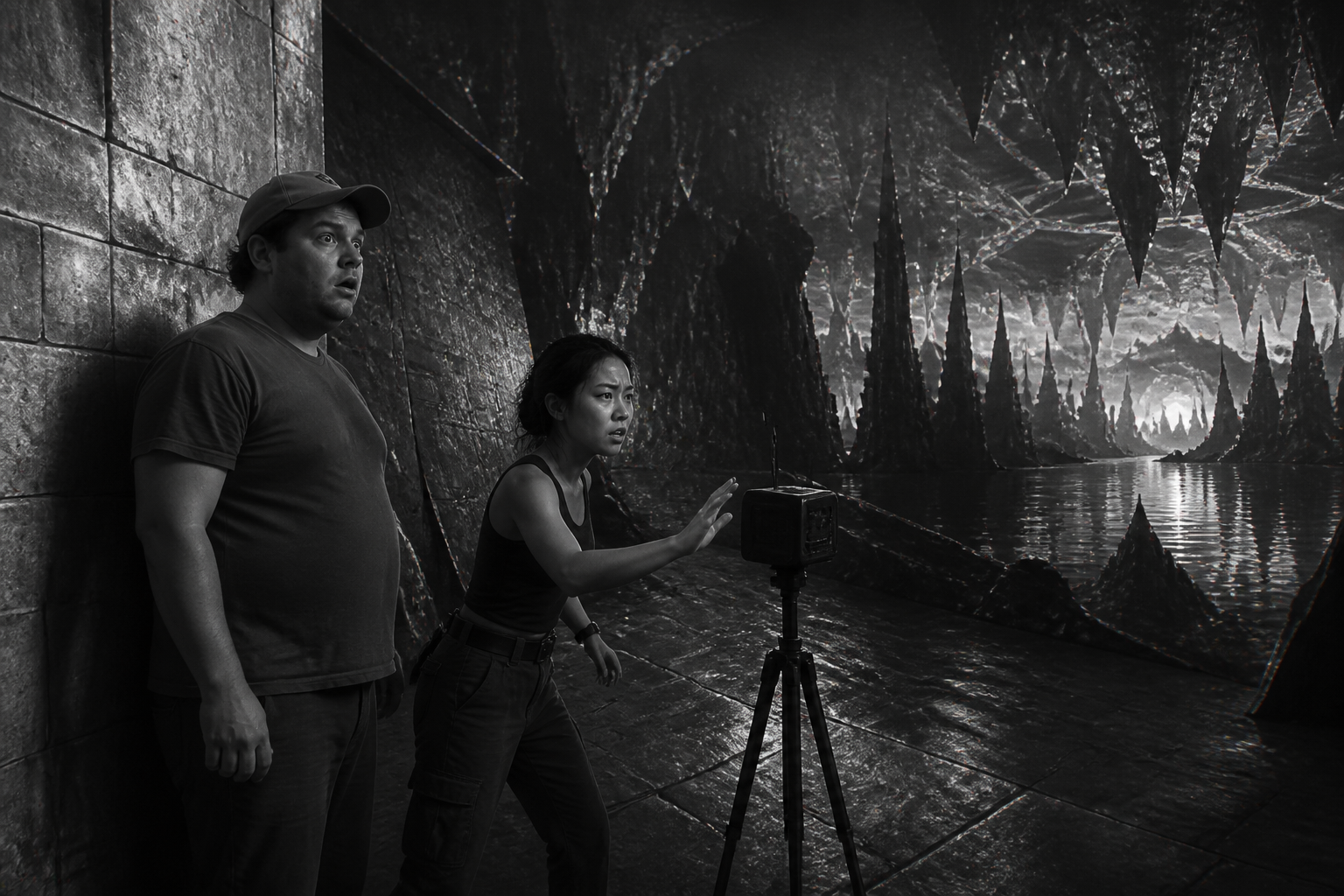
The ceiling above the center of the lobby fractured. It didn’t crack and fall. It buckled upward, the plaster and lathe peeling back like a flower blooming in reverse. A vertical shaft opened, yawning into darkness above the two-story space.
Inside the shaft, the air warped into a massive, stable lens. The lobby’s actual Art Deco walls and ceiling were visible behind it, but through this lens, they appeared crushed into a dense gravity well. Stonework stretched into parabolic curves; geometric ornamentation repeated in fractal patterns that terminated in singularities of pure black. The light bent, shearing into prismatic bands that vibrated at a visible frequency. The architecture was there, but every line was pulled toward a central point of infinite distortion.
A subsonic hum resonated through the floor. The air pressure spiked, then dropped sharply, making my ears pop. The floor beneath us tilted subtly, not enough to make us fall, but enough to feel a genuine, measurable pull toward the visual epicenter of the distortion.
At the focal point of the lens, where the light bent most severely, rested a single, polished granite block. It was faceted in an Art Deco pattern, clean and dry. It defied the intense gravitational distortion surrounding it.
Mr. Davenport didn’t speak. He was staring into the shaft, his face pale. This wasn’t the eager curiosity of a paranormal enthusiast. This was the shock of witnessing a stable physical anomaly.
The entire event lasted exactly thirty-seven seconds.
It ended with a pressure shift, a deafening thump of air collapsing back into place. The ceiling slammed down, sealing the shaft. Plaster dust rained onto the tiles. The lights flickered back to full brightness.
The granite block remained, sitting neatly in the center of the floor.
Aftermath
All our digital devices were locked. Every clock, every camera timestamp, every data-logger read 1924-09-12. The laser grid was dead.
Mr. Davenport walked over and picked up the block.
JUPITER You shouldn’t touch that.
JOE It’s real. It’s room temperature.
JUPITER That doesn’t make it safe. Put it down.
He turned it over in his hands, examining its facets. He didn’t put it down. He slipped it into his jacket pocket.
Cletus refused to re-enter the building. She stood by the van door, whining, her attention fixed on the riding hall entrance.
Local officials—a township maintenance supervisor and a county historic preservation officer—arrived at 10:50, demanding to know why we were there and what the “structural disturbance” had been. Mr. Davenport cited “private structural testing” and showed his HVAC contractor ID. It was a thin story. We left under a cloud of official protest at 11:03 a.m.
In the van, Cletus sat in the middle of the back seat, facing the rear window, watching the armory shrink into the distance. Mr. Davenport stared at the block in his hands.
I reviewed the corrupted data on my tablet. One file, a corrupted video fragment, showed 2.4 seconds of the gravitational lensing effect. The timestamp was 1924-09-12. The audio track was a 17 Hz subsonic pulse, temporally consistent with the structural stress patterns we’d recorded before.
JUPITER It’s not a glitch. It’s a signature. A resonant frequency spike, anchored to the architecture.
JOE This wasn’t playback. It was a call-and-response. The building didn’t remember being built. It vibrated to a standing wave we couldn’t see. And we just walked into its node.
FIELD NOTES
- 10:23:37–10:24:14: Full environmental anomaly event. Duration: 37 seconds exact.
- Laser Grid: Corrupted at 10:17. Final data packet timestamped 1924-09-12. Emitter 3 registered a physical bend in beam path before failure.
- Cold Pocket: Preceded main event by 47 seconds. Localized ΔT of -12°F. Iridescent residue on adjacent wall—sample collected.
- Canine Behavior: Cletus exited structure at 10:22, pre-manifestation. Post-event, exhibits avoidance behavior toward riding hall entrance. Persistent whining. Correlates with recorded subsonic vibration.
- Shaft: Observable phenomenon consistent with a localized gravity well or high-density spatial lens. Visual distortion prevented depth measurement. Architecture appeared subject to extreme gravitational shear.
- Artifact: One (1) polished granite block, faceted in Art Deco pattern. Acquired by JDS.
- Physiological: Significant inner-ear pressure fluctuation coincident with event. No physical injuries sustained.
- Equipment Status: All digital devices permanently timestamp-locked to 1924-09-12. Battery drain event coincident with manifestation.
- Conclusion: A measurable environmental resonance event. Physical parameters (temperature, pressure, light refraction) were altered. The site exhibits a persistent, anomalous standing wave within its structure.
– Jupiter Meteor Nguyen