Ghost Crusade X-Treme
Weird Little Server Field Report • September 25, 2026
The Church and Its Layers
We were there because Mr. Davenport read an unverified account online about anomalous readings at a historic church in Michigan—something about electromagnetic interference and sensor glitches. I was skeptical. The equipment, however, malfunctioned as described.
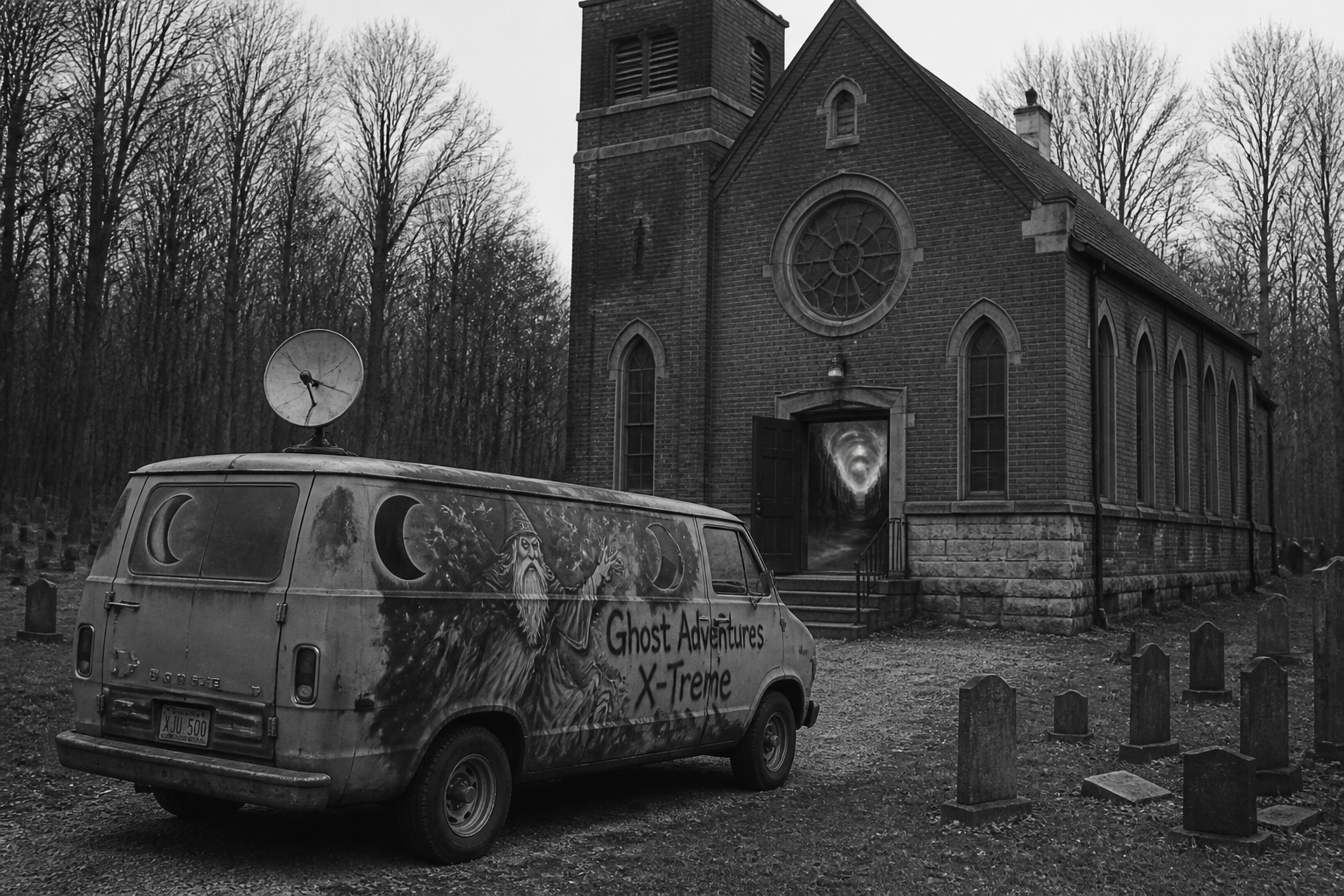
The parking area at St. Augustine Catholic Church was a patch of gravel and grass just off Faussett Road. It was late afternoon, the light turning gold, and the red brick Gothic Revival building stood stark against the surrounding trees. A random ashlar foundation supported walls accented with yellow Berea sandstone. Two cemetery plots, one older and one newer, flanked the building. Mr. Davenport leaned against the van, sipping from a thermos. I knelt beside an open equipment case, calibrating the resonance sensor. Cletus explored the boundary of the old cemetery.
I cross-referenced our GPS coordinates with the NRHP data on my tablet. The church was founded in 1843 by Rev. Patrick O’Kelly, a missionary priest from Detroit. The original frame church was constructed in 1846, the rectory in 1857. The parish name changed to St. Augustine around 1870, and the current brick structure was completed in 1895 under Father George J. Maurer, designed by a Detroit architect named Harry J. Rill. The site packet confirmed that the original 1846 frame church was dismantled during the 1895 construction.
JOE You know, in one of those old Time-Life books, they talked about sites of long-term use having a kind of… layered feeling. Like you can sense the history underfoot.
JUPITER That’s a subjective impression, Mr. Davenport. Physical stress patterns in reused materials, maybe. But not a conscious memory.
JOE We’ll see. My internet source claimed the sensor readings here were strange. Like overlapping signals.
Cletus paused, her ears perking up at some sound in the woods bordering the property—likely an animal. My sensor emitted a sharp chirp. The screen spiked at 17 Hz, then flickered. The timestamp in the corner glitched briefly before resetting to the current time.
I frowned at the readout. The 17 Hz spike remained.
JUPITER Did you see that? A strong, sustained 17 Hz reading. The timestamp glitched but corrected itself.
JOE I saw. Let’ s see if the interior environment is affecting the equipment.
He pocketed the thermos and headed for the church doors. I shut the sensor down, my left forearm giving a familiar, dull ache. I packed the gear and followed, Cletus walking beside me but stopping just outside the main entrance, seemingly interested in something on the ground.
The vestibule had been added in 1963, projecting beneath the large round window in the facade gable. The late sun slanted through the stained glass, casting colored diamonds across the floor. Joe stood in the center, looking up at the ceiling. I set up a tripod near the lobby entrance and activated the resonance grid.
JOE They reused materials, you know. From the old frame church they dismantled. In the 1895 build. The wood, some of the stone.
He ran his fingers along the yellow sandstone trim of a pointed-arch doorway. The stone felt cool.
The air in the vestibule felt still and slightly damp. My grid emitted a low feedback pulse, a subsonic thrum I felt in my teeth. The display screen lit up with a repeating numerical sequence of the site's known dates: 1843, 1846, 1857, 1870, 1895. Then it began to loop.
Cletus let out a short, sharp bark from outside, likely at a squirrel or passing bird. The van’s side window, thirty feet away, vibrated audibly in its frame from the subsonic output of my malfunctioning grid.
JOE That’s not in the NRHP form.
He pushed open the heavy wooden door to the nave.
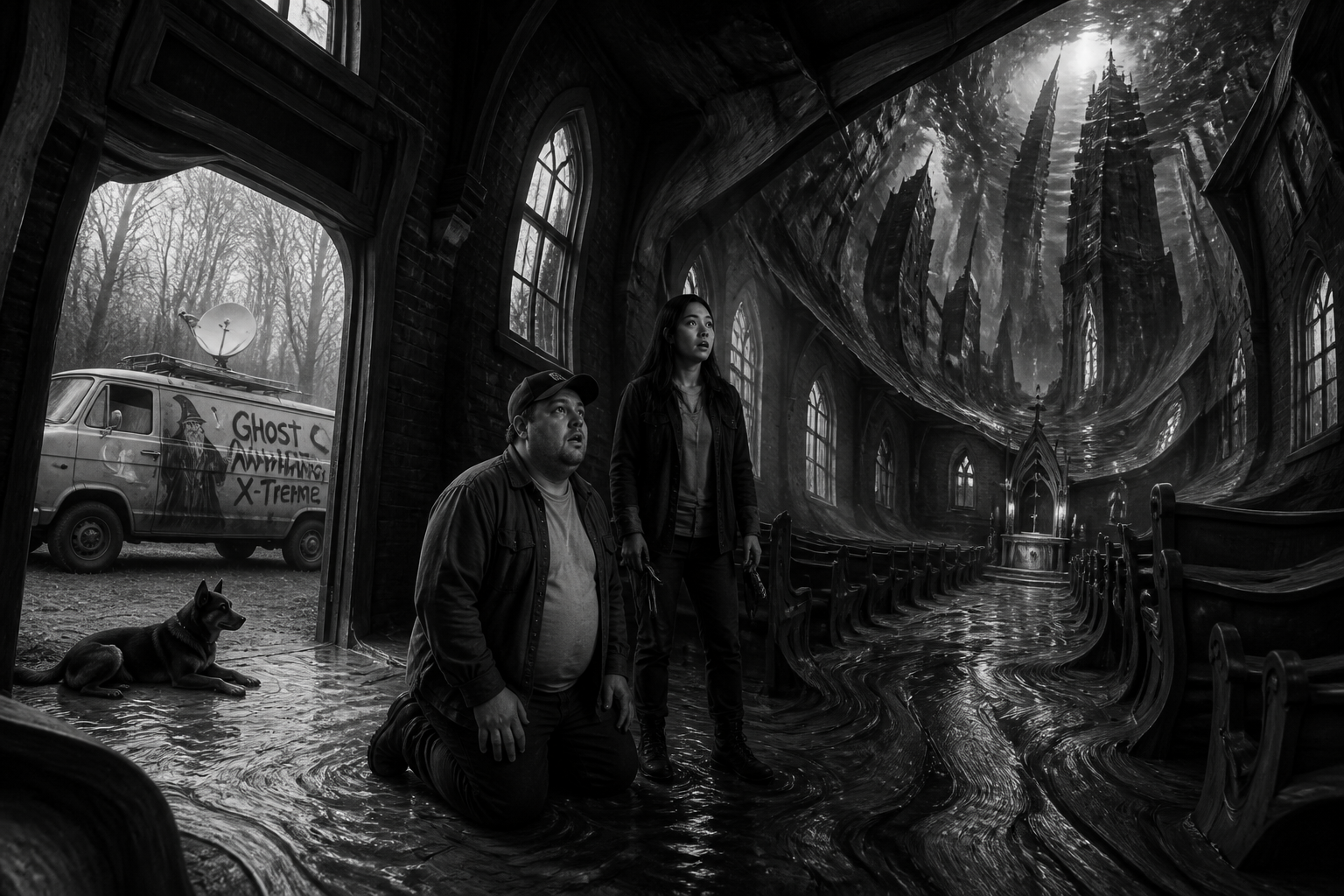
Dusk had settled fully inside. The only light came from the fading glow through the stained glass and a single, dusty bulb hanging from the ceiling near the altar. The nave was rectangular, with a shallow central space at the far end holding the main altar. Two square sacristy rooms flanked it. Joe walked slowly down the center aisle. I followed, adjusting the handheld monitor; the 17 Hz signal was now a constant, deep background hum.
JUPITER The altar area is near where the original 1846 church stood before it was dismantled. The old cemetery is basically right outside this wall.
JOE So we’re standing where one building was taken apart to make room for another.
He knelt, inspecting the wooden floor near the altar. I recorded the thermal differentials—a steady drop of five degrees centered on the aisle, not unusual for an old stone foundation. The hum from my equipment deepened, then distorted.
Then my visual perception seemed to waver.
It wasn’t a physical change in the room, but a momentary, intense distortion in my own vision, likely triggered by the persistent 17 Hz frequency affecting my equilibrium. The wooden pews along the walls seemed to shift in my sight. For a fraction of a second, my mind interpreted their arrangement differently. A wave of disorientation passed over me. The air felt close.
My devices screamed with corrupted data, every screen scrambling into numerical static.
Joe was frozen in a crouch, his face a mask of confusion and disorientation. The profound hum was affecting us both.
The disorienting episode lasted approximately thirty-seven seconds.
Then it passed. The room settled back into its normal appearance. The red brick walls were just walls. The pews were in their places. The air cleared.
My equipment was dead. Not powered off—completely drained and inert. Joe slowly stood up. From the center of the aisle, he picked up a small, loose fragment of yellow Berea sandstone that must have been dislodged from the trim. He pocketed it.
We exited the church in silence. Night had fallen. A partial moon hung behind fast-moving clouds. Cletus was lying at the tree line near the old cemetery, calm and resting.
We moved to the older cemetery plot, the one that held the graves from before the 1895 rebuild. The headstones were worn, many tilted. Joe examined one that had shifted recently, the earth around its base loose. I tried to reboot my handheld reader, but the battery was completely drained. Useless.
JOE (reading from the NRHP form by flashlight) ‘The original 1846 frame church was dismantled during the 1895 construction. Some materials were reused in the new structure.’
JUPITER It was a documented dismantling. Our equipment failure here was severe. The 17 Hz signal could be ambient interference from underground water or old wiring.
The inscriptions on the nearest tombstones were hard to read in the shaky flashlight beam. A faint, rhythmic vibration pulsed up through the soles of my boots—likely the subsonic residue of the earlier equipment feedback or a distant generator. The air carried a scent of damp earth and fallen leaves.
Cletus stood up. She snuffled at the ground near a moss-covered foundation stone at the edge of the plot, then lay back down, resting her chin on her paws, her eyes half-closed.
I shut off my dead equipment. Joe stared at the headstone, his flashlight beam trembling slightly from his hand.
JOE I thought I understood how old buildings showed their age—through stress, through wear, the way materials settle. But that episode in there… it felt like a cascade of sensor failure and disorientation. Not a memory.
JUPITER It was a combination of equipment malfunction and environmental factors—possibly infrasound from the foundation or interference from the cemetery’s older, buried materials. The 1895 church replaced the old one. Any sensation of overlap is a perceptual anomaly, not a recorded event.
We packed the van in silence. My forearm ached deeply. Joe kept the sandstone fragment. Cletus, comfortable where she was, didn't immediately get up when we called. After a minute, Joe didn’t force her. He just started the engine. She trotted over and jumped in just as we began to pull away.
As we drove onto Faussett Road, I looked back. The vestibule light of St. Augustine Church was steady.
Joe drove. Cletus settled in the back. My devices remained dead. The investigation was inconclusive, the anomalies likely stemming from technical and environmental causes.
FIELD NOTES
St. Augustine Church, Hartland, MI. 2026-09-25. Resonance grid malfunction: sustained 17 Hz signal, followed by complete power drain and data corruption. Timestamp glitch was temporary. Visual disorientation episode in nave lasting ~37 seconds, coinciding with peak equipment failure. Attribution: probable infrasound effect or sensory disruption from intense low-frequency signal. Loose Berea sandstone fragment recovered from aisle. Cletus exhibited normal canine curiosity and alertness to surrounding wildlife. Hesitation to re-enter van was brief and unremarkable. All digital equipment permanently drained. Left forearm injury (persistent from 9/22) ached severely during episode. No anomalous physical residues observed post-departure.