The Geometry That Remembered
College Internship Documentation, Casefile 2026-09-29 Jupiter Meteor Nguyen Published on the Weird Little Server
We came to Greencastle, Indiana because Mr. Davenport read online about ‘strings’ warping at old observatories. We stayed because the building began to remember a city that never was—through angles that refused to close and time that folded like wet paper.
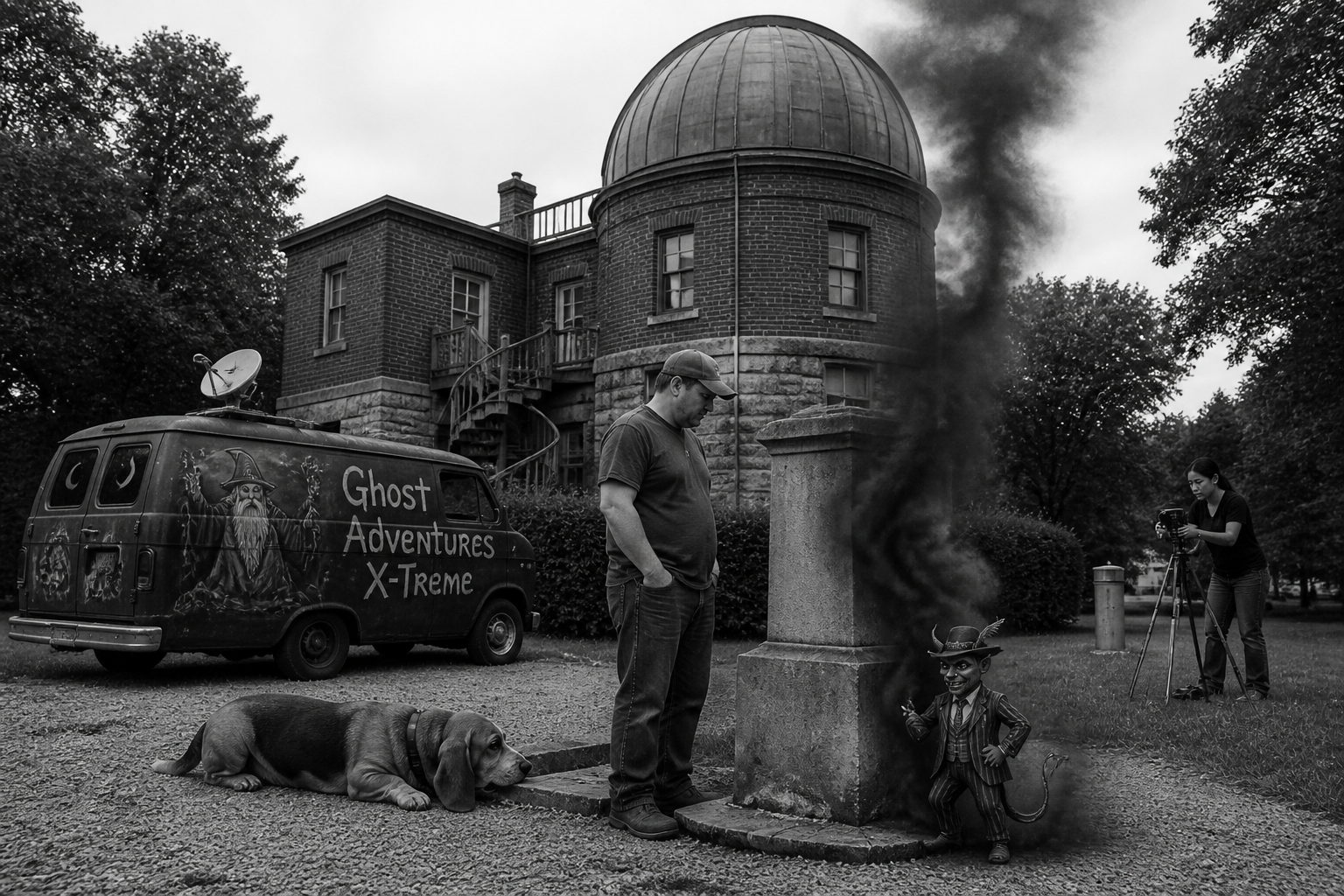
The McKim Observatory is a two-story brick building crowned by a motorized dome, sitting on high ground in a quiet residential neighborhood. It was constructed in 1884, funded by a prosperous contractor and hobbyist astronomer named Robert McKim. Its original two-ton iron dome could be rotated with just twelve pounds of force. A four-foot-thick layer of clay was placed beneath the central masonry pier, an 1880s engineering solution to dampen vibrations from nearby stone quarries and protect the delicate observations of the Clark refracting telescope, installed the following year.
The late afternoon sun cast long, precise shadows across the yard. Mr. Davenport knelt by the eastern base of the pier, his fingers tracing a hairline fracture in the soil where the masonry met the earth. I stood with my back to the dome, adjusting a handheld seismograph on its tripod. Cletus lay belly-down nearby, her nose pressed to the same seam, sniffing with a diligence that suggested nothing more than an interesting smell.
JOE That’s the interface. Clay to stone. They chose it because it’s plastic, right? Absorbs the shock instead of transmitting it. Smart.
JUPITER If the clay is still intact. Seismic baseline is running. It’s quiet.
JOE My old American Building book talks about this. Joseph G. Moore. They’d use sand, clay, even lead shot in foundations to kill vibration. This was high-tech for 1884.
He flipped open a worn paperback, showing me a diagram of vibration-dampening layers. I watched the seismograph’s readout, a flat green line. Cletus’s ear twitched. Then she flattened herself against the ground, a full-body press. The air tasted faintly of silt, like the bottom of a dried-up pond. My seismograph spiked—a sharp, narrow band at 17 Hz—for exactly three seconds before the line went flat again.
JUPITER Did you feel that?
JOE Metallic taste. Old pipes, maybe. What’d you get?
JUPITER A pulse. Seventeen Hertz. It’s gone.
He looked at Cletus, who was now staring intently at the crack, her body rigid.
JOE Probably a gopher. Let’s go check the big telescope. If the foundation’s talking, the instrument might be listening.
The wooden spiral staircase to the second-floor Equatorial Room was steep and worn smooth in the center of each tread. Mr. Davenport went first, his flashlight beam bouncing off the brass fittings of the handrail. I followed with a handheld EMF meter, more out of habit than expectation. Cletus, at the bottom, gave a soft whine and laid down, refusing to ascend.
The room was a high-ceilinged octagon dominated by the Clark refractor. Its nine-and-a-half-inch objective lens, ground by Alvin Clark & Sons in 1885, gleamed under the fading light coming through the dome slit. Mr. Davenport went straight to the gravity-drive mechanism, a restored clockwork system that once used falling weights to track stars across the sky.
JOE They put this back in the eighties. Howard Brooks and his students. Before that, it was just a motor. This is the real heart of it.
JUPITER Ambient temperature is stable. No unusual EM fields. The UV filter on the secondary scope is… misaligned.
He reached out and touched the drive lever, commenting on the craftsmanship of the Warner & Swasey mount. As his fingers made contact, the entire telescope assembly, with a soft grind of perfectly maintained gears, rotated fifteen degrees to the left. No power was connected. Through the eyepiece of the smaller UV scope, I saw the filter glint. Not with reflected twilight, but with something dark and fluid moving beneath the glass, a submerged lattice of impossible geometry.
A long, guttural wail came from outside, followed by a shiver of silence. Cletus.
JUPITER Mr. Davenport.
JOE The gears must be… hang on.
JUPITER Look at the finder scope.
I rushed to the window that overlooked the yard. From the exact clay cleft we’d just been examining, a thin column of rust-colored smoke was rising, coiling against the dusk like an inverted root.
We descended quickly. Cletus hadn’t moved from her spot on the gravel, but she was frozen, staring at the smoke. Mr. Davenport followed me, skepticism tightening his features as he shone his flashlight into the ground crack.
JOE Water intrusion. Or a root finally gave way. That’ll destabilize the whole…
The smoke condensed. It did not dissipate. It gathered, thickened, and formed the shape of a slim, lanky figure about two and a half feet tall. A feathered hat. A striped suit. Pointed shoes. Beelzebubba the Third stepped forward as if the lawn were a stage, his sharp grin cutting through the gloom. He stood directly in front of, and partially through, Mr. Davenport, who felt nothing.
BEELZEBUBBA A for effort, Broseph. But you’re digging in the guest book, not the foundation.
Mr. Davenport was now occupying the same space as the imp. He frowned at me as I stared, horrified, at a point just past his left hip.
JOE Jupiter? You okay? You’re white as a sheet.
JUPITER You don’t see him?
JOE See who?
Beelzebubba tipped his hat to me, then turned his gleaming eyes to Cletus, who had risen to a half-crouch.
BEELZEBUBBA She knows the taste. Older than clay. Older than stone.
He took a theatrical step toward her, kneeled slightly, and whispered something I could hear perfectly. His voice was intimate, a needle of sound.
BEELZEBUBBA You fear the forgetting, don’t you, hound? The great, hungry blank.
Cletus flinched as if struck, but she didn’t retreat. A low growl vibrated in her throat, her hackles rising in a perfect ridge along her spine. At that moment, the 17 Hz pulse returned, not as a reading but as a physical vibration. The loose stones around the base of the pier chattered against each other.
The lights inside the observatory flickered once, twice, and died.
JOE Okay. Power’s out. Let’s…
He was looking at Cletus reacting to empty space, at me staring at nothing, at the chattering stones. His practical explanation hit a wall. We both turned toward the darkened building.
We left Cletus outside. She lay down perpendicular to our van, as if bracing for impact. Inside the Equatorial Room, the only light came from the deepening blue of the evening sky through the open dome slit.
We were there to check the motor controls. We never got the chance.
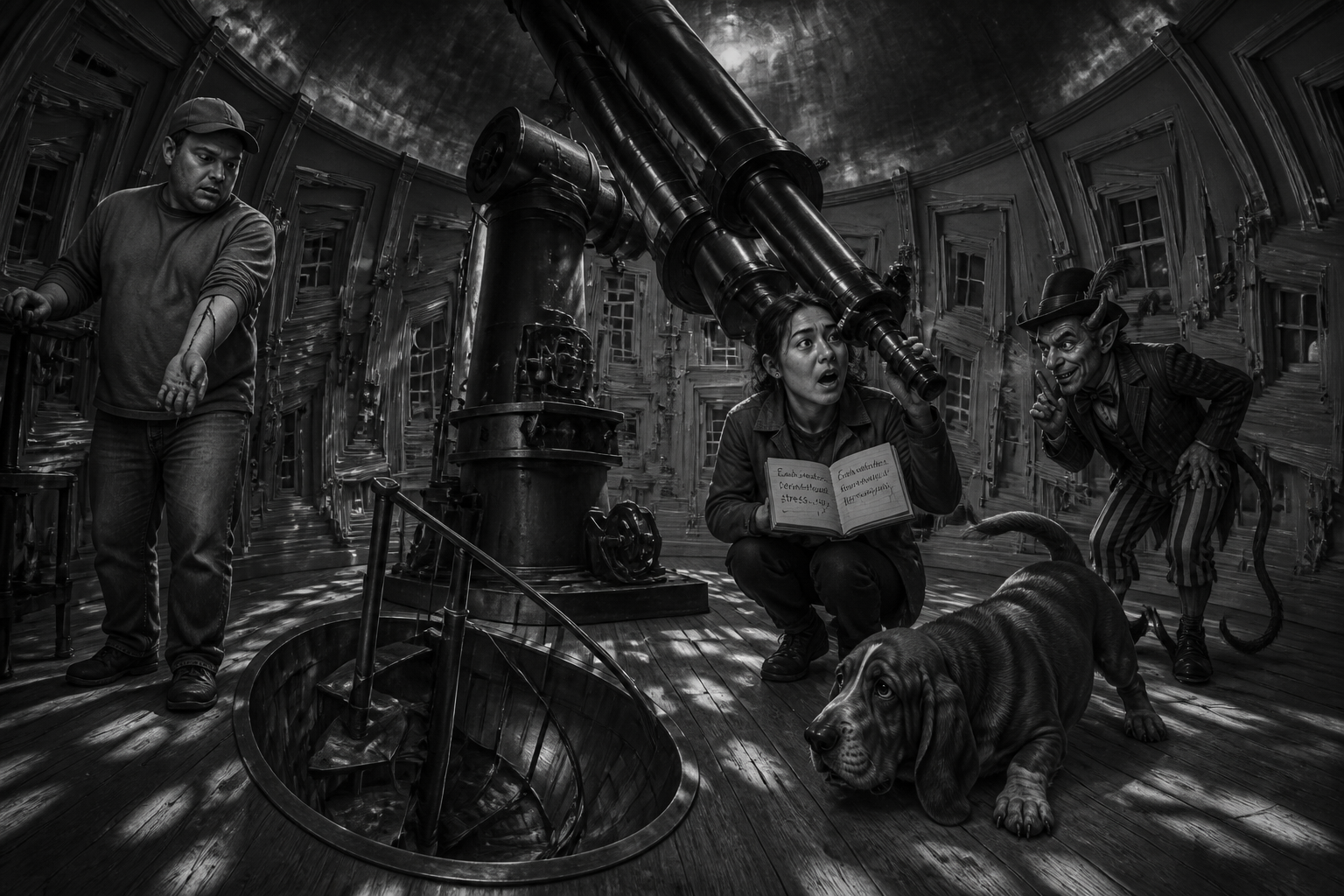
The dome began to shimmer. Its segmented metal surface lost definition, becoming impossibly smooth, a perfect mathematical sphere. The walls of the octagonal room did not vanish, but they multiplied. Each corner sprouted another corner, each wall revealed a smaller, receding version of itself, a visual recursion of angles that hurt to follow.
Below us, through the floor, I could see the octagonal room beneath the pier. It was expanding, not in size, but in conceptual depth, becoming a chamber of non-Euclidean geometry. The Clark telescope rotated again, autonomously, its lens now pointing at a fixed spot in the newly spherical dome.
JOE No. No, this isn’t a residual haunting. This is…
His words trailed off. My digital thermometer, my seismograph, my audio recorder—all their screens locked simultaneously. Not to zeros. To a date: 1885-04-17.
For fourteen minutes, the architecture warped. The spiral staircase, visible through the open trapdoor, no longer descended to the first floor. It spiraled down into a void of black-green stone. Light bent at acute angles, casting not shadows but constellations that do not exist—sharp, recursive patterns on the floor. In the UV finder scope, the lattice of geometry floated, not behind the glass, but submerged in a void-space behind our own.
Mr. Davenport clutched his left forearm. A line of blood welled up through his shirt sleeve, beading and running in a neat trickle. It pulsed in perfect, visual sync with a subsonic thrum I could now feel in my teeth. The 17 Hz pulse was no longer a spike. It was the heartbeat of the event.
He didn’t cry out. He just watched his own blood drip onto the oak floor, his face a mask of pure, unadulterated disturbance.
Then, with a sound like a great intake of breath, the world snapped back.
The dome was segmented metal again. The walls were simple, flat planes. The telescope was still. The blood on Mr. Davenport’s arm stopped flowing. The devices in my hands went black, then rebooted to their normal start-up screens. The silence was absolute and heavy.
We regrouped outside on the gravel path. The night was fully dark. Cletus refused to enter the van, lying stiffly where she’d been. Beelzebubba was gone, leaving only a faint scent of rust and damp earth.
Mr. Davenport was wiping his forearm with a bandana. No cut, no scratch. Just wiped-away blood. He flipped through his old book, not reading, just turning pages with a white-knuckled intensity.
JOE It’s a fault line. The dome. It’s a fault line in the geometry. My book… it got the shape right. But not the hunger behind it. It wasn’t reacting to us. It was… reciprocating.
JUPITER All devices locked to April 17th, 1885. There’s no recorded event on that date. Not for the Clark installation, not for McKim, not for the university.
JOE Then what is it remembering?
I had no answer. We loaded our gear in silence. Mr. Davenport drove, his grip on the wheel tight. I watched the observatory shrink in the side mirror, its dome a pale orb against the black trees. Cletus didn’t move from her spot in the back until the engine turned over.
This wasn’t a haunting. It was structural memory playback on a scale I hadn’t imagined. The observatory isn’t haunted. It’s a host. And we had just listened to it remember something buried long before the first brick was laid.
FIELD NOTES
- Seismic baseline remains unstable post-event; 17 Hz pulse is a durable signature.
- Clay-layer interface shows new microfractures radiating from the primary cleft.
- UV filter on secondary scope is physically damaged; trace mineral residue (not glass) collected for analysis.
- All digital devices experienced full corruption; hard reset required. Timestamp lock to ‘1885-04-17’ is persistent in internal logs.
- Mr. Davenport’s left forearm bled without antecedent injury. Bandana sample retained.
- Beelzebubba the Third confirmed visible/audible only to me and Cletus. Mr. Davenport perceives zero evidence of his presence.
- Cletus exhibited extreme avoidance behavior post-event, consistent with prior resonance exposures.
- Theory: The site is not reacting to stress. It is reciprocating with a deep, non-human geometric memory stored in its substrate. The date is an anchor, not an event.