Ghost Crusade X-Treme: The Angles That Held
Site: Old Taylor County Courthouse and Jail, Buffalo Gap Historic Village, Buffalo Gap, Texas
Investigation Date: 2026-10-02
Documentation by: Jupiter Meteor Nguyen, Parapsychology and Physics Intern
Published by: Joseph Davenport Sr., Weird Little Server
Joe said he read online about a 'strings phenomenon' vibrating through old courthouses. I said it sounded like structural resonance. Then the limestone started breathing.
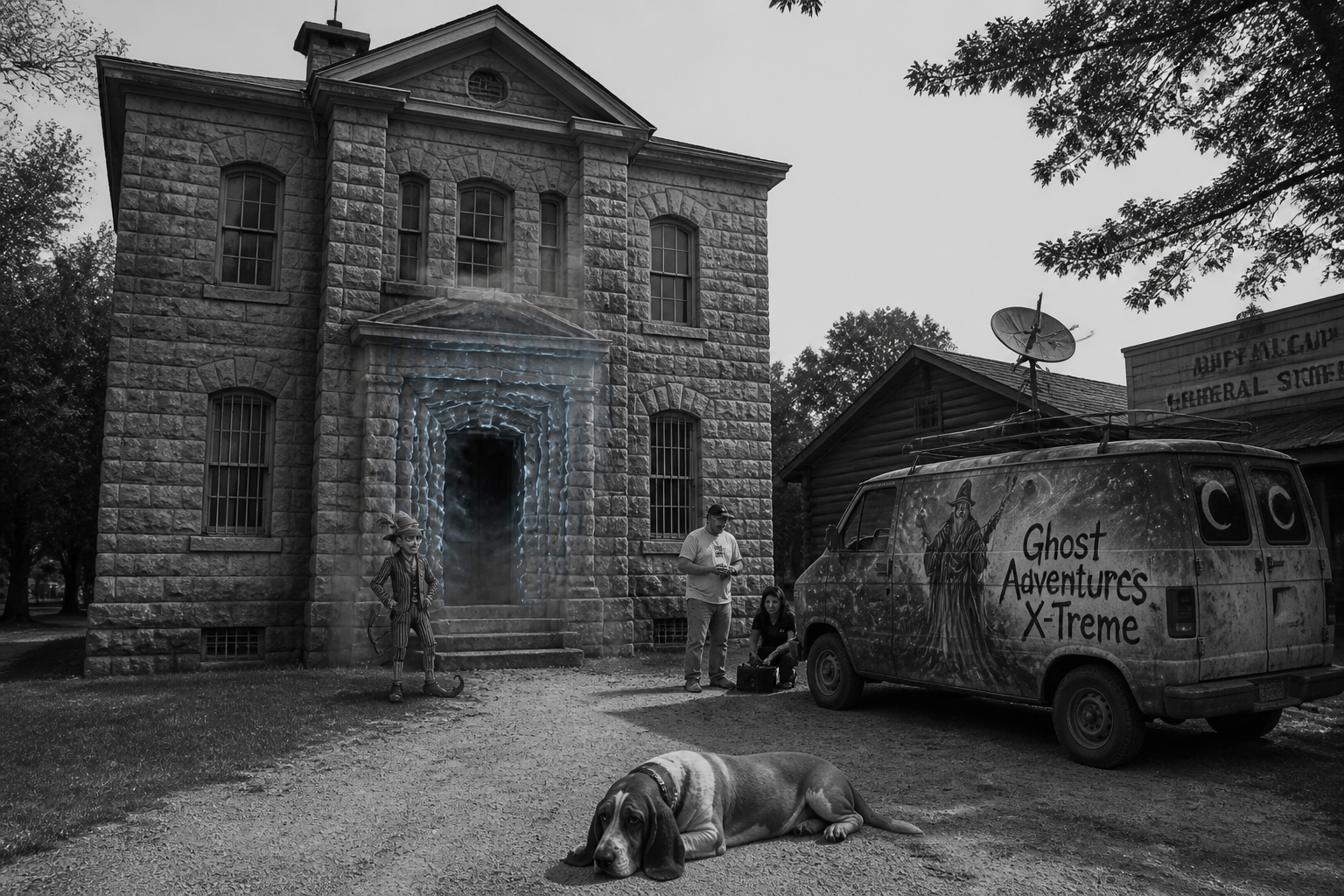
The Old Taylor County Courthouse and Jail sits at the intersection of Farm roads 89 and 1235, thirteen miles southwest of Abilene. The Callahan Divide, the topographic boundary between the Brazos and Colorado basins, crosses Buffalo Gap from east to west. The building is a two-story native limestone and sandstone structure, built in 1879 by Martin, Bryne & Johnston. It served as Taylor County’s first courthouse and jail until the county seat moved in 1886. Its most distinctive feature is the mortar: the builders used cannonballs between the concave-centered sandstone blocks to prevent chiseling by prisoners.
We arrived in late afternoon, the sun low over the Divide. Cletus hopped out and immediately lay in the gravel path, nose twitching. I unloaded my equipment case. My left forearm ached dully.
Joe stood at the central entrance, running a hand over the sandstone blocks. I knelt near the mortar line, calibrating a laser level on a tripod.
JOE Look at these joints. They mortared these with actual cannonballs. 19th-century prison engineering.
JUPITER The county was established in 1874. Buffalo Gap was the temporary seat. First election was July 23, 1878. Eighty-seven voters.
JOE See? A brand-new county, building a courthouse and a jail in one. They were thinking about order. About containment.
I was watching the laser’s red dot on the mortar. It flickered. A low hum, just at the edge of hearing, vibrated up through the stone into my knees. The mortar between two cannonballs seemed to darken for a second.
A small curl of smoke, smelling of old rope and river silt, emerged from the gap between the doorjamb and wall. Beelzebubba the Third stepped out, adjusting his bow tie.
BEELZEBUBBA Meteor. Your dog is judging the masonry.
Cletus lifted her head from the gravel. She stared at Beelzebubba, then sniffed the air.
JOE You getting a reading? The level glitched.
JUPITER It flickered. There’s a low-frequency resonance. Let’s check the inside.
I snapped a photo. Cletus did not move from her spot as we walked inside.
The interior had been restored as a museum. Modern lighting fixtures hung from the original ceiling beams in the courtroom. Dusk was falling outside.
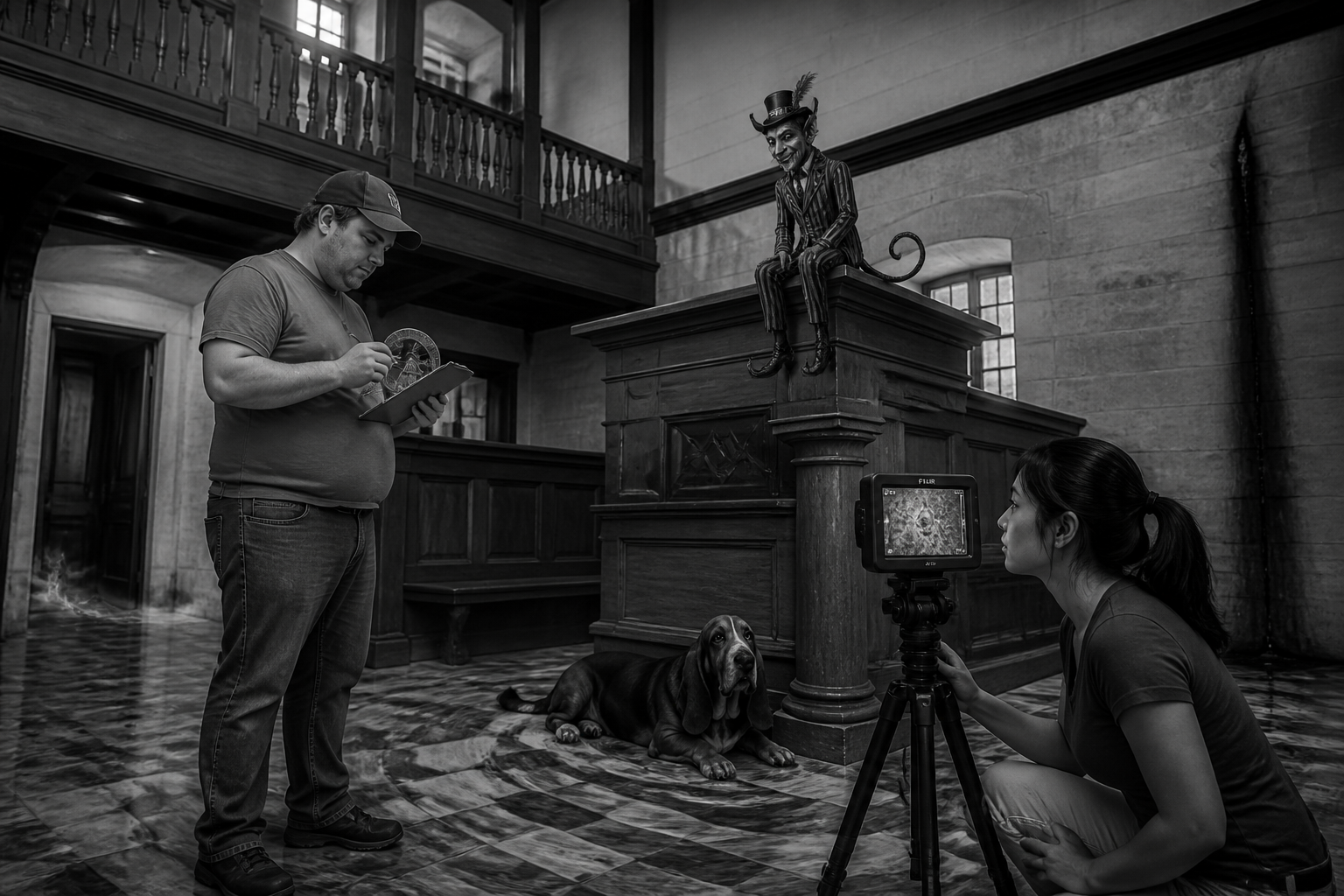
Joe walked the perimeter, tapping the walls. I set up the thermal imager in the center of the room. Cletus came in last. She went straight to the judge’s bench, sniffed the base of the central column supporting it.
JOE Testing the floor. These tiles aren’t original, but the subfloor might be.
The thermal screen came to life. I ran a baseline scan. The limestone walls showed as a cool blue. Then the image shifted. A wave of warmth, then coolness, flowed across the screen in a slow, rhythmic pattern. Expansion. Contraction.
JUPITER Mr. Davenport.
JOE What?
JUPITER The limestone. It’s… breathing.
He came over. On the screen, the entire north wall pulsed with a regular, organic rhythm. The floor tiles near the judge’s bench rippled. Not a visual effect—the physical tiles themselves lifted and settled in a slow wave. The air thickened with the scent of brine and wet stone.
A shadow detached from the north wall. It was not a human shape. It was an angular, intersecting mass of darkness that slid across the ceiling at a steady pace before dissolving into the corner.
Beelzebubba was perched on the judge’s bench, his tail curled.
BEELZEBUBBA It remembers the weight of the water.
Cletus turned her head toward him. A low, rolling growl began deep in her chest.
JOE Cletus? What’s she…?
JUPITER She sees something.
JOE Where?
My camera, still on the tripod, beeped. The screen froze. The timestamp in the corner was corrupted—a string of numbers and symbols.
JUPITER My camera just locked up.
Joe pulled out his field notebook. He flipped to a fresh page and began sketching the room, his protractor clicking against the paper.
JOE The building was the seat of government until 1886. Then it was a private residence. Ernie Wilson bought it in 1956, turned it into a museum.
JUPITER It transitioned from government function to private residence to museum. That’s a lot of different intentions layered in one structure.
Cletus’s growl grew louder. She was staring at the base of the column.
We went back outside. Night had fallen. A single security light above the doorway cast a yellow cone on the steps.
I tried to reboot my equipment. Every device—thermal imager, camera, audio recorder—was locked, screens showing static. Joe stood under the light, comparing his fresh sketches. Cletus lay motionless in the same gravel patch, eyes open.
I saw Beelzebubba standing near the doorjamb, watching the mortar.
JOE The angles in my sketch… they’re wrong. Not wrong like I drew them wrong. Wrong like the room doesn’t want to be measured.
JUPITER What does that mean?
JOE I don’t know. But it’s in the stone.
The central entrance rippled.
It was not an illusion. The concave sandstone blocks undulated inward, as if the wall were made of water disturbed by a stone. The mortar between the cannonballs darkened, then lightened, the contrast shifting in a slow wave.
The van’s rear camera, which I’d left running, froze on the dashboard display.
All my devices, now in my hands, simultaneously chimed. Every screen displayed a corrupted string of symbols. Then they went dark.
Beelzebubba smiled, a sharp, delighted expression.
BEELZEBUBBA And so it does.
Cletus did not move from the gravel. She only turned her head once—toward the northern corner of the building, where a dark, oily water began to weep from a joint in the limestone.
Joe closed his notebook with a definitive snap. He looked at the weeping stone, then at me.
JOE We’re leaving.
I didn’t argue. I powered down what little gear still responded. My forearm throbbed.
Cletus would not get up. Joe had to lift her and carry her to the van. She didn’t struggle. She stared back at the courthouse until Joe placed her in the back seat.
We drove away in silence. No one spoke. In the rearview mirror, I watched the courthouse recede. Its shadow, cast by the security light, seemed to fracture on the ground.
Joe’s hands were tight on the wheel. He finally spoke, just once, twenty minutes down the road.
JOE This wasn’t a haunting. It was a memory. But not of people.
I didn’t have a correction. I looked at my devices, all dark. I thought of the breathing limestone, the weeping stone, the angles that wouldn't stay measured.
FIELD NOTES
- Structural Anomaly: Limestone respiration confirmed via thermal imaging. Rhythmic expansion/contraction cycle observed.
- Acoustic Data: Low-frequency resonance detected at exterior mortar joint. Could not get a stable frequency reading due to subsequent equipment failure.
- Digital Anomaly: All digital recording devices (FLIR, Sony A7, Zoom H6) experienced simultaneous lock-up and data corruption. Corruption is persistent across power cycles. Data unrecoverable.
- Visual Phenomenon: Mortar between cannonballs at the central entrance exhibited a wave-like contrast shift. No legible letters or words formed.
- Material Emission: Dark, viscous fluid weeping from the northern corner joint. Smell: brine, silt, iron. Not collected. Cletus fixated on this location.
- Beelzebubba Sighting: Observed at exterior entrance and courtroom bench. Made no attempt to interact with the primary phenomenon. Commented on "the weight of the water."
- Canine Behavior: Cletus exhibited prolonged fixation on the weeping stone and the central column. She refused to leave her spot afterward.
- Personal Note: Left forearm injury (originally torn during the Shaffer Chapel event) ached during the investigation. Correlation noted.
- Historical Anchor: Building served as Taylor County Courthouse and Jail from 1879-1886. No verified unusual events from that period are documented. Site has been a museum since 1956.