THE CHAPEL THAT REMEMBERS HOW TO FALL
Gadsden, Alabama. October 4, 2026.
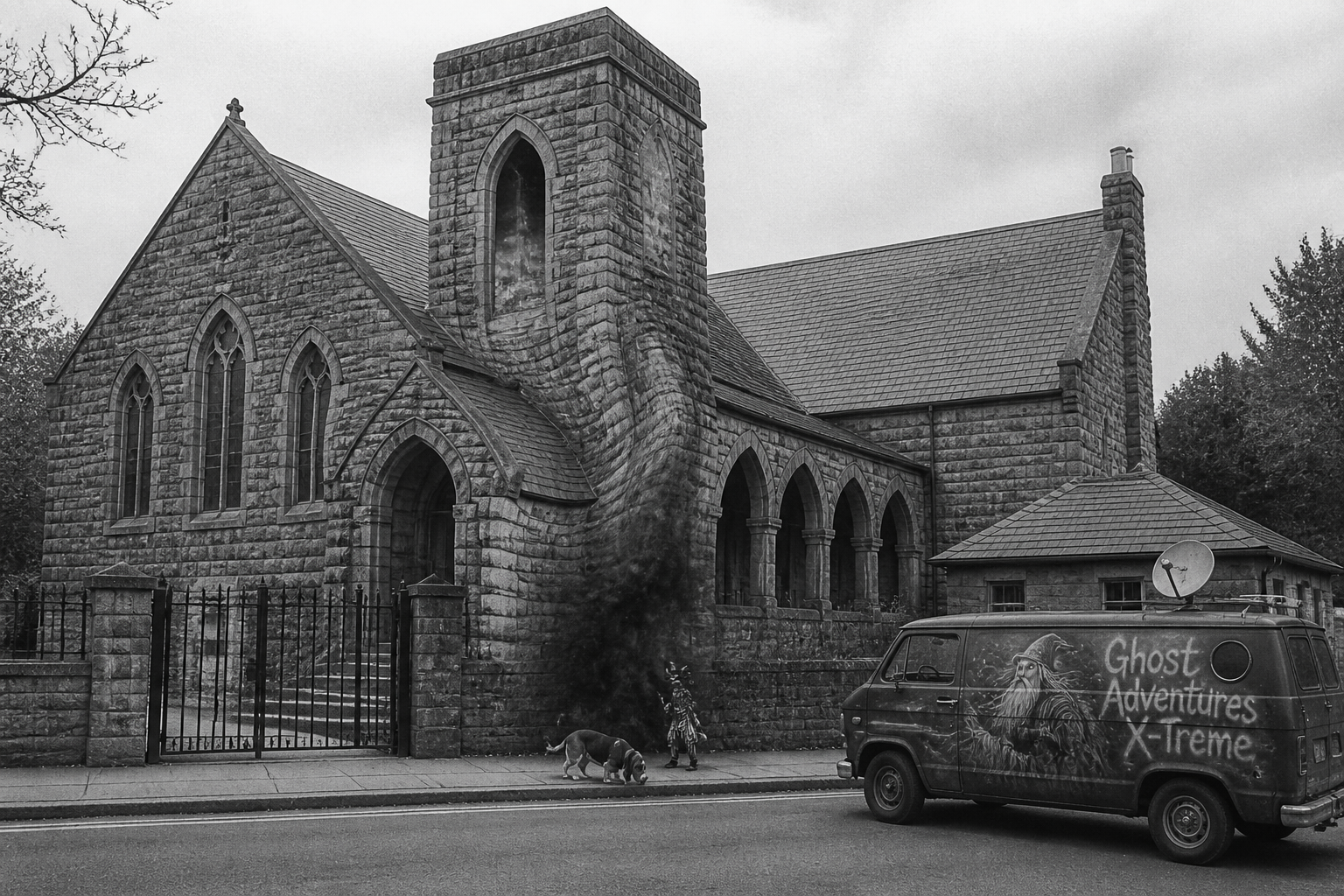
The Forrest Cemetery Chapel is a lesson in texture. From a distance, it’s a postcard: a small, L-shaped Gothic Revival church built from hand-cut sandstone, a central tower, steep slate roofs. Up close, you feel the weight of the stone, quarried from Lookout Mountain by Works Progress Administration laborers in 1935. The door hinges and plates were hand-forged by physically disabled workers on the same project. The pews inside are salvaged from the demolished Etowah County Courthouse. It’s a building assembled from other places, other purposes, other hands. Joe Davenport said he’d read online about “structural memory” fraying at the seams of old WPA projects—something about buildings that remember how they were made, and sometimes, remember other things. I told him the only thing fraying was his judgment after whatever he’d decided constituted a “road soda” last night. Then my camera’s timestamp flickered and settled on 1885-04-17. My phone matched it. So did the margin of Joe’s open notebook, in faint blue script he hadn’t written.
We parked on South 15th Street as the late afternoon sun threw the tower’s long shadow across the wrought iron gate. The west side of the cemetery adjoined the silent Gulf States Steel property, a blank industrial wall. The air was still and humid, Alabama October clinging to summer.
JOE Strings, Jupiter. Not ghosts. The books talk about residual stress in a building’s geometry—like a tape recording in the stones. If you know how to listen…
JUPITER The books also talk about vampire bats in Transylvania, Mr. Davenport. Can we focus on the fact that every digital device I have is insisting it’s April 17th, 1885? A date with no recorded event here.
JOE That’s the memory. Not the event. The schedule.
I was ten feet back from the gate, calibrating the laser level. Joe leaned against the ironwork, fiddling with a UV flashlight. Cletus had already trotted off, her nose to the base of the three-foot-high sandstone wall near the adjacent comfort station—a low, hip-roofed utility building that was once a restroom.
A sudden, sharp chill ran up my left forearm, centering on the thin cut that hadn’t fully healed from Crow Wing County. I looked down. The air near the foundation shimmered, like heat haze on a cold day, and a small, localized curl of oily black smoke pulsed out from the stones. It smelled of wet iron and rotten pine.
BEELZEBUBBA Meteor. You brought the hound. How… pastoral.
He was there, just behind Cletus. Slim, two and a half feet tall, in a shabby striped suit and a feathered hat. His grin was a blade. Cletus’s head swung around, ears twitching, and she sniffed sharply at the empty air where he stood.
JOE (Joe glances at Jupiter, then at Cletus) What’s she smelling?
JUPITER Nothing. She’s… it’s nothing.
I said nothing. The imp winked at me, then the smoke curled in on itself and he was gone. The chill in my arm remained.
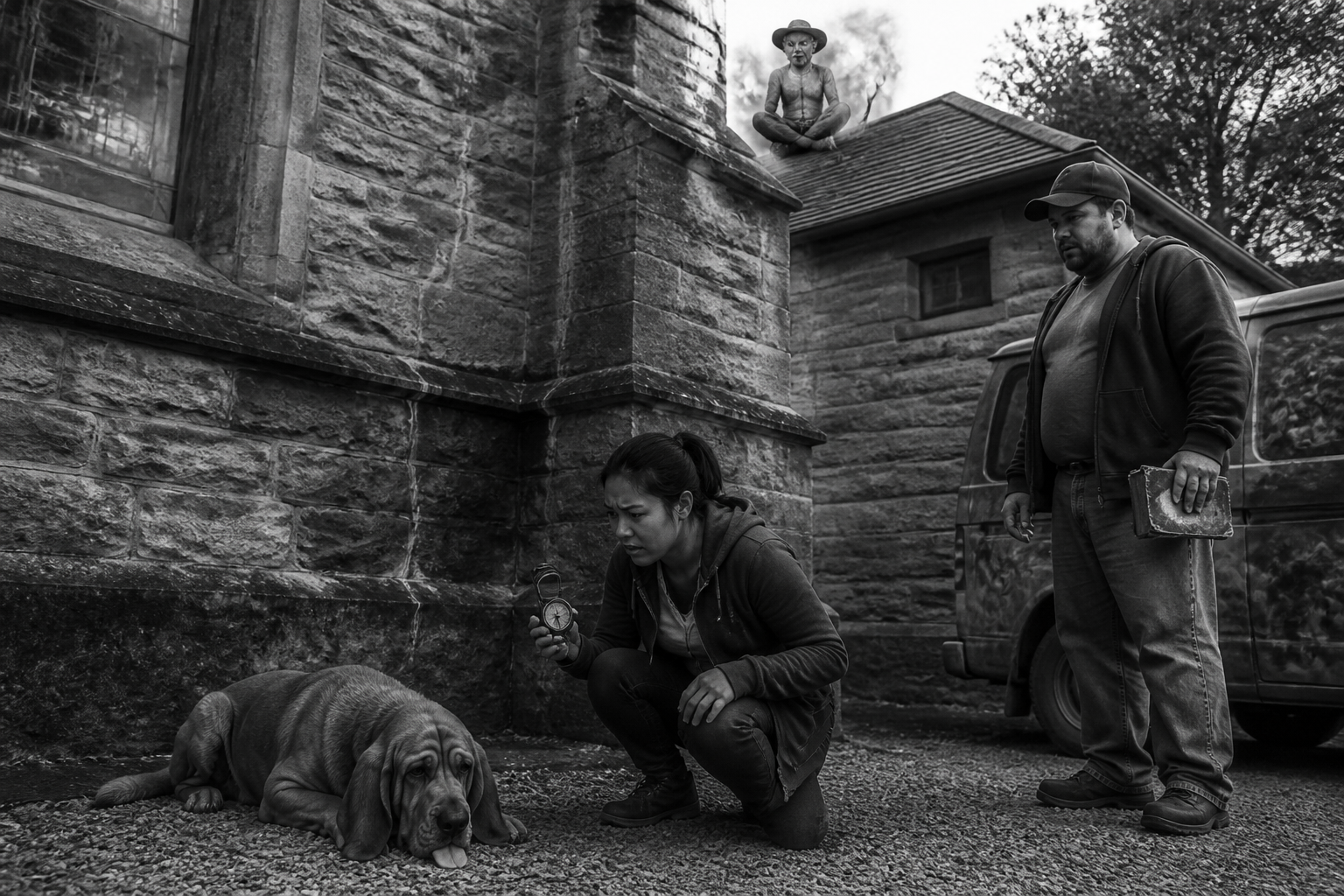
Cletus whined, low and uncertain, and turned to lick the northern corner of the chapel wall. I forced my breathing to steady and walked over, laser level in hand.
At the corner where the chapel met the comfort station, a fine seam in the sandstone was weeping. Not water. A clear, viscous fluid that beaded on the stone and smelled, when I bent close, of old parchment and pine pitch. Cletus lay down flat on the gravel, belly to the ground, her head tilted as if listening to something deep in the earth.
JOE (Kneeling, flipping through a tattered, water-stained book) See? Structural empathy. The building feels its own history. The stress of construction, the weight of the mountain it came from… it bleeds.
JUPITER It’s a mineral deposit, Joe. Probably a resin from the original quarry bedding. Can you hand me the UV light?
He did. Under the ultraviolet beam, the weeping seam was just a wet line. But six inches above it, a single chisel mark—a short, deep gouge left by the original stonecutter—glowed a faint, persistent blue. It wasn’t reflective. It was emitting.
JOE That’s not in the manual.
JUPITER No kidding.
Cletus lifted her head and licked a bead of the clear fluid from the ground. She did it once, then again, methodically.
BEELZEBUBBA She tastes the recipe. One part mountain, two parts forgotten hour.
He was perched on the low corner of the comfort station’s roof now, legs crossed, watching Cletus. She sniffed the air in his direction but didn’t look up.
JOE (Not looking up from his book) What’s she doing now?
JUPITER Licking the wall. Or the ground. I don’t know.
My compass, clipped to my belt, began to spin. Not a slow drift. A violent, whirling oscillation that settled not on north, but pointing directly into the foundation, at an angle about twelve degrees below horizontal. The origin point, if I traced the vector back, was somewhere under the cemetery, outside the chapel’s footprint.
Joe saw my face. He stood up, brushing gravel from his knees.
JOE Okay. Let’s go inside before it gets dark. I want to see if the interior geometry matches the stress lines.
The double wooden doors were heavy, the hand-forged hinges cold to the touch even through the warm evening air. Joe pushed. The door didn’t creak. It groaned—a deep, resonant sound not of friction, but of compression, as if the wood were being squeezed inward against itself.
JOE That’s not settling. That’s… breathing.
We stepped into the entrance foyer. The floor was solid sandstone, cool and uneven. Ahead lay the sanctuary. The three iron chandeliers—made, according to the plaque, from wagon wheel rims and farm equipment scrap—hung dark and still. We flicked on our lanterns.
The air changed. It didn’t get colder. It thickened, like we were moving through something more substantial than air. My compass needle remained locked, pointing down and eastward through the floor.
The sanctuary was simple: exposed wooden buttresses, a high ceiling, the repurposed courthouse pews. To the left, an open doorway led to a small office with a corner fireplace. Joe moved toward the elevated stage area under the large Gothic window. I crouched by the northern office’s fireplace, its marble mantel cool and veined.
JOE (Shining his light on the chandeliers) The Time-Life book had a case… a church in Cornwall where the fixtures would rotate during services. They thought it was a draft.
JUPITER It probably was a draft.
As I said it, the chandelier above me began to turn. Slowly, silently. Not all of them. Just that one. The shadows of its iron straps wheeled across the floor and up the wall.
BEELZEBUBBA He’s not wrong. He’s just reading the wrong edition.
He was sitting cross-legged on the marble mantelpiece beside me, tail curled, watching the compass in my hand. I flinched, nearly dropping it.
JOE (From the stage) What now?
JUPITER Nothing. The compass is… stuck.
The chandelier picked up speed. Then the one over the stage began to rotate in the opposite direction. The third remained motionless. The air began to carry a subsonic thrum, a pressure against the ears more than a sound. 17 Hertz. I could feel it in my teeth, in the old cut on my arm which began to ache in time with the pulse.
Then the floor rippled.
It wasn’t a wave. It was a localized buckling, as if the sandstone slabs were a carpet being snapped. The wall to my left, the north wall with its Gothic window, twisted. Not cracked. Twisted, like soft taffy, the stone flowing and re-forming into a different, sharper angle. The window stretched, its arch elongating into a thin, impossibly tall slit.
JOE (His voice tight) That’s not in the book. That’s not in any book.
The L-shaped interior of the chapel ceased to obey. The space between the fireplace where I crouched and the stage where Joe stood didn’t lengthen—it multiplied. An archway appeared in the solid wall beside the stage. Through it, I saw another archway, identical but slightly smaller. Through that, another, smaller still. A recursive tunnel of stone arches diminishing into infinity, all converging on a single, impossible point somewhere beneath the foundation.
The ceiling above us ceased to be a ceiling. It became a living membrane, undulating slowly, the color of a deep bruise. The chandeliers hung unsupported in the open air, spinning at different speeds, casting overlapping, impossible shadows that didn’t match their positions.
The fireplace in front of me was no longer a fireplace. It was the top of a vertical column of fireplaces, each stacked perfectly atop the other, receding downward through the floor. Within each hearth, a flickering scene played: a blizzard raging on a barren plain; a frozen forest under a green moon; a glacier calving into a black sea. Impossible winter landscapes, one per hearth, all silent.
The subsonic pulse solidified into a physical force. Time fractured. A second stretched into an hour; a minute snapped past in a blink. The smell of brine and wet, deep stone flooded the room, choking out the scent of old wood and dust.
BEELZEBUBBA (His voice clear amidst the distortion) Every building is a prayer. Some are answered.
He stood in mid-air, at the center of the recursive archways, untouched by the folding geometry. He spread his arms slightly, a conductor before a catastrophic orchestra.
Joe had stumbled back, his back against the now-useless stage. He was staring at the column of winter fireplaces, his face pale, the tattered book hanging forgotten from his hand.
The phenomenon lasted forty-three seconds.
It ended not with a bang, but with a sudden, profound snap of realignment. The arches sucked back into the walls. The ceiling solidified. The chandeliers dropped back into their mounts with a triple clang. The column of fireplaces collapsed back into a single, ordinary stone hearth.
The thick air vanished, replaced by the familiar damp chapel atmosphere. The subsonic hum was gone.
My compass still pointed down and east. The timestamp on my camera still read 1885-04-17.
Joe let out a long, shaky breath.
JOE We need to go. Now.
We exited not through the front doors, but through a side door that led into the comfort station—now a storeroom—and out its exterior door. The gravel path felt unstable beneath my feet. Cletus was exactly where we’d left her, lying belly-down on the gravel. She hadn’t moved.
Joe stood frozen by the comfort station door, staring at the lane that led back to our van. His face was blank.
JOE The road…
JUPITER What about it?
JOE It looks like water. Deep water.
I looked. It was asphalt, dry and gray in the dusk. But for a moment, my own eyes insisted it was a lane of dark, still water, ready to swallow anything that stepped onto it. I blinked, and it was asphalt again.
Cletus whined. I approached her, kneeling. “Come on, girl. Time to go.”
She wouldn’t get up. She looked at me, then deliberately licked the gravel a third time. In the fading light, her tongue shimmered with an oily, iridescent sheen, like oil on water.
BEELZEBUBBA She’s chosen her side of the gate.
He was there one last time, leaning against the sandstone wall. His form was faint, translucent.
JUPITER (To the imp) What did we walk into?
BEELZEBUBBA A shift change.
He tipped his hat. A small, localized cloud of infernal smoke, smelling of sulfur and burnt wiring, curled around him and he was gone. A faint, bell-like reverberation hung in the air after.
JOE (Still staring at the now-normal road) You okay? You’re staring at nothing again.
JUPITER I’m fine. Help me with Cletus.
We coaxed her, finally, to her feet. She walked, but she avoided every stone slab, every paved section, keeping strictly to the gravel and then the grass. She refused to enter the van until Joe physically lifted her in.
He drove, silent for the first ten minutes. I watched the rearview mirror. The Forrest Cemetery Chapel, its square tower against the night sky, shrank behind us. Just as it was about to disappear from view, the tower flickered. Not a light. A visual flicker, as if for one second it wasn’t a Gothic Revival tower, but something older, thinner, a drowned spire breaking a black water surface. Then it was stone again, and then it was gone.
JOE (This, softly) That wasn’t in the Time-Life books. That wasn’t even in the margins. That date—1885—it’s not a memory. It’s a schedule. And we walked right into its shift.
I looked at my hands. The cut on my arm throbbed dully. The van’s dashboard clock, my phone, everything still read 1885-04-17. The building wasn’t haunted. It was occupied. And whatever was in it didn’t care about ghosts. It cared about geometry, memory, and the weight of the hands that built it.
And now, it was remembering how to fall.
FIELD NOTES
Jupiter Meteor Nguyen // Internship Log #GCX-20261004
Site: Forrest Cemetery Chapel & Comfort Station, Gadsden, AL. GPS: 34.01139, -86.02611 Conditions: 68°F, 72% RH, late afternoon into dusk.
Anomalies Logged:
1. Pervasive timestamp lock on all digital devices: 1885-04-17. No historical event on record for site. Precedent from Crow Wing County (10/2) continues.
2. Chisel mark at 0.8m height on north exterior wall exhibits persistent faint blue phosphorescence under UV (365 nm). Not bioluminescent. Material sample (weeping exudate) collected: odor of parchment/pine pitch. Awaiting lab.
3. Triaxial compass shows sustained anomalous orientation: vector points 12° below horizontal, origin extrapolates to a point ~15m east and 5m below exterior foundation. Magnetic field disturbance localizes to structure.
4. Primary manifestation recorded (subjectively) as 43-second event. Characteristics: recursive non-Euclidean archway collapse (diminishing series), vertical columnation of fireplace hearths displaying impossible landscapes (winter scenes), unsupported rotation of iron chandeliers, 17 Hz subsonic pulse (correlated with structural flex in prior event), olfactory shift to brine/wet stone. Time perception distortion reported by both investigators.
5. Post-event, Cletus exhibits persistent behavioral aversion: refuses to step on stone or paved surfaces. Tongue shows anomalous oily iridescence after third contact with site soil/gravel.
6. Van’s forward-facing dash cam shows 17 seconds of blank/void footage corresponding to peak manifestation. Audio track for same period is a flat digital null.
7. Beelzebubba the Third present. Selective visibility confirmed. 3-5 interventions. No actionable intel provided. Noted Cletus’s behavior (“tastes the recipe,” “chosen her side”).
Conclusion: Site demonstrates “structural memory” phenomenon of extreme magnitude. Manifestation is coherent, physical, and operates on a perceivable schedule/timestamp. The “occupant” is non-human, indifferent, and manipulates local geometry and deep time. Not a ghost. A tenant.
Pending: Analyze exudate sample. Attempt to correlate 1885-04-17 with regional geological or unrecorded survey data. Monitor Cletus’s condition. Left forearm laceration (Crow Wing) aches during resonance events—note for medical review.