Ghost Crusade X-Treme: The Ledger Beneath the Tide
Internship Field Report by Jupiter Meteor Nguyen
We came for a lighthouse. We left with a coordinate that doesn’t exist, a compass pointing into the riverbed, and a van parked where it couldn’t have driven.
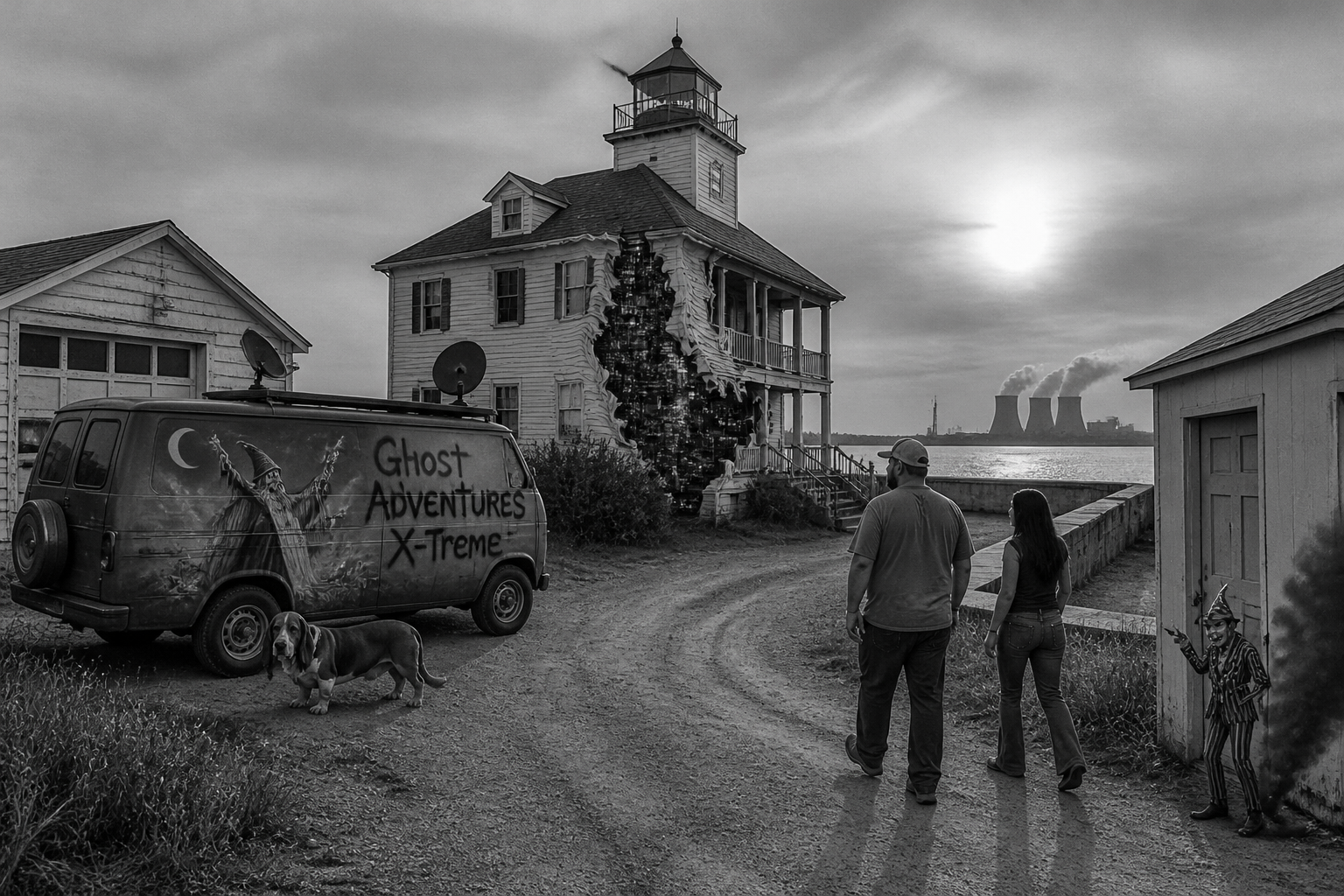
The Liston Range Front Lighthouse is a two-story frame Colonial Revival dwelling built between 1908 and 1909 at a sharp bend in the Delaware River. Its light tower rises two additional stories from a central dormer, capped by a widow’s walk with simple turned balusters. The property includes a white glazed brick oil storage building, a frame garage, and the overgrown concrete hexagon of a 1941 gun emplacement. The whole 4.77-acre lot sits on filled marshland, held in place by a concrete seawall. The nuclear power plant at Salem, New Jersey, glows across the water. Joe had read about strings of unexplained reflections seen from the widow’s walk. That’s why we were there.
Late afternoon, main dwelling, first-floor hallway.
Sunlight cut through the east-facing windows, laying rectangles of warm gold on the chestnut wall panels. Joe stood near the central staircase, his hand resting on the square white oak newel post. I knelt beside my open field kit on the hardwood floor, calibrating the laser level. Cletus lay between us, panting softly, one ear twitching at the distant lap of river water.
The only sounds were the faint electronic hum from my devices and the occasional creak of century-old timber settling. The house felt solid, ordinary, stubbornly present.
JOE Major Flagler knew how to build a house. These walls are chestnut. You don’t see that anymore.
JUPITER The NRHP form says Warner and Blair were the architects. Flagler was the supervising engineer for the Lighthouse Service.
JOE Semantics. The point is, they built it to last. On filled land, with a concrete seawall. That’s a statement.
I finished the calibration and aimed the laser down the hallway toward the rear porch. The red beam flickered. Not a power glitch—the line itself bent, curving upward like light refracting through water. I shut the unit off, waited three seconds, and turned it back on. The beam projected straight. I ran a diagnostic. All green.
JUPITER Atmospheric distortion. Maybe humidity from the river.
JOE Or maybe the house remembers it’s on fill. Places have memory. I read that once.
He said it casually, like he was noting the weather. I stood, my left forearm aching dully from the cut I’d gotten at the covered bridge. I muttered about checking the line of sight and moved toward the back of the house.
Sunset, rear porch overlooking the seawall.
The light was golden, painting the Delaware River in molten streaks. I stepped onto the porch, clinometer raised, measuring the angle of the seawall where it met the water. Joe followed, squinting across the river toward the blocky silhouette of the Salem plant. Cletus trotted ahead, nose to the painted floorboards, sniffing the corner post with intense canine focus.
JOE They put a gun here in ’41. Concrete hexagon, powder magazine. Imagine that—a lighthouse keeper doubling as coastal defense.
JUPITER It’s documented. The fortifications are still there, south of the garage. Mostly buried in marsh grass now.
JOE Right. But why here? Not every lighthouse got a gun. Something about this bend in the river made it worth defending. Maybe they saw something out there worth shooting.
A low vibration began. Not a sound, but a pressure in my teeth, a subsonic hum that seemed to originate in the foundation. I looked at the digital recorder clipped to my belt. The timestamp was frozen: 1885-04-17.
Cletus stopped sniffing. Her ears pricked forward, then she turned her head sharply toward the white glazed brick of the oil storage building thirty feet away. A sudden, dry chill passed over the porch, though the air was still. Joe noticed Cletus’s posture.
JOE What’s she onto? Diesel residue maybe. Old tanks leak.
Cletus barked once—short, sharp, a warning. Not at the river. At the ground near the oil shed’s single north-facing door. A wisp of grayish, sulfurous smoke curled from beneath it.
Dusk, oil storage building, north elevation.
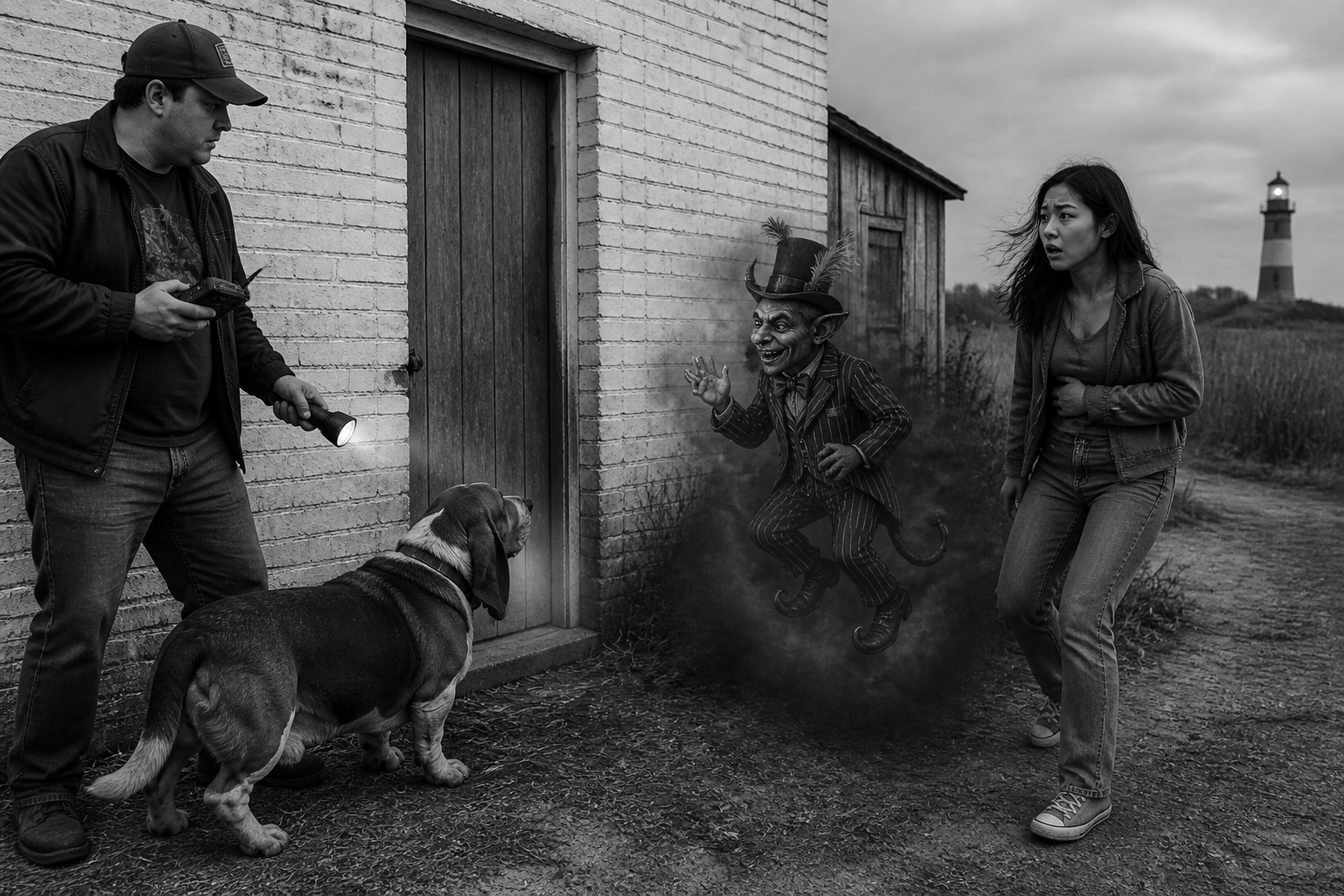
Shadows pooled around the masonry walls. Cletus stood rigid, nose pointed at the base of the weathered door. I took a step forward, my eyes locked on a small, dense cloud of smoke coalescing at knee-height. Joe hung back a pace, his hand on his flashlight.
JUPITER Do you see that?
JOE See what? Cletus is just keyed up. Probably a groundhog hole.
The smoke condensed, twisted, and resolved into a shape. Two and a half feet tall, a lanky humanoid in a shabby striped suit and a feathered hat, with small horns and a sharp, mischievous grin. He tipped his hat at Cletus, who growled low in her throat.
BEELZEBUBBA She always smells the paperwork. That’s why she’s afraid of the machine.
I stumbled back, my heel catching on a root. Joe saw me flinch and stare at empty air.
JOE Jupiter? You okay?
JUPITER There’s… a…
The imp—Beelzebubba, his name surfaced in my mind unbidden—flicked ash from a nonexistent cigar. He winked at me, then at Cletus, who had taken a cautious step forward, sniffing audibly.
BEELZEBUBBA Better a crooked foundation than a straight one that sinks.
He vanished. Not a fade, but a sudden, localized puff of brine-scented smoke that dissipated into the twilight. Joe stepped forward, clicking on his EMF meter and sweeping it near the door.
JOE Nothing. No spikes. You sure you didn’t just get a whiff of something… industrial?
I didn’t answer. My heart was hammering. Cletus whined, nosing the spot where he had been.
Nightfall, basement access via rear porch hatch.
Joe pulled open a reinforced hatch set into the porch floor, revealing a narrow stairway descending into darkness. He went down first, his flashlight beam cutting through the damp air. I followed with the thermal camera, my shoulder brushing against rough plaster. Cletus waited at the top, watching the doorway behind us.
The basement was a cramped space of poured concrete and exposed joists. In the center, a vertical wooden chase—now empty—ran from the ceiling down into the floor.
JOE This is where the clockwork was. Chains, weights, ratchets. Like a grandfather clock. It turned the Fresnel lens every four seconds. Automated before automation was cool.
I panned the thermal camera slowly across the walls. The display showed the expected temperature gradients—cooler near the foundation, slightly warmer near the chase. Then, for 0.8 seconds, the image rippled. The walls on the screen appeared to tilt, the corridor elongating into an impossible perspective. Within that distortion, I glimpsed a grid—black stone streets, angular and wet, laid out beneath the foundation.
I gasped. The image snapped back to normal.
JOE What? You get something?
JUPITER The camera glitched. The walls… for a second they weren’t walls.
From above, Cletus whined—a high, anxious sound. I looked up the stairs. She was staring at the banister, her body tense. Perched on the newel post, legs crossed, was Beelzebubba. He was visible only to me, and apparently to her. He watched us, tail twitching.
BEELZEBUBBA A delayed echo. How terribly punctual it is.
The 17 Hz vibration returned, stronger now, a physical pulse in the air. Cletus scrambled down the stairs in a clatter of claws, pressing herself against Joe’s leg.
JOE Okay. That’s new. Feels like… the whole foundation’s humming.
23 minutes past midnight, main floor front parlor.
We’d regrouped in the parlor, a room of simple trim and wide floorboards. Joe had flipped open his weathered 1923 copy of The Antiquarian’s Guide to Forgotten Grids. I was lining up my clinometer with a crack in the seawall, visible through the window. Cletus lay curled beneath the drop-leaf table, her tongue glistening with an odd, oily shimmer in the light of our work lamps.
JOE Listen to this. “Ledgers write themselves when the tide rises.” Page forty-seven. I’ve never understood that until tonight.
JUPITER It’s a metaphor, Mr. Davenport.
JOE Is it? What if a ledger is just a record of what’s already happened? And the tide is… time? Or pressure? This place was built on fill. Maybe they filled over something that was already keeping records.
My clinometer’s bubble drifted left, held, then slid right without the instrument moving. The digital readout flashed an error. I sighed, a frustrated, weary sound.
JUPITER All my data is corrupting. The timestamp is still 1885. Across every device. That’s not a malfunction. That’s a marker.
JOE April 17th, 1885. Not in the records. No shipwreck, no fire, no death. A blank page. Maybe that’s the point.
Then the world broke.
The entire structure shuddered. Not a shake, but a deep, recursive unfolding. For 4.3 seconds, architecture became suggestion. The walls peeled back like wet paper, not to reveal studs and insulation, but to expose a vista of profound, indifferent age.
Black stone spires, slick and organic, rose from the riverbed where no spires should be. The geometry was wrong—angles that did not close, curves that functioned as ramps. A drowned city, green-black and glossy, its streets laid in a diagram the size of a county. The widow’s walk above us rotated 180 degrees with a sound of grinding stone. Through its now-inverted balusters, the nuclear power plant across the river was not a power plant. It was a cluster of spectral, ice-coated towers, reflecting a light that had no source.
It was not a haunting. It was a resumption. This bend in the river, this filled land, this lighthouse—they were built in obedience to an arrangement far older than human architecture.
Beelzebubba stood beside me, grinning his sharp grin. Joe was on his knees, hands pressed to his ears, his face a mask of disorientation and raw horror. He saw the warping, felt the pressure, but he did not see the city. He saw a building coming apart. Cletus stared, frozen, at Beelzebubba, who reached down and patted her head with mocking gentleness.
BEELZEBUBBA It doesn’t want. It is. And it is… unbuilt.
The world snapped back.
The lighthouse was intact. The parlor was just a room. Joe was breathing hard, sweat on his forehead. I was trembling. Cletus let out a soft, confused whimper.
Joe stood up, wiping his face. He walked shakily to the front window and looked out.
JOE The van.
I joined him. Our white van was parked on the concrete seawall, its front wheels inches from the drop-off to the water. There was no road to the seawall. It couldn’t have been driven there.
We exited through the rear porch. The night air was cold and smelled of brine and burnt parchment. Cletus refused to go near the van. She stood ten feet back, her mournful eyes fixed on it, then on the river.
My compass, when I pulled it from my kit, didn’t point north. Its needle was locked, pointing straight down through the foundation, toward the riverbed. Bearing 214° into the earth.
Joe crouched by the seawall, not looking at the van. He picked up a small, black fragment of stone. It was cold to the touch, even through his glove. He held it under his flashlight. A single, precise spiral was etched into its surface, 0.3 millimeters deep. An exact match for an illustration on page 47 of his journal.
He pocketed the stone and looked at me. The enthusiastic ghost-hunter was gone. In his place was a man who had just seen a page of reality turn, and realized he was written on it.
JOE That wasn’t a glitch. That was a page turning. And we were on it.
JUPITER This isn’t haunted. It’s indexed. And something’s updating the entry.
We didn’t drive away. We walked up the curving drive, past the small pond, toward the distant county road. Cletus trailed behind, glancing back every few steps. The van remained on the seawall, parked where no road leads, facing the black water and the sleeping city below.
FIELD NOTES
Jupiter Meteor Nguyen
- Clinometer readings inconsistent with physical slope of property. Error suggests non-Euclidean baseline.
- Seawall erosion pattern matches hydraulic uplift from below, not tidal wear. Concrete is being pushed from underneath.
- Compass deviation permanent. Needle fixed to sub-foundational vector (214° into riverbed). Instrument mechanically sound.
- Audio recorders show 3-second void of absolute silence recurring precisely every 17 seconds. Void is not absence of sound; it is a recording of nothing.
- Cletus saliva sample exhibits surface-tension anomaly (contact angle 97°). Residue is slick, odorless, evaporates leaving crystalline dust.
- Black stone fragment: non-terrestrial silicate matrix. Spiral groove depth 0.3mm, tool marks absent. Seems grown, not carved.
- All digital devices permanently timestamp-locked to 1885-04-17. Not a software error. ROM chips physically overwritten.
- Conclusion: The Liston Range Front Lighthouse is not a structure on a site. It is a marker placed on a ledger. The tide is rising.