The Archive That Builds Around Itself
Ghost Crusade X-Treme Newsletter – St. Mark the Evangelist Catholic Church, Convent and Academy, St. Louis, Missouri
Documentation by Jupiter Meteor Nguyen, Internship Credit Pending
Published by Joseph Davenport Sr. on Weird Little Server
We came to St. Mark the Evangelist for the strings phenomenon Mr. Davenport read about online—something about buildings growing in ways they shouldn’t. But the real story wasn’t in the brochure. It was in the walls.
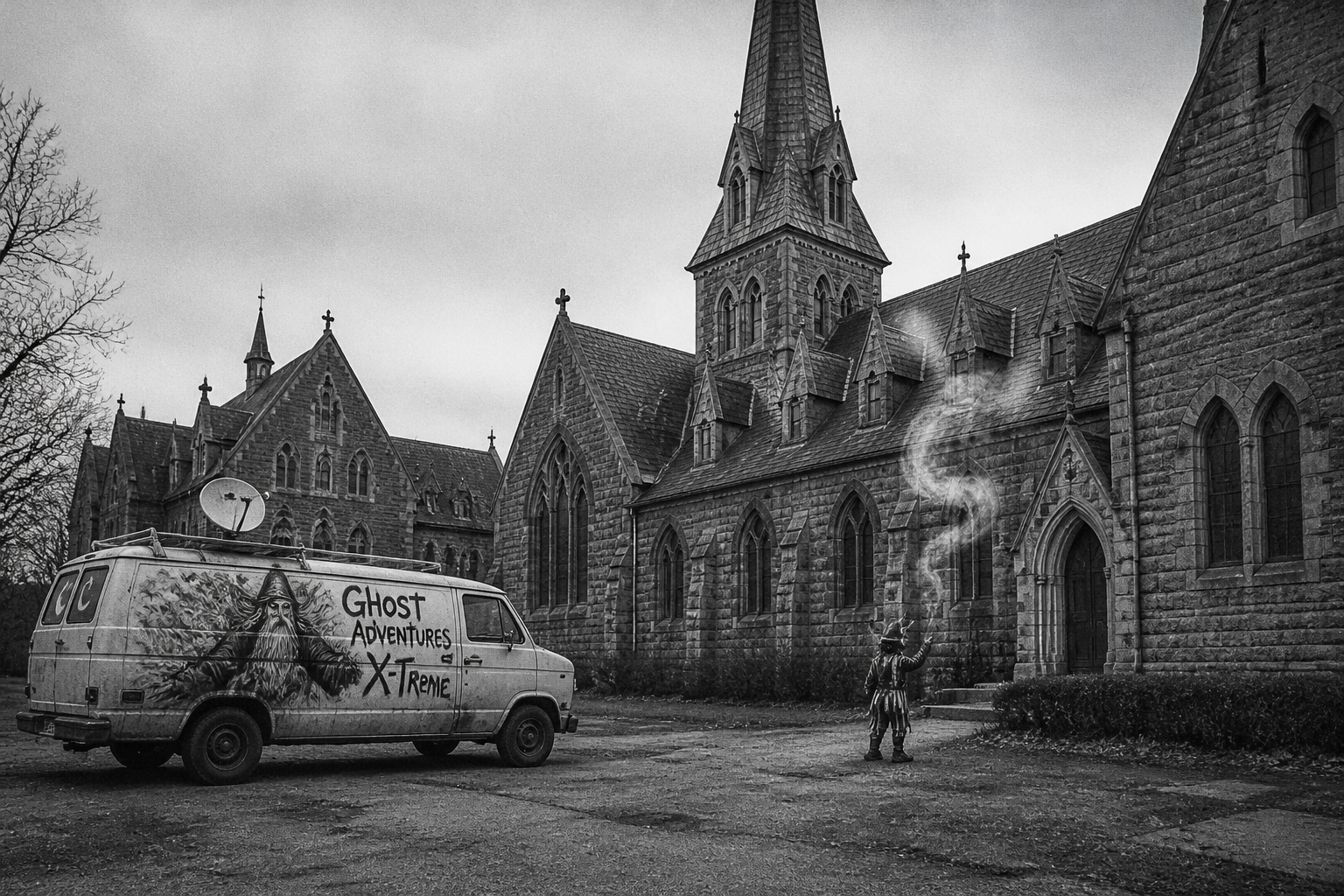
The complex sits on 1.5 acres where Academy Avenue meets Minerva Avenue, a Gothic Revival campus built in phases between 1902 and 1921 by architects like Barnett & Haynes and Kennerty & Isedell. The National Register lists it as significant from 1900 through 1974. It’s a church, a convent, and an academy, all connected by shared grounds and a century of quiet institutional use. No murders, no scandals, no tragedies in the records. Just bricks, mortar, and three separate construction dates.
Late afternoon sunlight slanted across Minerva Avenue, throwing long shadows from the steeple. Mr. Davenport adjusted his cap and knelt beside the masonry base, running an infrared gun over the stones. I calibrated the laser level near the church door, logging GPS coordinates. Cletus snuffled in the grass along the foundation, her nose deep in whatever dogs find interesting about old limestone.
JOE
See, Jupiter, the forum post said the stones here shift when no one’s looking. Like the building’s adding rooms without a permit. Strings phenomenon—like threads pulling the architecture into new shapes.
JUPITER
And the forum poster provided photographs? Calibration data? Or just a compelling narrative?
JOE
Pictures. Blurry ones. But Time-Life had a whole chapter on “living architecture.” Places that remember how to grow.
I sighed and fiddled with the level. The readout flickered: SLOPE: INCORRECT. Not an error code. A redefinition.
The stonework near the steeple base rippled. Not a trick of the light. The surface went liquid, like wet paper being smoothed from beneath. Across the courtyard, in the convent wall, a pointed archway began to form. It didn’t appear—it grew, stone flowing and setting over thirty silent seconds, completing a doorway that hadn’t been there a minute ago.
Cletus froze. She stared at a small curl of black smoke near the steeple base.
The smoke coalesced into a lanky figure about two and a half feet tall, dressed in a shabby striped suit and a feathered hat. He had small horns, a sharp grin, and curled pointed shoes. He tipped his hat to me.
BEELZEBUBBA
Meteor. Delightful. You’ve brought the hound. She lacks archival discipline, but her nose is a marvel of brute-force search.
I took a step back. Cletus whined, then padded over and sniffed his shoe.
JUPITER
What are you?
BEELZEBUBBA
Beelzebubba the Third, at your intermittent service. I’m here for the filing. It’s overdue, you see. Quite overdue.
JOE
Jupiter? You seeing something?
Mr. Davenport turned, following my gaze to the empty grass where Cletus was sniffing.
JUPITER
There’s a… a doorway forming. In the convent wall.
JOE
Where?
He looked at the wall, now holding a perfect, empty Gothic arch. His face went slack.
JOE
Okay. That’s new.
We moved inside as dusk settled, dragging work lights into the nave. The air smelled of dust and damp plaster. The church’s 1921 renovation had expanded this space; the proportions felt both grand and subtly wrong, like a book with an extra chapter sewn into the binding.
Mr. Davenport knelt near the altar, running a vibration sensor along the floor tiles. I held a compass, watching the needle spin lazily before locking—pointing down, into the foundation. Cletus circled the altar rail, her claws clicking on stone.
JOE
Baseline vibration’s normal. But the floor’s… humming. Not through the sensor. Through my knees.
JUPITER
Compass is indicating downward magnetic attraction. That’s not possible unless there’s a significant ferrous mass below us, or the local field is being altered.
JOE
Time-Life talked about places that pull. Not haunted, just… heavy with memory.
The altar stone split.
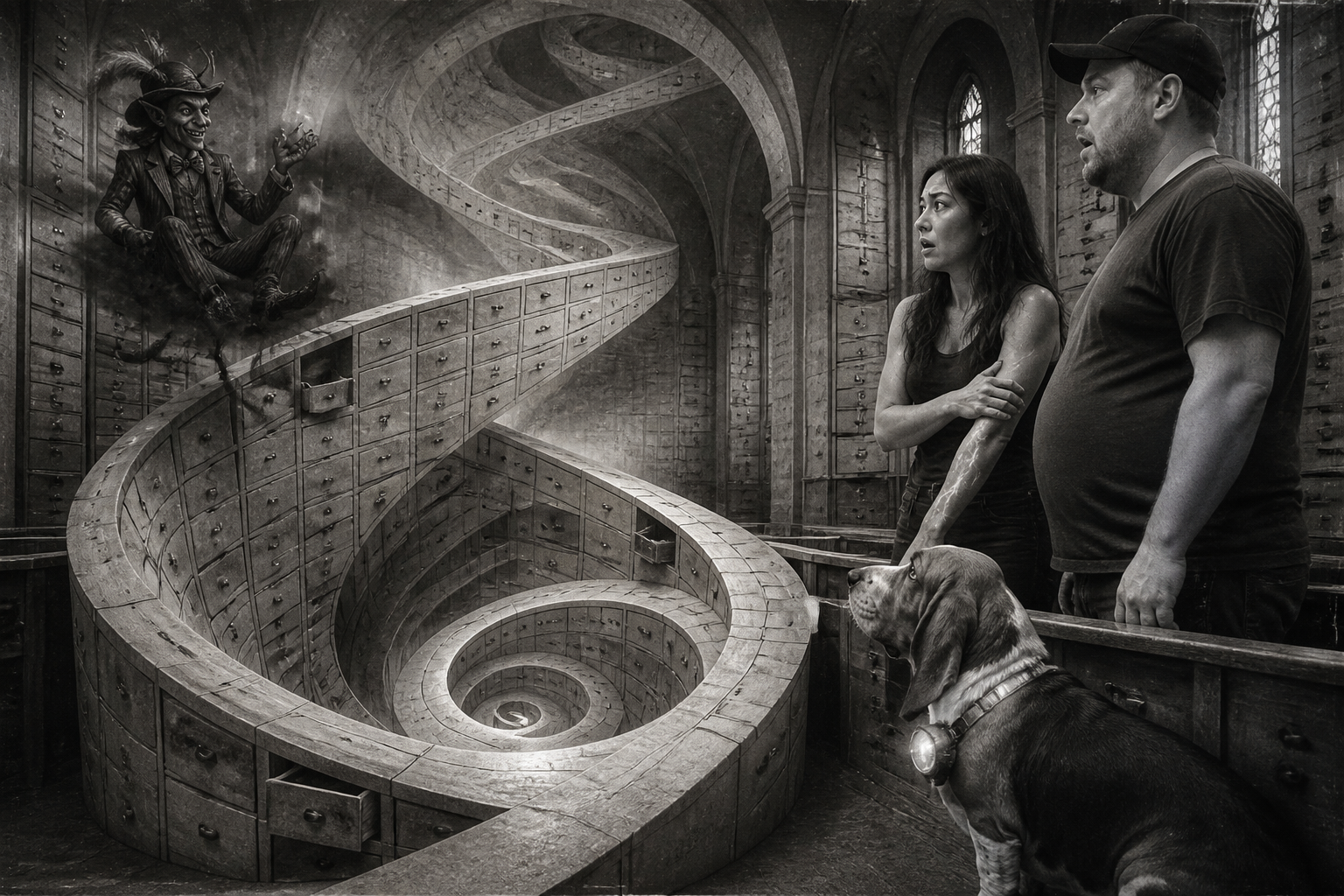
It didn’t crack. It unfurled, vertical and slow, like the pages of a giant book being opened. Behind it was a spiral corridor, descending and ascending simultaneously, lined with thousands of small, rectangular drawers. They were blank, pale wood, and as I watched, new drawers silently grew from the walls, extending the spiral deeper. The air thickened with the scent of wet parchment.
A small cloud of infernal smoke puffed atop the pulpit. Beelzebubba sat cross-legged, grinning.
BEELZEBUBBA
The archive that builds around itself! A classic. Self‑cataloging, self‑shelving. It doesn’t need librarians. It needs submissions.
Cletus looked up at him and gave a low whine.
JOE
You hear that? A hum. Three beats per second. Like a heartbeat.
My left forearm began to ache, a deep throb synchronized exactly with that rhythm. The cut from Merkel Mill—barely a scar—had reopened without a wound, just a steady, resonant pain.
JUPITER
It’s a 3 Hz pulse. I can feel it.
JOE
Biological?
BEELZEBUBBA
A signature! The system knows you’re here. It’s taking your measure. Don’t worry—it’s not malicious. It’s just very, very thorough.
JOE
Who are you talking to, Jupiter?
JUPITER
Something you can’t see. He says he’s here for the filing.
Mr. Davenport stood, staring at the spiral corridor. He took a step toward it.
JOE
I read about this. Not this exactly, but… places that are more than places. They’re systems.
BEELZEBUBBA
He’s not wrong! It’s an administrative entity. Quite old. Quite indifferent. It doesn’t want anything from you. It just needs to know where to put you.
The floor pulsed again. At the base of the spiral, something glowed—Cletus’s collar, lying on the stone, emitting a soft, steady light.
JUPITER
Cletus’s collar. How did it get down there?
Cletus, still beside me, looked at her own neck, then back at the glow.
BEELZEBUBBA
A return key! How charming. The system uses what’s handy. Collars, clocks, compasses… little tokens of presence.
Mr. Davenport pulled out his notebook. He flipped it open. Every page, even the blank ones, now bore the same handwritten line: Disposition: Not Filed.
JOE
What the hell.
His voice was quiet. Not scared, but deeply unsettled.
BEELZEBUBBA
You’re in the intake queue. Don’t take it personally—it files everything. Stones, memories, building permits, lost dog tags. It’s not a haunting. It’s municipal.
The spiral corridor hummed louder. The drawers began to slide open and shut in sequence, a wave of motion traveling up and down the shaft. It sounded like a card catalog in a library the size of a city.
JOE
We should go.
JUPITER
Agreed.
BEELZEBUBBA
Oh, don’t rush. The filing’s already started. You can’t stop it. You can only be filed correctly or… misfiled.
Mr. Davenport grabbed my arm—the one that wasn’t throbbing—and pulled me back toward the nave entrance. Cletus followed, casting a last mournful look at the glowing collar.
We didn’t run. We walked, fast, through the darkening church, the 3 Hz pulse echoing in the stone under our feet. When we reached the van, Mr. Davenport fumbled with the keys. The engine turned over, but the dashboard clock read: 1885-04-17. It wouldn’t reset.
We left because the architecture was still changing. The next morning, the parish priest called Joe’s number from the site packet contact sheet. He reported, calmly, that the convent’s east wing had gained an extra story overnight. The academy library now had a new section, shelves filled with blank, leather‑bound volumes labeled Unfiled: 1885-04-17.
My forearm still aches at 3 Hz intervals. The compass in my bag still points down. Cletus hasn’t moved from her spot in the van since we got back; she just stares out the window, her eyes huge and red and mournful. The van smells like old paper.
Mr. Davenport hasn’t said much. He’s been flipping through his notebook, looking at those words on every page.
JOE
I thought it was ghosts. I thought it was spirits. But it’s not. It’s filing. And we walked right into the return slot.
I looked at the site packet, at the clean historical facts: construction dates, architects, periods of significance. No horror, no death. Just a building that grew when it was supposed to, and now grows again, according to a different set of rules.
This isn’t haunting. It’s archiving. And we’re not investigators. We’re entries.
FIELD NOTES – JUPITER METEOR NGUYEN - Laser level failed with message “SLOPE: INCORRECT” – device not broken, but recalibrated to local geometry. - Compass points downward consistently; magnetic anomaly localized to site center. - Left forearm cut (origin: Merkel Mill) reopened without laceration; aches at precise 3 Hz intervals. - Cletus’s collar missing, presumed still at spiral base. She is withdrawn, refuses treats. - All digital devices timestamp‑locked to 1885‑04‑17. Data corruption persistent. - Van clock stuck on same date; engine runs fine, but radio scans only static with 3 Hz pulsed undertone. - Site change confirmed via third party: convent east wing added one unpermitted story overnight. New masonry matches 1909 style perfectly. - Scent at spiral corridor: wet parchment, dry moss, ozone. - Beelzebubba’s last observed comment before vanishing: “Better a crooked archive than a straight one that loses things.”